
Nonprofits run on passion — but passion alone doesn't write grant proposals at midnight, send 200 personalized thank-you emails, or generate quarterly impact reports.
According to a 2026 Nonprofit AI Adoption Report by Virtuous and Fundraising.AI, 82% of nonprofits are now using artificial intelligence in some capacity. But here's the gap: most are using it in isolation — one-off ChatGPT prompts here, a Canva AI design there — without truly integrating AI into nonprofit operations.
The report found that only organizations willing to "rethink how work gets done" — rather than treating AI as a side experiment — are seeing meaningful fundraising impact. The rest are stuck in the experimentation phase, unsure how to move from trying generative AI tools to building real workflows.
That's where OpenClaw changes the game.
What Is OpenClaw?
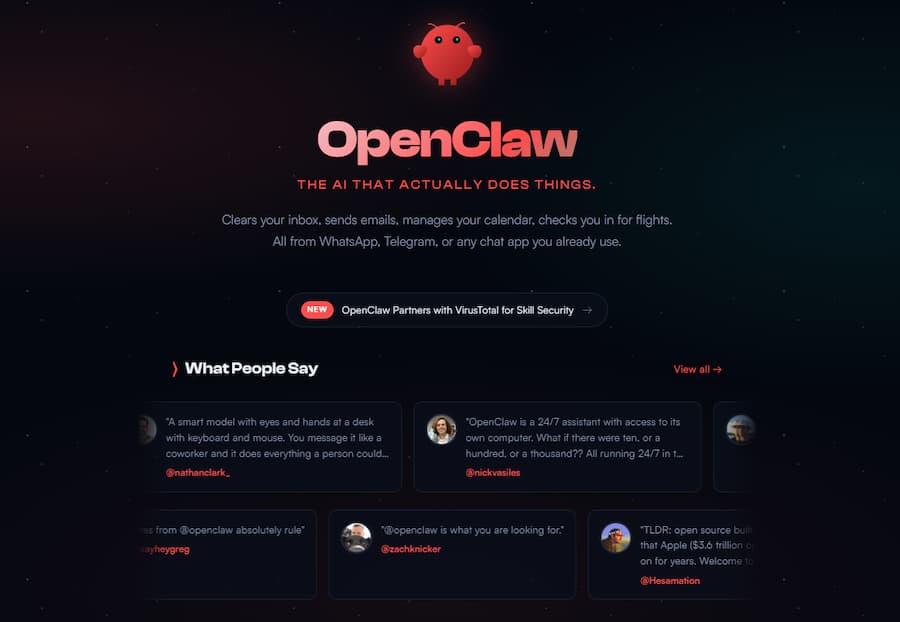
OpenClaw is a free, open-source AI agent platform that goes far beyond chatbot-style Q&A. Built by Austrian developer Peter Steinberger, it has quickly grown into one of the most popular open-source artificial intelligence agent projects on GitHub.
Unlike tools like ChatGPT or Claude — where you type a prompt and get a response — OpenClaw is an autonomous agent. You give it a job, and it executes multi-step workflows on its own: reading emails, searching files, calling APIs, drafting documents, sending messages, and reporting back when it's done. It uses generative AI models (like Claude, GPT, or open-source alternatives) as its reasoning engine, but wraps them in an action layer that can actually do things in the real world.
Key features that matter for nonprofits:
-
Free and open-source — No per-seat licensing fees. Your entire team benefits from one instance.
-
Connects to your existing tools — Gmail, Google Drive, Slack, CRMs like HubSpot and Airtable, and 100+ other services via plugins (called "Skills" and MCP servers).
-
Runs on a schedule — Set it to check emails every morning, send weekly donor reports, or monitor grant deadlines automatically.
-
Works through messaging apps — Control it from WhatsApp, Telegram, Discord, or iMessage — no special interface to learn.
-
Runs locally or on your own server — Your data stays under your control, which matters when handling donor information and financial records.
-
Extensible with Skills — Browse thousands of community-built skills at skills.sh to add capabilities instantly — from SEO writing to data analysis.
Think of it as hiring a tireless digital volunteer who works 24/7, connects to all your software, and never asks for PTO.
For budget-constrained nonprofits paying thousands per year in software subscriptions, OpenClaw offers enterprise-level automation at zero licensing cost.
The State of AI for Nonprofits in 2026
Before diving into specific use cases, it's worth understanding where the nonprofit sector stands with artificial intelligence adoption.
The numbers paint a clear picture: AI adoption is widespread, but deep integration is rare. According to TechSoup, nonprofits spend an average of $12,000–$50,000 annually on software tools — yet many still rely on manual processes for core operations. Meanwhile, the Virtuous report revealed that organizations achieving real results with AI share three traits: clear strategy, simple guardrails, and intentional integration into decision-making.
The biggest barriers to adopting AI for nonprofits remain cost, technical expertise, and concerns about responsible AI use. Open-source tools like OpenClaw directly address the first two — they're free and designed to work without a dedicated IT team.
What types of AI are nonprofits using?
-
Generative AI — Content creation, grant drafting, email writing, social media posts
-
Predictive AI — Donor lapse prediction, fundraising forecasting, program outcome modeling
-
Process automation — Data entry, report generation, scheduling, CRM updates
-
Conversational AI — Chatbots for donor inquiries, volunteer FAQs, beneficiary support
OpenClaw is unique because it combines all four into a single agent that can reason, create, automate, and interact — without switching between multiple platforms.
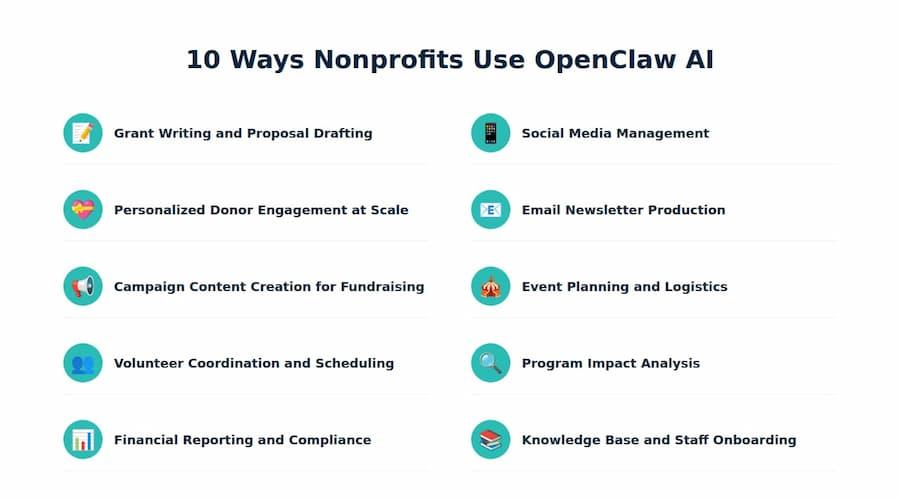
Here are 10 real ways nonprofit teams are putting it to work right now.
1. Automated Grant Writing and Proposal Drafting
Grant writing is the lifeblood of nonprofit funding — and the biggest time sink. A single federal grant application can take 40-80 hours to complete. Small nonprofits without dedicated grant writers often miss funding opportunities simply because they can't produce applications fast enough.
OpenClaw can:
-
Pull your organization's past successful proposals from Google Drive
-
Research funder guidelines and requirements automatically
-
Generate structured first drafts that match the funder's formatting
-
Cross-reference your budget templates and program data
-
Check for compliance with funder-specific requirements
The result? Your development director reviews and refines a solid draft instead of starting from a blank page. Organizations report cutting grant drafting time by 60-70%, allowing them to submit more applications per quarter.
We wrote a full step-by-step guide on this: How to Automate Nonprofit Grant Writing With OpenClaw AI →
2. Personalized Donor Engagement at Scale
Every fundraiser knows: donors who feel personally appreciated give again. Research shows that personalized donor communications increase retention rates by 20-40%. But when you have 5,000 donors and a team of three, personalization seems impossible.
OpenClaw connects to your CRM (HubSpot, Airtable, Salesforce) and can:
-
Draft personalized thank-you emails based on giving history
-
Flag donors approaching their annual giving anniversary
-
Generate tailored updates showing how their specific donation made an impact
-
Queue communications for human review before sending
-
Segment donors by giving patterns and suggest targeted outreach strategies
This turns "Dear Valued Supporter" into "Hi Sarah, the art supplies your $150 donation funded just helped 23 kids complete their first gallery show."
3. AI in Fundraising: Campaign Content Creation
Fundraising is where AI for nonprofits delivers some of its most immediate ROI. Crowdfunding campaigns can raise thousands in days — but creating compelling campaign copy, social posts, and email appeals takes time most small teams don't have.
OpenClaw can generate:
-
Campaign descriptions optimized for emotional engagement and donor conversion
-
A week's worth of social media posts with varied messaging angles
-
Email sequences for your supporter list (launch → update → milestone → final push)
-
Suggested image descriptions and hashtag strategies
-
Donation ask amounts calibrated to your donor segments
Real impact: Nonprofits using generative AI for fundraising content report 25-35% higher engagement rates on campaign emails compared to manually written copy. The key is that AI produces the first draft quickly, freeing staff to add the personal touches that make campaigns authentic.
4. Volunteer Coordination and Scheduling
Managing volunteers is like herding cats — enthusiastic, well-meaning cats who all have different schedules.
With OpenClaw connected to Slack or your messaging platform, it can:
-
Send shift reminders and confirmations automatically
-
Match volunteer skills to open roles based on past performance
-
Handle cancellation and replacement logistics in real-time
-
Compile post-event feedback summaries
-
Track volunteer hours for reporting and recognition
Organizations using this report saving 5-10 hours per week on coordination alone — hours that go directly back to mission-critical work.
5. Financial Reporting and Compliance
Nonprofits face unique financial reporting requirements — Form 990 preparation, donor-restricted fund tracking, grant expenditure reports, and audit documentation.
OpenClaw can:
-
Pull transaction data from your accounting software
-
Generate monthly financial summaries in consistent formats
-
Flag unusual spending patterns for review
-
Draft board-ready financial reports from raw data
-
Track grant expenditures against approved budgets and alert you when spending approaches limits
This doesn't replace your accountant — it gives them a 90% finished product to review instead of raw spreadsheets. For smaller organizations without a CFO, it's the difference between scrambling at audit time and being prepared year-round.
6. Social Media Management
Most nonprofits know they should post consistently. Few have the bandwidth to actually do it. Yet social media is one of the most cost-effective channels for nonprofit awareness and fundraising.
OpenClaw can:
-
Draft a content calendar based on your upcoming events and campaigns
-
Generate platform-specific posts (LinkedIn professional, Instagram visual, X concise)
-
Monitor mentions of your organization and flag important ones
-
Suggest timely content tied to awareness days and trending topics
-
Repurpose existing content — turn a blog post into 5 social snippets, or a program report into an infographic outline
One community food bank reported going from 2 posts per week to daily content across three platforms — all reviewed by staff but drafted by their OpenClaw agent.
7. Email Newsletter Production
Your monthly newsletter shouldn't take a full week to produce.
OpenClaw automates the heavy lifting:
-
Aggregates program updates from your team's shared documents
-
Pulls recent impact metrics and success stories
-
Drafts newsletter sections with consistent voice and formatting
-
Generates subject line variations for A/B testing
-
Ensures accessibility best practices (alt text suggestions, readability scoring)
Staff spend 30 minutes reviewing and personalizing instead of 8 hours writing from scratch.
8. Event Planning and Logistics
From annual galas to community workshops, events drive donor engagement and public awareness. They're also logistical nightmares without proper planning.
OpenClaw can:
-
Create detailed event timelines and task checklists
-
Draft invitation copy and RSVP follow-ups
-
Generate day-of run sheets with contingency plans
-
Compile post-event surveys and summarize feedback
-
Calculate event ROI by comparing costs against donations raised
For recurring events, it remembers what worked last time and suggests improvements — institutional memory that doesn't walk out the door when a staff member leaves.
9. Program Impact Analysis
Funders don't just want to know you spent their money — they want to know it worked. And increasingly, grant makers require data-driven evidence of program effectiveness.
OpenClaw can:
-
Process survey responses and extract key themes using natural language analysis
-
Calculate program metrics from raw data (attendance rates, completion rates, outcome changes)
-
Generate narrative impact summaries suitable for grant reports and board presentations
-
Create before-and-after comparisons with supporting data
-
Identify trends across multiple program cycles
This transforms impact reporting from a dreaded quarterly chore into a streamlined process that actually helps you understand your own programs better — and makes a stronger case to funders.
10. Knowledge Base and Staff Onboarding
Nonprofit teams face high turnover — the sector averages 19% annual turnover, and for frontline roles it's even higher. When a program manager leaves, their knowledge often leaves with them.
OpenClaw can:
-
Build and maintain an internal knowledge base from existing documents
-
Answer new staff questions by searching organizational files
-
Generate onboarding checklists tailored to each role
-
Summarize policies and procedures in plain language
-
Create training materials from existing program documentation
Think of it as your organization's always-available institutional memory.
Case Studies: AI Impact in Nonprofits
These use cases aren't theoretical. Here's how real organizations are seeing results with artificial intelligence:
-
Silicon Valley Chinese American Foundation (SVCAF) hosted an OpenClaw seminar in March 2026, where they described themselves as "building an AI-first nonprofit — not because it is trendy, but because it lets our volunteer team serve the Chinese American community at a scale that was previously impossible." They use multiple OpenClaw agents collaborating on tasks — from writing poetry to community outreach.
-
Grant writing acceleration: According to Fast.io's nonprofit workflow analysis, organizations using OpenClaw for grant writing are able to increase their monthly application volume significantly by having the agent handle first-draft generation while staff focus on strategy and relationship-building.
-
Donor retention through personalization: The 2026 Virtuous report found that nonprofits integrating AI into their donor engagement workflows — not just using it for one-off tasks — saw measurably better retention outcomes. The key factor wasn't the AI tool itself, but how deeply it was woven into existing processes.
-
Fundraising content performance: Organizations using generative AI for campaign content report being able to launch campaigns faster, iterate on messaging in real-time, and reach their fundraising goals more consistently — particularly for time-sensitive emergency appeals where speed matters most.
Responsible AI Adoption: What Nonprofits Need to Know
Adopting AI for nonprofits comes with unique ethical responsibilities. Your organization handles sensitive data — donor financial information, beneficiary personal details, program participant records. Responsible AI adoption isn't optional; it's foundational. Key principles for responsible AI in the nonprofit sector:
Data Privacy and Security
OpenClaw's open-source, self-hosted model gives nonprofits a significant advantage here. Unlike cloud-only AI tools where your data passes through third-party servers, OpenClaw can run entirely on your own infrastructure. Donor records, financial data, and beneficiary information never leave your control.
Human Oversight
AI should augment your team, not replace human judgment. The most successful nonprofit AI implementations keep humans in the loop for:
-
Final review of all external communications
-
Decisions involving beneficiary services
-
Financial approvals and compliance sign-offs
-
Donor relationship management strategy
OpenClaw supports this naturally — you can configure it to draft and queue content for human approval rather than sending automatically.
Bias and Fairness
Generative AI models can reflect biases present in their training data. Nonprofits serving diverse communities should:
-
Review AI-generated content for cultural sensitivity before publishing
-
Avoid using AI for decisions that directly affect beneficiary eligibility or services without human review
-
Regularly audit AI outputs for patterns that might disadvantage certain groups
Transparency
Be upfront with stakeholders about how you use artificial intelligence. Many funders now ask about AI usage in grant applications. Having a clear AI use policy — what you use it for, what safeguards you have, and where human oversight applies — builds trust with donors, board members, and the communities you serve.
Cost of "Free"
While OpenClaw itself is free, it does use AI model APIs (like Claude or GPT) that have usage costs. For most nonprofit workloads, this runs $10-50/month — a fraction of commercial software subscriptions, but worth budgeting for. Some organizations qualify for free or discounted API access through programs like Google.org or Anthropic's nonprofit initiatives.
AI Tools for Nonprofits: How OpenClaw Compares
The AI tools landscape for nonprofits is growing rapidly. Here's how the main options stack up:
|
Feature |
ChatGPT / Claude |
Zapier / Make |
Bloomerang AI |
OpenClaw |
|---|---|---|---|---|
|
Type |
Chatbot |
Workflow automation |
CRM-embedded AI |
Autonomous AI agent |
|
Multi-step tasks |
❌ Single prompt |
✅ Pre-built flows |
⚠️ Limited to CRM |
✅ Autonomous workflows |
|
Connects to your tools |
❌ Copy-paste |
✅ Via connectors |
⚠️ Own CRM only |
✅ Email, CRM, Drive, Slack, 100+ |
|
Generative AI content |
✅ Strong |
❌ No |
⚠️ Donor comms only |
✅ Any content type |
|
Runs on a schedule |
❌ Manual |
✅ Triggers |
⚠️ Limited |
✅ Cron jobs, heartbeats |
|
Cost |
$20-240/mo per user |
$20-100/mo |
Bundled with CRM |
Free (open-source) |
|
Data privacy |
Cloud-based |
Cloud-based |
Cloud-based |
Self-hosted option |
|
Learning curve |
Low |
Medium |
Low (within CRM) |
Low-Medium |
The key difference: most AI tools for nonprofits do one thing well. OpenClaw does many things well and connects them together. Your grant research feeds into your proposal draft, which references your impact data, which was compiled from your program surveys — all in one agent.
Getting Started
You don't need a technical team to start. Here's the path:
-
Install OpenClaw — Takes about 10 minutes on any computer
-
Connect your tools — Gmail, Google Drive, Slack, and your CRM
-
Start with one workflow — We recommend grant writing automation as your first win
-
Expand gradually — Add donor engagement, social media, and reporting as you get comfortable
The Bottom Line
Nonprofits don't have the luxury of large IT budgets or dedicated operations teams. But with OpenClaw, you don't need them.
Every hour your team spends on repetitive admin is an hour not spent on your mission. Artificial intelligence isn't here to replace your team's heart and judgment — it's here to handle the busywork so your people can focus on what they do best: making a difference.
OpenClaw gives that time back — automatically, reliably, and for free.

Looking for a Free Fundraising Platform?
If your nonprofit runs crowdfunding campaigns, check out *spotfund — a free fundraising platform with 0% platform fees, so organizers keep 100% of every donation. *spotfund also includes built-in AI fundraising tools to help you write compelling fundraising stories in minutes. Combined with OpenClaw's automation capabilities for donor outreach and campaign content, you get a powerful, zero-cost fundraising stack.