

Generosity is its own reward, but lowering your taxable income is a welcome financial benefit during tax season. Americans give hundreds of billions of dollars to charity each year, yet many leave valuable tax savings on the table simply because they misunderstand the IRS rules.
When you give to causes you care about, the government often allows you to write off those contributions. This makes your philanthropy a win-win: the organization gets the critical funding it needs, and you reduce your overall tax burden.
However, navigating the rules around a charitable donation tax deduction can feel overwhelming. Not every act of giving qualifies. Whether you are supporting a local animal shelter, an international disaster relief fund, or an online crowdfunding campaign, understanding these regulations ensures you maximize your impact while staying fully compliant.
Here is the complete, step-by-step guide to securing tax benefits for your charitable gifts.
How the Charitable Donation Tax Deduction Works
To take advantage of tax-deductible giving, you must itemize your deductions on your tax return (Schedule A) rather than taking the standard deduction.
The IRS offers taxpayers a choice every year:
-
The Standard Deduction: A flat, no-questions-asked reduction in your adjusted gross income (AGI). For example, for the 2024/2025 tax years, this amount is typically over $14,000 for single filers and over $29,000 for married couples filing jointly.
-
Itemized Deductions: A detailed list of specific eligible expenses—like mortgage interest, state and local taxes, medical expenses, and your philanthropic gifts—that collectively lower your AGI.
You should only itemize if your total eligible expenses exceed your standard deduction amount. If you are a homeowner in a high-tax state who gives generously to charity, itemizing is often the smartest financial move.

Is My Gift Tax-Deductible? 3 Key Requirements
Not all good deeds are recognized by the IRS. To legally claim a donation tax deduction, your contribution must meet three non-negotiable criteria.
1. The Organization Must Be a Verified 501(c)(3)
You cannot deduct contributions made directly to specific individuals, political campaigns, or unverified grassroots groups. To qualify for a tax write-off, your money must go to a legally registered tax-exempt organization.
In the United States, this typically means a charity with 501(c)(3) status. This classification includes:
-
Religious organizations (churches, synagogues, mosques)
-
Educational institutions and non-profit schools
-
Public charities (like the Red Cross or local food banks)
-
Volunteer fire companies
-
War veterans' organizations
-
Pro Tip: Do not guess. You can verify an organization's official tax-exempt status using the IRS Tax Exempt Organization Search (TEOS) database.
2. No Goods or Services Exchanged (The "Quid Pro Quo" Rule)
If you receive something of value in return for your financial support, you cannot deduct the full amount. You are only allowed to claim the amount that exceeds the fair market value of the item or service you received.
-
Example: You attend a charity gala. The ticket costs $250. The catered dinner and entertainment are valued at $100. Your allowable charitable donation tax deduction is only $150.
-
Example: You buy a $20 raffle ticket for a charity fundraiser. Because you are purchasing a chance to win something, this $20 is not tax-deductible at all.
3. The Gift Must Be Made by December 31st
To claim a deduction for the current tax year, the contribution must be made by December 31st. If you mail a check, it must be postmarked by December 31st. If you use a credit card, the charge must be processed by December 31st, even if you do not pay the credit card bill until January.
Types of Eligible Contributions
While cash is the most common form of giving, the IRS allows you to claim tax benefits for several types of contributions.
1. Cash and Cash Equivalents
This includes direct monetary support made via check, credit card, debit card, or electronic bank transfer.
2. Physical Property and Non-Cash Items
You can deduct the fair market value of items donated to charity, such as:
-
Clothing and shoes
-
Furniture and household goods
-
Vehicles (cars, boats, airplanes)
-
Real estate
Note: The IRS requires that donated clothing and household items be in "good used condition or better."
3. Stocks and Securities
Donating appreciated stock is one of the most tax-efficient ways to give. If you have held a stock for more than one year and its value has increased, donating it directly to a 501(c)(3) allows you to claim a donation tax deduction for its full current fair market value, and you entirely avoid paying capital gains tax on the appreciation.
4. Out-of-Pocket Volunteering Expenses
While you cannot deduct the value of your time or professional services donated to a charity, you can deduct out-of-pocket expenses directly related to your volunteering. This includes purchasing supplies for the organization or tracking mileage driven specifically for charitable purposes.

What is NOT Tax-Deductible?
To avoid IRS penalties, it is equally important to know what you cannot write off. Common non-deductible expenses include:
-
Contributions to specific individuals (even if they are in desperate need)
-
Political contributions, campaign funds, or PACs
-
Dues paid to country clubs, lodges, or fraternal orders
-
The cost of lottery or raffle tickets
-
The value of your own time or labor
-
Blood donations
Are Crowdfunding Donations Tax-Deductible?
With the rapid growth of online fundraising, this is one of the most common questions donors ask. The short answer is: it depends entirely on who receives the money. The IRS looks at the final beneficiary, not the website or platform you use to make the gift.
Here is how to tell the difference:
-
Personal Campaigns (Not Deductible): If you donate to help a specific family with medical bills, support a friend's emergency fund, or contribute to an individual's memorial costs, the IRS considers this a "personal gift." While incredibly generous, these contributions are not tax-deductible.
-
Nonprofit Campaigns (Tax-Deductible): If the campaign is specifically hosted on behalf of, and directly benefits, an officially registered 501(c)(3) organization, your contribution generally qualifies for a tax write-off.
Pro Tip: Always look for clear indicators on the campaign page confirming the beneficiary's legal nonprofit status before assuming your gift can be deducted.
Record Keeping and Tax Forms
The IRS requires clear documentation to back up any tax benefits you claim. Without proof, your deduction can be disallowed during an audit.
Receipts Required by the IRS
-
Under $250: A bank record (canceled check, bank statement, or credit card statement) or a receipt from the charity showing the name, date, and amount.
-
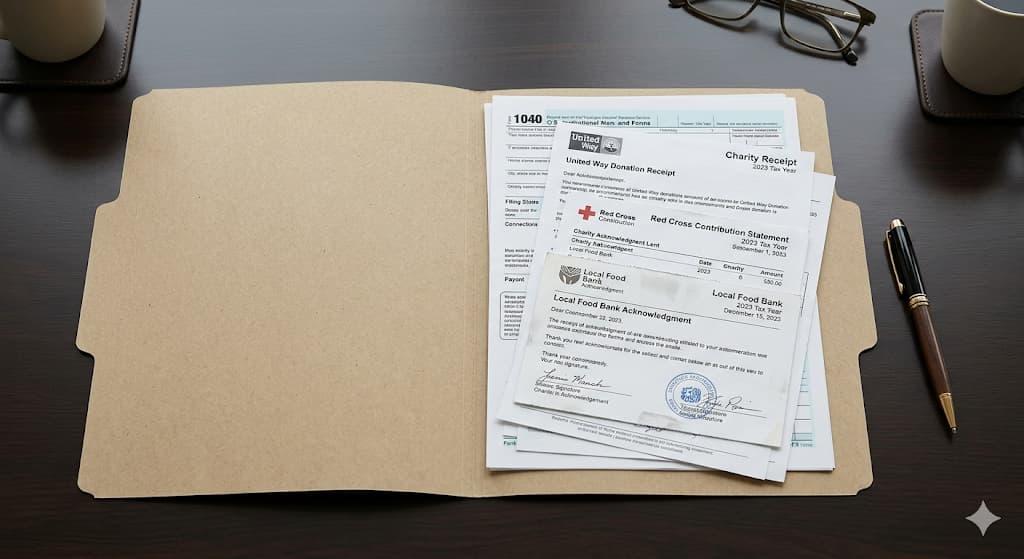
$250 or More: You must obtain a contemporaneous written acknowledgment (an official letter or receipt) from the charity before you file your taxes. This document must state the amount given and explicitly mention whether any goods or services were provided in exchange.
Key Tax Forms
-
Schedule A (Form 1040): This is the form where you will list your itemized deductions, including your total charitable giving.
-
Form 8283: If your total non-cash contributions (like clothing, furniture, or stock) exceed $500 for the year, you must fill out and attach this form to your tax return. If a single non-cash item is worth more than $5,000, you will also need a qualified written appraisal.
Limits on Your Donation Tax Deduction
Is there a cap on how much you can deduct? Yes. The IRS limits your total charitable donation tax deduction based on your Adjusted Gross Income (AGI).
-
For cash contributions to public charities, you can generally deduct up to 60% of your AGI.
-
For donations of appreciated assets (like stock), the limit is typically 30% of your AGI.
What if I give more than the limit? If your generosity exceeds the IRS limits in a single year, you don't lose the tax benefit entirely. The IRS allows you to carry over the excess deduction for up to five subsequent tax years.
The Bottom Line on Deducting Your Charitable Gifts
Navigating the rules to deduct charitable contributions does not have to be intimidating. By ensuring your chosen organization is a verified 501(c)(3), keeping accurate records of your receipts, and understanding how itemized deductions work, you can confidently claim your tax benefits.
Ultimately, these tax incentives are simply a well-deserved financial bonus. The true reward of giving is knowing that your generosity is making a tangible difference for the causes and communities you care about most.
Frequently Asked Questions (FAQ)
1. Can I deduct charitable donations if I take the standard deduction?
Generally, no. Under current tax laws, you must itemize your deductions on Schedule A to claim a tax write-off for your charitable giving. If your standard deduction amount is higher than your total itemized expenses, it usually makes the most financial sense to take the standard deduction—even though you will not get a separate line-item benefit for your charitable gifts.
2. Do I need to attach my donation receipts to my tax return?
No. You do not need to mail or electronically attach your receipts to your tax return when you file. However, you must keep them safely in your personal records for at least three to seven years in case the IRS decides to audit your return and request proof of your giving.
3. Are donations to public schools or PTOs tax-deductible?
Yes. Even though they may not hold a standard 501(c)(3) designation like traditional charities, gifts made exclusively for public purposes to state or local governments—which includes public schools, parent-teacher organizations (PTOs), and volunteer fire departments—are generally tax-deductible.
4. Can I claim a deduction for a pledge I made but haven't paid yet?
No. You can only claim a deduction in the tax year you actually make the payment. A legally binding pledge or a verbal promise to give does not count for tax purposes until the funds or property actually transfer hands.
5. Are donations to foreign charities tax-deductible?
Generally, no. Contributions made directly to foreign organizations are usually not deductible on your U.S. tax return. However, there are a few exceptions for certain Canadian, Mexican, and Israeli charities under specific tax treaties. Additionally, many international causes have a U.S.-based "Friends of" 501(c)(3) organization that allows Americans to make tax-deductible gifts that ultimately support the global mission.

Start Your Free Fundraiser Today
Whether you are rallying your community for a personal emergency or raising vital funds for your favorite registered charity, spotfund makes the process seamless, secure, and transparent. When supporting causes on our platform, please keep in mind that only donations to verified 501(c)(3) nonprofit campaigns can be considered for a donor tax deduction. This will clearly be stated on the campaign and on the donation email receipt. As the #1 rated fundraising platform on Trustpilot, spotfund charges 0% platform fees, ensuring more money goes directly to the cause. With next-day payouts, easy-to-use QR codes, and our built-in AI Fundraising Tool that helps you write a compelling story in seconds, launching a successful campaign has never been easier.