

If you are paying entirely out of pocket, a standard MRI typically costs between $1,000 and $3,000 in the United States. However, depending on where you get the scan and the specific type of imaging required, total prices can range anywhere from $400 to over $12,000.
Facing a new health issue is stressful enough without the anxiety of a massive, unexpected medical bill. When a doctor orders magnetic resonance imaging (MRI) to diagnose an injury or monitor a condition, uninsured or underinsured patients are often left scrambling to figure out how to afford it.
In this guide, we break down exactly what drives up the price of these diagnostic scans, the difference between facility and professional fees, and actionable strategies you can use to significantly reduce your final bill.
So, How Much Does an MRI Cost?
The short answer is that the national average price can range anywhere from $400 to over $12,000 depending on where you go.
When wondering how much does an MRI cost, it is essential to understand that hospital prices vary drastically. However, the average out-of-pocket expense for a standard MRI usually falls between $1,000 and $3,000 in the United States.
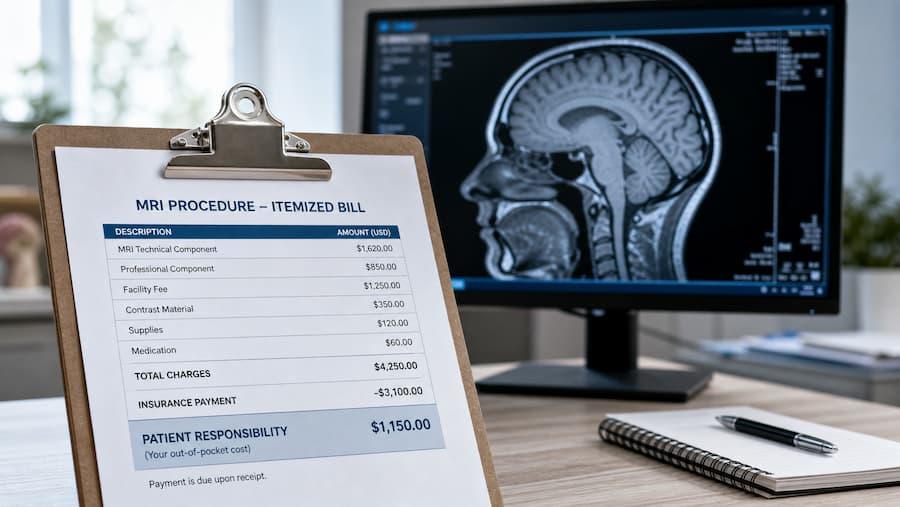
When you look at a hospital invoice for a diagnostic scan, you aren't just paying a single flat rate. The total cost of an MRI without insurance is usually split into two parts:
-
The Technical Fee: This covers the actual use of the machine, the facility’s overhead, electricity, and the supplies used during the procedure.
-
The Professional Fee: This is the cost for the specialized radiologist who reads the 3D images, interprets the results, and writes the medical report for your primary doctor.
Pro Tip: When calling clinics to ask for a price estimate, explicitly ask: "Does this quote include both the technical and professional fees?" This prevents surprise bills from arriving in your mailbox weeks later.

5 Factors That Impact How Much Does an MRI Cost Without Insurance
Understanding what drives the price of your scan can help you find much more affordable options. Here are the five main variables.
1. Inpatient Hospitals vs. Outpatient Imaging Centers
Where you get your scan is the single biggest factor in your final bill. Hospitals have massive overhead costs—they operate 24/7 and have large real estate footprints. Because of this, their imaging departments charge premium rates.
Independent, freestanding outpatient imaging centers only focus on diagnostics and have much lower overhead. Getting your scan at a dedicated outpatient clinic can often save you thousands of dollars compared to a hospital.
2. Your Geographic Location
Just like the cost of living, healthcare costs fluctuate depending on where you reside. An MRI in a major metropolitan city like New York, Los Angeles, or Boston will generally cost more than one in a rural midwestern town due to higher operating and staffing costs.
3. Type of MRI (Open vs. Closed)
Standard "closed" MRI machines are tube-like and provide the highest resolution images. However, they can cause severe claustrophobia for some patients.
"Open" MRI machines are wider, less confining, and more comfortable. Because open MRIs utilize different technology and are less common, they can sometimes be more expensive to operate and maintain.
4. The Body Part Being Scanned
The complexity of the scan directly impacts the price. A standard knee, wrist, or shoulder MRI is relatively quick and straightforward. Conversely, a full-body scan, functional brain MRI, or cardiac MRI takes significantly more time, energy, and medical expertise, resulting in a higher bill.
5. Use of Contrast Dye
Sometimes, doctors require an MRI with contrast. This involves injecting a special dye (typically gadolinium) into your veins to make tumors, inflammation, or blood vessels show up vividly on the scan. Using contrast dye requires additional medical supplies, nursing staff, and monitoring, making it more expensive than a scan without contrast.
How to Pay for an MRI Without Insurance: 6 Proven Strategies
If you are uninsured, underinsured, or facing a massive deductible, do not panic. There are multiple ways to reduce your financial burden when figuring out how much does an MRI cost without insurance.
1. Ask for the Cash-Pay Discount
Many medical facilities offer steep discounts to self-paying patients. Because they do not have to deal with the administrative hassle, coding errors, and claim denials of an insurance company, they pass those operational savings on to you. Always ask the billing department for their "cash-pay" or "self-pay" rate upfront.
2. Shop Around Using Healthcare Price Tools
You wouldn't buy a car without comparing prices; treat your healthcare the same way. Ask your doctor for the exact CPT code of your procedure (for example, CPT 70551 for a brain MRI without contrast). Then, call multiple imaging centers and use online transparency tools to compare apples-to-apples MRI prices in your zip code.
3. Negotiate the Final Bill
Medical bills are not always set in stone. If you cannot afford the initial quote, speak directly to the facility's billing manager. You can often negotiate a lower total price or set up an interest-free, long-term monthly payment plan that comfortably fits your budget.
4. Look into Hospital Financial Assistance (Charity Care)
By law, nonprofit hospitals are required to offer financial assistance programs, often known as charity care. If your household income falls below a certain threshold (usually tied to the Federal Poverty Level), the hospital may forgive a large portion—or even the entirety—of your MRI bill.
5. Use HSA or FSA Funds
If you have a Health Savings Account (HSA) or a Flexible Spending Account (FSA) from a previous employer or spouse's insurance, you can legally use these pre-tax funds to pay for your diagnostic imaging and medical travel expenses.
6. Turn to Medical Crowdfunding
When healthcare costs become an overwhelming barrier to getting the treatment you need, your community often wants to step up and help. Using a dedicated medical crowdfunding platform like *spotfund allows you to raise money quickly from friends, family, and kind strangers to cover diagnostic tests, doctor visits, and travel expenses.
Unlike traditional platforms that hold your money or charge high fees, *spotfund offers 0% platform fees and next-day payouts directly to your bank account. This means you keep more of the funds you raise and can pay your imaging center immediately, taking the financial stress off your shoulders so you can focus entirely on your diagnosis and recovery.
Start Your Free Fundraiser Today
Figuring out how much does an MRI cost without insurance can be overwhelming, but you don't have to face the financial burden alone. By leveraging medical crowdfunding, you can cover your imaging costs, reduce your medical debt, and focus entirely on your health and recovery. With 0% platform fees, next-day payouts directly to your bank account, and a built-in AI writing tool to help you tell your story, *spotfund makes it incredibly easy to gather support from your friends, family, and community.
👉 Create your free fundraiser on *spotfund
Frequently Asked Questions (FAQs)
How much does an MRI cost with insurance?
Even with robust health insurance, you may still owe a copay, coinsurance, or your annual deductible. Depending on your specific health plan, you could pay anywhere from $100 to over $1,000 out of pocket. Always call your insurance provider directly to verify your coverage before booking an appointment.
Why are MRIs so expensive?
MRIs are incredibly expensive because the superconducting magnet technology costs millions of dollars to purchase and install. Additionally, the liquid helium required to keep the magnets cold is costly, and interpreting the complex 3D scans requires highly trained, specialized radiologists.
Is it cheaper to pay cash for an MRI?
Surprisingly, yes. In many cases, paying cash at an independent imaging center is actually cheaper than using a high-deductible insurance plan at a hospital. Facilities offer substantial cash-pay discounts because they save time and resources by avoiding insurance paperwork.
Can I get an MRI without a doctor's referral to save money?
Generally, no. In the United States, diagnostic MRIs require a prescription or referral from a licensed medical provider. While some private wellness clinics offer elective "full-body scans" without a referral, if you need an MRI to diagnose a specific injury or illness, you must see a doctor first.
Does the quoted MRI price include the radiologist’s fee?
Not always. When asking a clinic how much an MRI costs without insurance, you must ask if the quote includes both the technical fee (the cost of using the facility and machine) and the professional fee (the cost for the radiologist to read the results). Uninsured patients are often surprised by a second bill if they don't clarify this upfront.
What is the cheapest type of MRI scan?
The most affordable MRI is typically a standard "closed" MRI performed at an independent, outpatient imaging center without the use of contrast dye. Scans that require contrast dye, or those performed in specialized "open" MRI machines, generally cost more.
Do imaging centers offer payment plans for uninsured patients?
Yes, most imaging centers and hospitals offer payment plans for patients paying out of pocket. You can often negotiate an interest-free monthly installment plan with the billing department directly.