
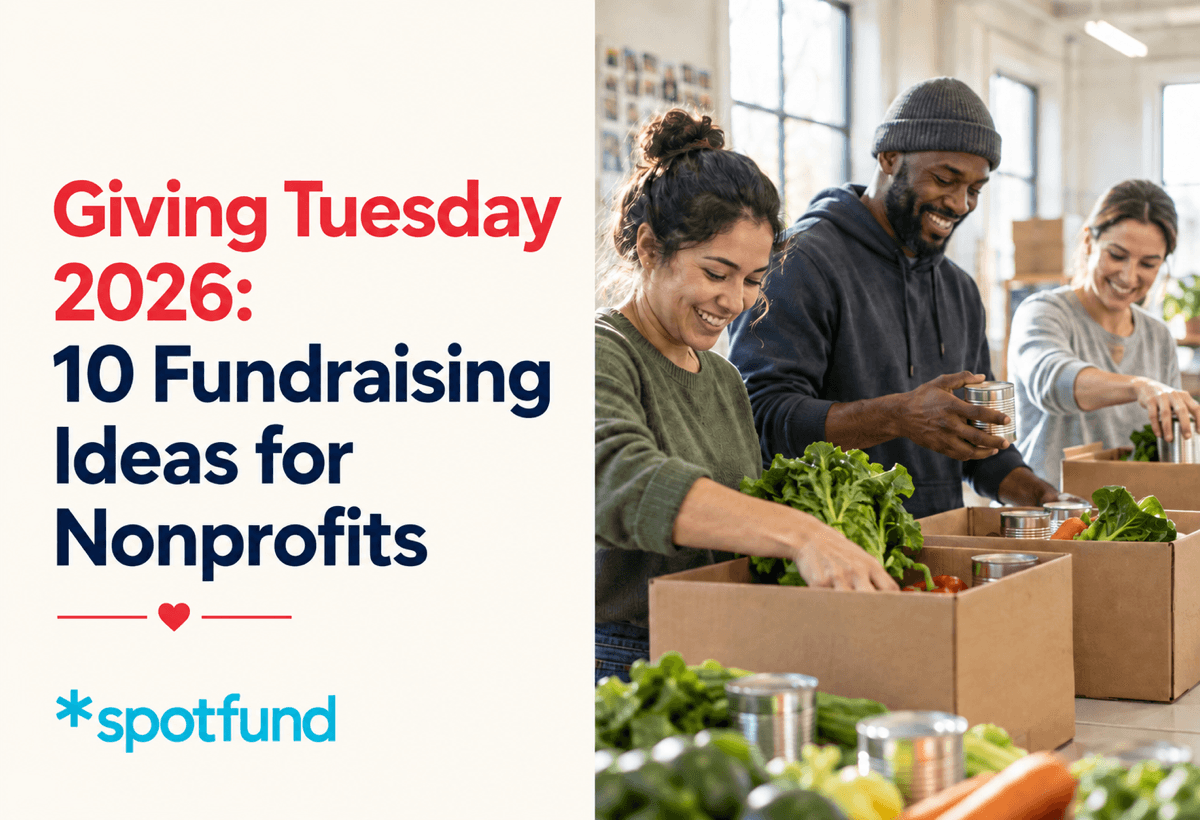
Giving Tuesday 2026 falls on Tuesday, December 1. For your nonprofit, that date can become a shared goal for your board, a reason for a major donor to offer a match, or the start of a monthly giving program that supports your work throughout 2027.
Start by deciding what you want the day to accomplish. Do you need funding for a specific project, introductions to new supporters, or more people giving every month? Your answer will help you choose a campaign your team can manage and your community can understand.
Below are 10 Giving Tuesday fundraising ideas, with practical ways to organize each one. Choose one as your main campaign, then add a complementary approach if it serves the same goal. All dollar amounts and campaign targets in the examples are illustrative.
At a glance: Mobilize supporters through a team fundraiser, set clear Give/Get commitments, secure a donor match, and make room for support that continues after December 1.
In this guide
-
What is Giving Tuesday, and when is it in 2026?
-
10 Giving Tuesday fundraising ideas
-
How to plan and promote your campaign
-
Start planning with spotfund
-
Frequently asked questions

What Is Giving Tuesday, and When Is It in 2026?
GivingTuesday is a global generosity movement that encourages people to support their communities through donations, volunteering, advocacy, and other acts of kindness. The official GivingTuesday website confirms this year's date as December 1, 2026.
Your campaign can begin before that date and continue afterward. Use the day to bring attention to a clear milestone, while explaining how it fits into your organization's longer-term work.
10 Giving Tuesday Fundraising Ideas for Your Nonprofit
1. Launch a Group Fundraiser With Your Community
Invite board members, ambassadors, volunteers, and fans of your organization to raise money together. Give each participant a personal fundraising page so they can explain why the cause matters to them and share it with their own network.
With spotfund's group and team fundraiser setup, individual fundraisers appear together on a team page, with the collective amount raised displayed at the top. Supporters can see their own contribution to a larger effort.
Before launch, provide a short campaign description, approved images, a suggested personal target, and sample outreach messages. Encourage participants to add their own story instead of sending identical appeals.
You can also offer a donated prize to the person who raises the most during Giving Tuesday. Set the counting period, eligible donations, and tie-breaking approach in advance. Recognize other contributions too, such as helping a first-time fundraiser get started.
2. Set a Give/Get Challenge for Your Board and Key Supporters
A Give/Get challenge asks participants to commit to a fundraising amount they can personally donate, raise from others, or achieve through a combination of both.
For example, 10 board members might each commit to giving or raising $500 by December 1, creating a shared $5,000 target. One member could donate the full amount; another could recruit 10 people to give $50 each.
Agree on realistic commitments with each participant. Then use the team fundraising setup to view individual fundraising activity together. Maintain a separate commitment tracker for pledges or gifts that have not yet appeared on the pages.
During check-ins, ask what help participants need: a personal introduction, a stronger appeal, or a clearer explanation of the project. Keep pledged amounts separate from money received, and count each donation only once when reporting the overall result.
3. Multiply Donations With a Matching Gift Campaign
Ask a major donor, foundation, or business partner to match Giving Tuesday donations up to an agreed amount. A specific match gives supporters a clear explanation of how an eligible gift will be supplemented.
For instance, a sponsor could match donations dollar for dollar up to $10,000. If supporters contribute $10,000 in eligible gifts, the sponsor adds another $10,000, producing a combined $20,000 before any applicable fees.
Confirm the terms before announcing the campaign: the ratio, maximum contribution, eligible gifts, start and end times, and when the sponsor will provide the funds. For monthly donations, specify whether the match applies to the first payment or another agreed amount.
Publish updates as the match is used. Once the limit is reached, change the appeal so donors understand the current terms. This campaign-specific donor match is distinct from an employer's employee matching gift program.
4. Move Your Capital Campaign Toward Its Next Milestone
A Giving Tuesday capital campaign appeal can help fund a defined part of a larger building, renovation, or equipment project.
Choose a milestone donors can picture. A community center with a $250,000 renovation goal might dedicate Giving Tuesday to raising $25,000 toward an accessible entrance, using its actual project budget to explain the target.
Show what the improvement will make possible, who it will serve, and how it fits into the overall project schedule. Include a photo, drawing, or other useful visual, and identify concept images as such.
Be clear about how funds will be used if the day's target is exceeded or not reached. Afterward, report both the Giving Tuesday contribution and the remaining project need. That gives donors a concrete reason to follow the campaign's next stage.
5. Recruit Monthly Donors to Support Your Mission Throughout 2027
Use Giving Tuesday to invite supporters into an ongoing relationship with your organization. Set a recruitment target, such as welcoming 100 new monthly donors, and explain the work their recurring gifts will support.
If 100 people each give $20 per month, that represents $2,000 in monthly support. If all continue for 12 months, the total would be $24,000 before fees. Present this as an illustration of sustained giving, not money already collected or guaranteed income.
Offer a few manageable amounts and explain how supporters can change or stop their recurring gift. Confirm that information in your actual donation flow before sending traffic to it.
spotfund's recurring donations guide explains availability for nonprofit campaigns and support-assisted setup for individual peer-to-peer fundraisers. Test your campaign's options before launch, then plan welcome messages and regular impact updates for 2027.
6. Build Excitement With a Giving Tuesday Sweepstakes
A sweepstakes can give your community another reason to pay attention to your campaign. Choose a prize that fits your audience, such as a donated experience, and keep the organization's mission visible throughout the promotion.
Start by securing the prize and confirming fulfillment details. Then work with your platform and qualified adviser to establish the official rules and entry process before promotion. Make the participation terms, eligibility, closing time, and winner notification process easy to find.
Keep entry instructions separate from your donation appeal so people understand both clearly. Avoid describing the activity as a paid raffle or promising that every donation automatically creates an entry unless the approved structure supports that wording.
If you plan to run the campaign on spotfund, contact the team to confirm the setup and support available for your organization. Include prize and administration costs when evaluating the campaign's results.
7. Turn a Specific Community Need Into a Donation Challenge
Give supporters a practical target tied to your current work. A food program might aim to fund a defined number of grocery packages; an animal rescue might raise money for a scheduled set of veterinary appointments.
Build donation examples from real costs. If a package costs approximately $40 and your goal is 150 packages, the corresponding target is $6,000. Explain whether that amount includes delivery, staffing, or other expenses.
Show progress toward the service goal as well as the dollar goal. An update such as “We've funded 90 of 150 packages” helps people understand what remains.
If contributions support a pooled program budget, describe gift amounts as examples of what donations help provide rather than promising a specific item for every gift.
8. Partner With Local Businesses to Expand Your Reach
Invite a business with a connection to your cause to bring the campaign to its employees and customers. The partnership could involve an employee fundraising team, an in-store promotion, or a contribution tied to an agreed portion of sales.
Offer a manageable role. A bookstore could display your campaign during a community event, while a local employer could invite staff to create fundraising pages.
For a sales-linked contribution, agree on the calculation, eligible purchases, dates, any maximum contribution, and payment timing before publishing the offer. Give the business accurate copy and a clear link to the campaign.
After Giving Tuesday, report the contribution and thank everyone involved. Discuss whether there is a useful way to continue the relationship beyond the day.
9. Host a Live Giving Tuesday Fundraising Event
A short livestream or open-house event can let supporters see your work and ask questions before giving. Build the event around something worth attending: a project walkthrough, a conversation with your team, or a demonstration of the program being funded.
For a 30-minute livestream, you could spend the opening five minutes introducing the goal, 15 minutes showing the work, and the final 10 minutes answering questions and explaining how to help.
Assign someone to host and someone to manage questions and donation links. Test the sound, connection, and giving page beforehand. Obtain permission before sharing anyone's story or image.
Repeat the fundraising link at natural moments, and send a recording or short recap to supporters who could not attend.
10. Reconnect With Past Donors Through a Personal Appeal
Giving Tuesday offers an opportunity to contact people who previously supported your work. Start with a relevant update about the project or program they helped fund, then explain the current need.
A useful message might say: “Your past support helped keep our after-school program running. This Giving Tuesday, we're raising funds for the next term's supplies. Would you consider helping us reach that goal?” Use only details you can substantiate about the donor's involvement.
Ask staff or board members with an existing relationship to make personal contact where appropriate. Include one clear next step and honor communication preferences.
Track returning donors separately from first-time donors. Their response can help you understand which relationships to nurture after the campaign.

How to Plan and Promote Your Giving Tuesday Campaign
Choose one main outcome and assign someone to own it. A small team might focus on a project appeal with a donor match. An organization with an active board might combine a team fundraiser with Give/Get commitments. You do not need to run all 10 ideas.
Use this planning schedule as a starting point:
|
When |
What to prepare |
|---|---|
|
Early to mid-October |
Select the campaign, confirm its budget, assign responsibilities, and approach partners. |
|
Early November |
Set up pages, recruit participants, confirm match terms, and prepare outreach materials. |
|
November 17–30 |
Introduce the campaign, share the need, test donation options, and check participant readiness. |
|
December 1 |
Launch the appeal, answer questions, report progress, and communicate deadlines with a time zone. |
|
December 2–8 |
Thank supporters, reconcile gifts and pledges, confirm matching funds, and share initial results. |
|
January 2027 onward |
Report project progress, welcome recurring donors, and continue relevant conversations. |
Prepare a short launch message, a progress update, and a closing reminder. Each should identify the need, explain what support will accomplish, and link to the appropriate page. The official GivingTuesday resource hub offers additional preparation resources.
Before launch, complete this campaign brief:
-
We are raising money for: [specific purpose]
-
Our target and deadline are: [amount or donor target, date, and time zone]
-
Our participants and partners are: [names and responsibilities]
-
Supporters can take action here: [tested campaign link]
-
We will report back on: [date and communication channel]
When reporting results, distinguish donations received, outstanding pledges, confirmed matching commitments, campaign costs, and new recurring gifts. Monthly giving projections belong alongside those figures, not inside the day's cash total.
Start Your Giving Tuesday 2026 Campaign With *spotfund
Give your community a shared goal and a clear way to participate. A group fundraiser can bring individual supporters' efforts together, while personal pages let them explain their connection to your organization.
To arrange a team fundraiser on *spotfund, contact the team through the Team Fundraiser page. The setup process includes an invitation code your members can use to create their own fundraisers within the team initiative.
Choose your Giving Tuesday 2026 target, gather your first participants, and prepare the page before your outreach begins.
Plan Your Giving Tuesday Team Fundraiser Today!
Giving Tuesday 2026 FAQs
When is Giving Tuesday 2026?
Giving Tuesday 2026 is Tuesday, December 1. Organizations can begin fundraising earlier and continue afterward, using the day as a shared campaign milestone. State the deadline and time zone for any time-limited match, prize, or other offer associated with your campaign.
When should nonprofits start planning?
Allow six to eight weeks for a manageable campaign, with more time for complex partnerships or events. Begin with the goal, participants, and donation flow. Secure any matching commitment or prize arrangements before including them in public announcements.
What are some Giving Tuesday ideas for small nonprofits?
A specific project appeal, a small team fundraiser, or a personal invitation to past donors can be a manageable starting point. Choose an approach that fits your existing relationships and staff capacity. Add a donor match if a suitable partner is available.
How does a team fundraiser work?
Participants raise money for a shared cause through individual fundraising pages. On spotfund, those pages can be brought together on a group page displaying the collective total. This lets supporters share their own appeals while contributing to the same overall initiative.
How can nonprofits encourage monthly giving on Giving Tuesday?
Set a monthly donor recruitment goal, explain the ongoing work gifts will support, and make the recurring option easy to find. Follow up with a welcome message and useful updates. Track new monthly donors separately from one-time gifts and long-term income projections.