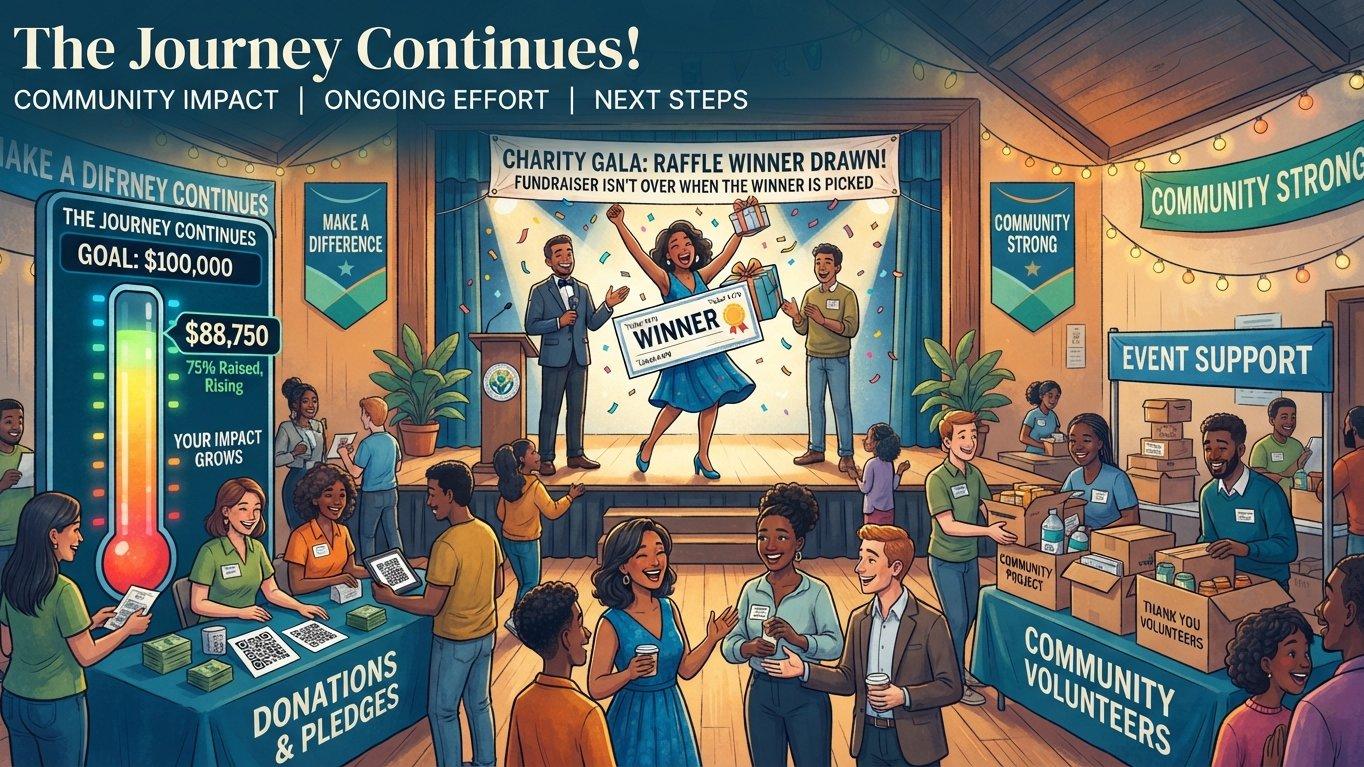

A prize fundraiser that stops paying attention once the winner's name is drawn has, in most cases, left its most useful work undone. The drawing settles one question for one person. Every other donor, which in a national sweepstakes can mean thousands of people, walks away with whatever the organization decides to tell them next. That message shapes whether they feel they gave to a cause or bought a ticket. The real test of a prize campaign usually comes in the weeks after the livestream, the stretch many organizers treat as cleanup.
Most Entrants Lose, and They're Still Your Donors
Start with the arithmetic of losing. A drawing with one grand prize produces one delighted entrant and a crowd of people who spent a few days picturing themselves in a truck they'll never drive. Plenty of them had never heard of the charity until a sponsored post found them an hour before entries closed. That makes prize campaigns good at finding new donors, in a sector that has trouble keeping them. The field's own quarterly benchmark data for early 2026 showed dollars rising while new donor counts kept falling. The report that came with it called the poor rate at which first gifts turn into second ones the sector's sorest spot.
That second gift is where a prize campaign earns its keep. Someone who entered for the truck and lost has every reason to file the experience next to a scratch-off card bought at a gas station. Drawing day is unlikely to change that comparison, since any persuading has to happen in the messages that follow. If you've entered one of these drawings, you know how fast the confirmation email sinks. What did you hear from the charity once someone else had the keys?
Make the Winner Easy to Find
Proof comes first. A donor who suspects the winner was invented probably won't believe much of what the charity says about the money afterward, and that suspicion has real roots. The FBI's 2025 Internet Crime Report logged 5,623 complaints in its lottery, sweepstakes and inheritance category, with reported losses of about $194 million. Against numbers like those, a blurry photo of an oversized check captioned with a first name and a state won't settle many nerves.
For a sense of what a better standard looks like, there's a report from A Race Against Blindness, a charity funding research into inherited retinal disease in children, that walks through its own process. Most of the steps happen after the drawing. A neutral third-party administrator selects the winner at random. That person gets a call during a social media livestream, the name and date go into a public archive of past winners, and anyone who wins a vehicle gets travel covered to collect it and pays nothing to claim it. None of it raises a dollar on the day it happens.
If you run prize campaigns, the pattern is worth borrowing. Name the administrator in your official rules, publish each winner with a date once that person agrees to it, and keep the archive online long after the campaign page goes quiet. The church-basement raffle never needed an archive, because the winner was usually somebody's cousin. Online, strangers only meet the winner if the charity introduces them.
Don't Leave the Winner Holding a Surprise Tax Bill
The winner is the other loose end, and a more delicate one than organizers sometimes admit. Since federal tax law counts prizes and awards as gross income, the person grinning on camera with a set of keys may be facing a tax bill on a vehicle they never planned to buy. A charity can't rewrite the tax code. What it can do is state the prize's approximate retail value and the winner's tax responsibility plainly in the official rules, repeat both on the phone, and consider a cash alternative where its rules allow one. Every future entrant is, in a sense, watching how that one person gets treated.
Companies Already Have to Publish Their Winners
On public proof of winners, the law in at least one state asks more of companies than of charities. Florida's statute on game promotions requires an operator offering more than $5,000 in prizes to file with the state before launch and to back those prizes with a trust account or a surety bond. Within 60 days of the winners being determined, the operator owes the state a certified list of everyone who won more than $25, and it must either give a copy free to anyone who asks or publish the names in a Florida newspaper. The same statute exempts the activities of nonprofit organizations.
So if a supermarket in Florida gives away a car, it owes you a winners list when you ask. With a charity's pickup raffle, you're mostly relying on the charity's sense of obligation, which plenty of charities have in abundance. When one doesn't, the damage can spread to every organization that runs a drawing afterward.
Small raffles carry paperwork too. California's rules for nonprofit raffles require eligible groups to register before selling a single ticket and to file an annual report by February 1 showing what each raffle took in, what it spent and how the proceeds were used. Even if your state asks for less, that's a sensible bar to hold yourself to.
What to Tell the Donors Who Didn't Win
Practical advice on running raffles and other fundraising games already folds the winner announcement into a campaign update, which is the right instinct carried halfway. Everyone who didn't win deserves a second message, and what it ought to say is less obvious than it looks.
The obvious candidate is the money. Reporting back with numbers feels right, but the research is less comforting. In a direct mail experiment involving more than 21,000 donors to an anti-poverty charity, economists added a paragraph to some appeals saying the program's impact had been measured with rigorous scientific methods. Across the whole sample, it made no difference to who gave or how much. Donors who had previously given $100 or more became more likely to give, while smaller donors became slightly less likely to. That split matters here, since prize campaigns tend to bring in plenty of small gifts.
That finding doesn't sink the case for reporting back, because what the researchers tested was a sentence about methodology. Other work has found that detailed descriptions of a charity's work tend to raise giving, apparently because concrete details make people feel their gift has a real effect. A donor who lost a raffle is rarely wondering whether the charity runs controlled trials. They want to know the drawing was real and that someone noticed their twenty dollars, and months later they'd like to hear what the work their money joined actually accomplished.
A Post-Drawing Plan Worth Copying
Sending that second message is the easy part now. One person can get personal thank-you notes and progress updates out to an entire donor list in a sitting, which leaves a small campaign without its old excuse about staff time. Finding something true to say takes more thought. For a PTO, the news might be that the playground fund hit its goal and the equipment arrives in March. A surgery fundraiser needs even less than that, just a photo of the paid hospital bill with the account number covered.
The donation thank-you note belongs in the first few days after the drawing, and it should name the gift without a word about the next prize. One real update a month or two later is usually all donors expect. Is the follow-up paying off? Count the prize-acquired donors who give a second time, and keep that number out of your blended retention rate, where those donors tend to disappear.
There's a financial case as well. Prize campaigns usually get judged on the cost to raise a dollar, with the car or the cash entered as the main expense. That arithmetic ends at the drawing. It leaves out what the organization may spend next year replacing entrants who heard nothing and drifted off, a cost that usually turns up later under another budget line.
Plan the Follow-Through Before You Pick the Prize
We tend to treat the drawing as the climax because it's the only part with a countdown clock. The follow-through has no date, so it slides, and the next grand prize gets announced to people who were never told what became of the last one. A fair number of them probably still think of their entry as a lost ticket.
Next time, write the post-drawing messages first, before anyone falls in love with a prize, and put their send dates on the same calendar as the launch. The drawing ends the contest. Donors learn their money mattered from those later messages, which are also likely to be on their minds when your next appeal arrives.