
Taking the leap to start a charitable organization is an incredibly generous and impactful decision. If you have recognized a pressing need in your community, you might be wondering exactly how to start a 501c3. While the legal paperwork can seem overwhelming at first, breaking the process down into manageable steps makes it highly achievable.
Establishing an official nonprofit organization ensures your cause can accept tax-deductible donations, apply for grants, and operate with public credibility. This comprehensive guide will walk you through exactly what is a 501c3, the core 501c3 requirements, and how to successfully navigate the 501c3 application.
What Is a 501c3?
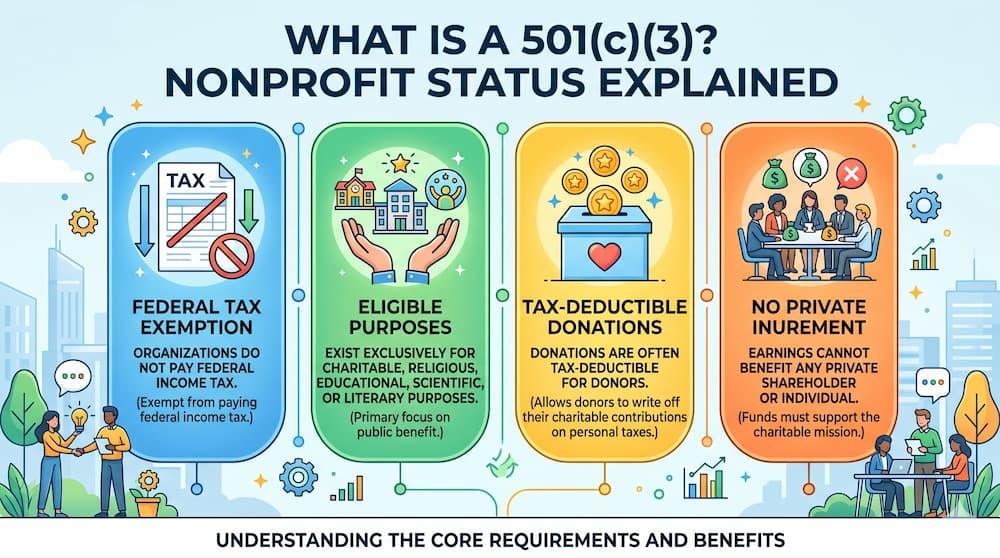
Before diving into the paperwork, it is helpful to answer the foundational question: what is a 501c3? Simply put, a 501(c)(3) is a specific portion of the United States Internal Revenue Code. It allows the IRS to grant federal tax exemption to certain nonprofit organizations.
When people talk about starting a "nonprofit" or a "charity," they are almost always referring to a 501(c)(3) organization. Obtaining this status means your organization does not have to pay federal income tax on the funds it brings in.
More importantly for your future supporters, it allows donors to write off their charitable contributions on their personal taxes. According to the National Center for Charitable Statistics, there are over 1.5 million tax-exempt organizations in the U.S., proving that while the process takes time, it is a well-trodden path.
Key 501c3 Requirements to Consider
Before you begin the legal filings, you need to ensure your vision aligns with strict federal guidelines. To be approved by the IRS, you must meet several non-negotiable 501c3 requirements.
First and foremost, your organization must exist exclusively for one of the IRS's approved exempt purposes. These primarily include charitable, religious, educational, scientific, or literary purposes. Other 501c3 requirements involve strict rules on how the organization is governed and how its money is spent:
-
No Private Inurement: The nonprofit's earnings cannot be used to benefit any private shareholder or individual. All funds must be strictly funneled back into the charitable mission.
-
Lobbying Limitations: A 501(c)(3) organization cannot dedicate a substantial part of its activities to influencing legislation.
-
Political Campaign Prohibition: Nonprofits are absolutely prohibited from participating in, or intervening in, any political campaigns on behalf of (or in opposition to) a political candidate.
-
Asset Dedication: If the nonprofit eventually dissolves, all remaining assets must be distributed to another tax-exempt organization, not to the founders or board members.
Understanding these 501c3 requirements early on prevents costly mistakes during the application phase.
How to Start a 501c3 in 7 Essential Steps
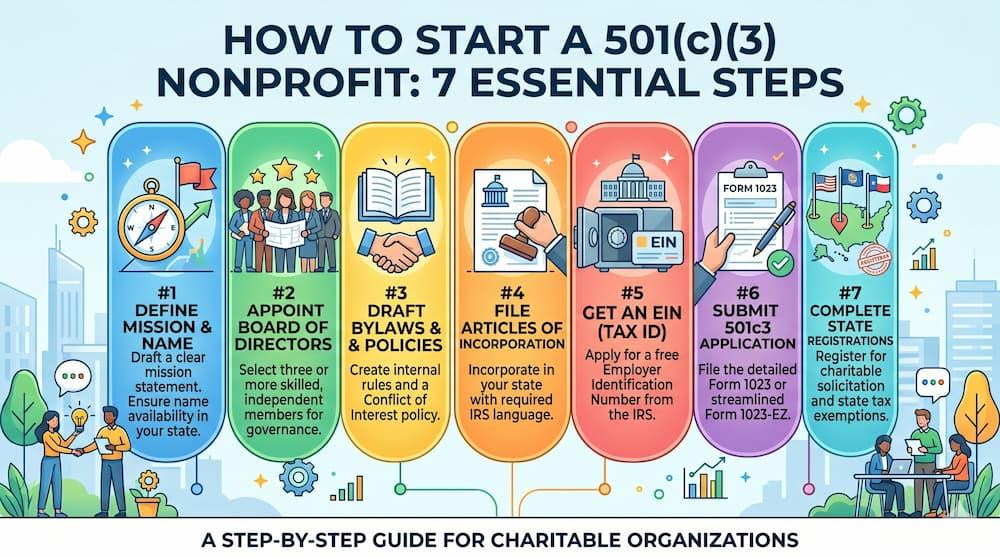
If you are confident your mission meets the federal criteria, you are ready to begin the official formation process. Here is exactly how to start a 501c3, from your initial idea to full IRS approval.
Step 1: Define Your Mission and Choose a Name
Every successful nonprofit starts with a rock-solid mission statement. Your mission will dictate your programs, appeal to future donors, and satisfy the IRS's definition of a charitable entity. Keep it clear, actionable, and focused on the public good.
Once your mission is set, you need to choose a legal name. Check your state's Secretary of State database to ensure the name is not already registered by another business or organization. You should also verify that the corresponding website domain is available.
Step 2: Appoint a Board of Directors
The IRS and your state government require nonprofits to be governed by a board of directors. This group is legally responsible for overseeing the organization's activities and financial health.
-
Most states require a minimum of three board members.
-
To avoid conflicts of interest, board members should generally not be related to one another by blood or marriage.
-
Look for individuals who bring diverse skills to the table, such as legal expertise, accounting experience, or deep community ties.
Step 3: Draft Your Bylaws and Conflict of Interest Policy
Bylaws are the internal rulebook for your organization. They dictate how the board will operate, how meetings are held, and how officers are elected. While bylaws are not usually filed with the state, they are a critical part of your 501c3 application.
Alongside your bylaws, you must adopt a Conflict of Interest policy. This policy ensures that any decisions made by the board of directors prioritize the nonprofit's interests over any personal financial interests. The IRS scrutinizes this closely to ensure compliance with 501c3 requirements.
Step 4: File Articles of Incorporation
To become a legal entity, you must file "Articles of Incorporation" (sometimes called a Certificate of Formation) with your state's corporate filing office. This is typically done through the Secretary of State.
To successfully apply for federal tax exemption later, your Articles of Incorporation must include specific language required by the IRS. This includes a clear statement of your charitable purpose and a dissolution clause detailing what happens to assets if the organization closes.
Step 5: Get an Employer Identification Number (EIN)
Just like an individual has a Social Security Number, your new nonprofit needs an Employer Identification Number (EIN) to be recognized by the federal government. You need an EIN to open a bank account, hire employees, and submit your 501c3 application.
You can apply for an EIN for free directly through the official IRS website. The number is usually generated and provided to you immediately upon completing the online form.
Step 6: Submit Your 501c3 Application (Form 1023)
This is the most time-consuming and critical step of the entire process. Your official 501c3 application is known as IRS Form 1023 (or Form 1023-EZ for smaller, eligible organizations).
This comprehensive document requires you to detail your organizational structure, past and projected financials, program activities, and board composition.
-
Form 1023-EZ: A streamlined, 3-page online form for organizations projecting less than $50,000 in annual gross receipts. The filing fee is $275.
-
Form 1023 (Long Form): A detailed, 28-page application for larger organizations. The filing fee is $600.
Because the standard 501c3 application is incredibly complex, many founders consult with a legal professional or a CPA to ensure it is filled out perfectly.
Step 7: Complete State Charitable Registrations
Receiving your determination letter from the IRS means you are federally tax-exempt, but your work isn't quite finished. Most states require nonprofits to register with the state's Attorney General before they can legally ask for donations. This is known as "charitable solicitation registration."
Additionally, you may need to file separate paperwork with your state's Department of Revenue to gain exemption from state income taxes and state sales taxes. Check with your local state offices to ensure you remain fully compliant.
Frequently Asked Questions (FAQ)
How long does the 501c3 application take to process?
The timeline for IRS approval varies based on the current backlog and the form you use. If you use the streamlined Form 1023-EZ, you may receive approval in 2 to 4 weeks. The standard Form 1023 can take anywhere from 3 to 6 months—or longer if the IRS requires additional information.
How much does it cost to start a 501c3?
The primary costs include your state incorporation fees (which range from $50 to $200 depending on your state) and the IRS 501c3 application fee ($275 for the 1023-EZ, or $600 for the full 1023). If you hire legal or accounting professionals to assist with the paperwork, costs can easily exceed $1,500.
Can I raise money before getting 501c3 status?
Yes, you can raise money while your 501c3 application is pending, but there is a catch. You must inform donors that your tax-exempt status is pending. If the IRS approves your application, the exemption is typically retroactive to your date of incorporation, meaning those early donations will become tax-deductible. If you are denied, those donations are not tax-deductible. Many people use personal crowdfunding to cover the initial startup fees of their nonprofit.
What is the difference between a nonprofit and a 501c3?
While often used interchangeably, they are not exactly the same thing. "Nonprofit" is a state-level legal designation indicating that your organization's primary goal is not to generate profit for owners. "501c3," on the other hand, is a specific federal tax-exempt status granted by the IRS. You must first incorporate as a nonprofit at the state level before you can submit your 501c3 application to the federal government.
Can the founder of a 501c3 receive a salary?
Yes, founders, executives, and employees can receive a reasonable salary for the day-to-day work they perform for the organization. However, strict 501c3 requirements dictate that all compensation must be "reasonable" and based on fair market value. The IRS heavily scrutinizes executive pay to ensure the charity's funds are not being used to personally enrich the founders, a violation known as "private inurement."
Do I need a lawyer to file my 501c3 application?
No, there is no legal requirement to hire an attorney or CPA to start a 501c3. If your organization is small and eligible for the streamlined Form 1023-EZ, you may be able to navigate the process independently. However, if you must file the standard, 28-page Form 1023, consulting with a professional who specializes in nonprofit law is highly recommended to ensure your bylaws and narrative perfectly align with IRS guidelines.
Do I have to file taxes after my 501c3 is approved?
Yes! Even though your organization is federally exempt from paying income tax, you are still required to file an annual information return with the IRS, typically Form 990 (or 990-N/990-EZ for smaller charities). This form ensures public transparency regarding your finances and activities. If you fail to file your Form 990 for three consecutive years, the IRS will automatically revoke your 501c3 status.

Start Your Free Fundraiser Today
Figuring out how to start a 501c3 takes time, patience, and financial resources. Whether you are looking to raise the initial funds to cover your IRS filing fees, or you are an established nonprofit looking for a reliable way to collect ongoing donations, *spotfund is here to help. With our #1 Trustpilot rating and 0% platform fees, you keep more of the money you raise. Plus, our built-in AI fundraising tool can help you craft the perfect campaign story in seconds, while features like text-to-donate, donation QR codes, and next-day payouts make managing your charity effortless.
Is my *spotfund donation tax-deductible? Personal crowdfunding donations are not tax deductible for donors. Only donations to verified 501(c)(3) nonprofit campaigns can be considered for a donor tax deduction. This will clearly be stated on the campaign and on the donation email receipt.