Spotfund logo
Spotfund logo
Start Fundraising
PricingContact SupportStart Fundraising

Fundraise for

  • Medical Fundraising
  • Emergency Fundraising
  • Memorial Fundraising
  • Education Fundraising
  • Nonprofit Fundraising
  • Animal Fundraising
  • Community Fundraising

Featured topics

  • Easy Fundraising Ideas for Individuals
  • Creative Fundraiser Dinner Ideas
  • Raising Money for Medical Expenses
  • *spotfund for NIL Collective Fundraising
  • Giving Tuesday Fundraising 2025NEW

Trending in

  • Medical
  • Memorial
  • Emergency
  • Nonprofit
  • Family
  • Sports
  • Business

Featured topics

  • *spotfund as a Recurring Donation Solution
  • Matching Gift CampaignsPOPULAR
  • Why Recurring Donations Are Important for Nonprofits
  • How it works
  • Common questions
  • Success stories
  • For brands and nonprofits
  • How do I withdraw money?
  • *spotfund blog
  • Reviews from people like you
  • Compare *spotfund to others

Snow Day Predictor: How It Works And Why Millions Of Student

Snow Day Predictor: How It Works And Why Millions Of Student

Fundraising for

Hanif Asad

Fundraising forHanif Asad
Hanif Asad

Hanif Asad

Bethel Island, California

$0of $100 goal
0
Donors
0
Comments
0Share Arrow
Shares
Donation protected
👍 0% fee

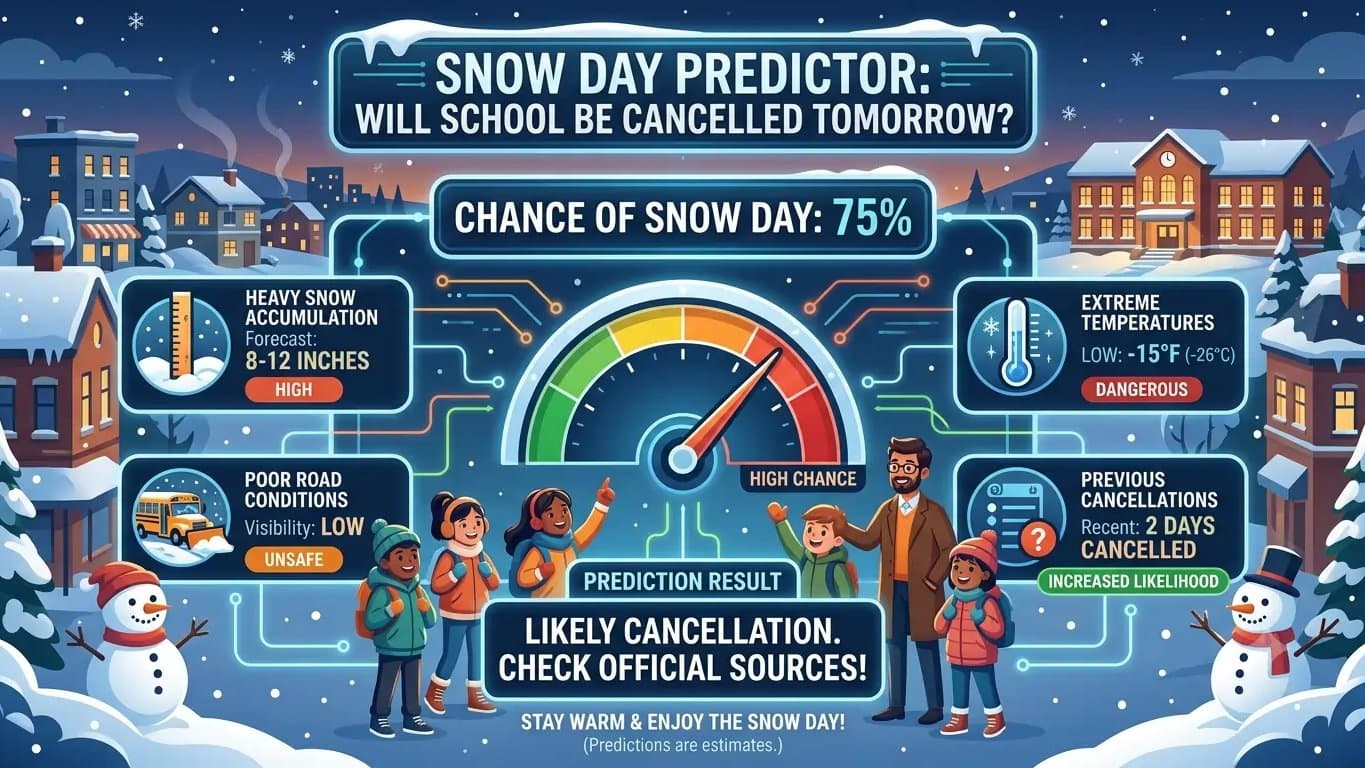
Snow Day Predictor: How It Works and Why Millions of Students Swear By It

Every winter, as forecasts start hinting at falling temperatures and incoming storms, a familiar ritual plays out in households across snow-prone regions: kids (and more than a few adults) pull up a snow day predictor, cross their fingers, and refresh the page every hour hoping for good news. What started as a niche curiosity has grown into a full-blown winter tradition, with dedicated websites, apps, and social media communities built entirely around the question every student wants answered  "Will school be canceled tomorrow?"

What Is a Snow Day Predictor?

A snow day predictor is a tool  usually a website or app  that estimates the likelihood of school closures due to snow, ice, or other winter weather. Users typically enter their zip code, and the tool combines that location with weather forecast data to generate a percentage chance of a snow day, delay, or early dismissal.

The most well-known of these tools is simply called the Snow Day Predictor, a website that has become something of a cultural institution for students in the northern United States. It's bookmarked on countless school-issued laptops and shared constantly on social media the moment a storm shows up on the radar.

How Do Snow Day Predictors Actually Work?

While the exact algorithms are proprietary, snow day predictors generally rely on a mix of the following factors:

  • Forecasted snowfall totals – The more snow expected, the higher the odds.

  • Timing of the storm – Snow that falls overnight or during morning commute hours is far more disruptive than snow that arrives in the afternoon.

  • Temperature – Colder temperatures mean roads stay icy longer and snow doesn't melt, increasing closure likelihood.

  • Wind speed – High winds can cause blowing snow and dangerous drifting, even with modest accumulation.

  • Historical closure patterns – Some tools factor in how a specific school district has responded to similar storms in the past. A district in Minnesota might need a foot of snow to close, while a district in Georgia might shut down over an inch.

  • Day of the week – Interestingly, some predictors note that schools are statistically slightly more likely to call a snow day on a Friday or before a long weekend.

By weighting these variables, the tool produces a percentage anywhere from a disappointing 10% to a triumphant 95%  representing the odds of no school.

Why People Trust (and Distrust) Snow Day Predictors

Snow day predictors are entertaining, but it's worth being honest about their limits. They are not official sources. School closure decisions are made by superintendents and district officials, who consider factors a website simply can't measure in real time: the condition of specific rural roads, the availability of school bus drivers, whether sidewalks are safe for kids walking to school, and even liability concerns.

That said, these tools tend to perform reasonably well in situations with dramatic, unambiguous forecasts  a major nor'easter or blizzard warning, for instance. They're far less reliable in borderline cases, like a light dusting or a storm that could go either way. In those situations, the predictor might say 50/50, and so might reality.

The Cultural Phenomenon

Part of the appeal of snow day predictors isn't just the forecast  it's the ritual. Checking the percentage has become a shared experience, almost like checking a sports score. Students compare predictions with friends, parents use them to plan childcare, and even teachers quietly check them the night before a storm.

Social media has amplified this. During major winter storms, it's common to see screenshots of snow day predictor percentages shared across group chats, TikTok, and Instagram, often accompanied by superstitious rituals believed (half-jokingly) to increase the odds of a closure:

  • Wearing pajamas inside out

  • Putting a spoon under your pillow

  • Flushing ice cubes down the toilet

  • Doing a "snow dance"

None of these have any actual bearing on weather or district decisions, but they've become part of the fun, turning a simple weather forecast into a shared cultural moment.

Tips for Using a Snow Day Predictor Wisely

If you're checking a snow day predictor this winter, here are a few tips to get the most accurate read possible:

  1. Check the night before, not days in advance. Forecasts become significantly more accurate within 12–24 hours of a storm.

  2. Cross-reference with your local weather service. Use the predictor as a fun estimate, and confirm actual conditions through the National Weather Service or a trusted local meteorologist.

  3. Know your district's history. If your school district rarely closes, treat even a high percentage with some skepticism. If it closes easily, a moderate percentage might still mean a day off.

  4. Watch for official communication. Schools typically announce closures via automated calls, emails, texts, and social media  usually very early in the morning or the night before.

The Bottom Line

Snow day predictors won't replace an official school closure announcement, but they've earned their place as a beloved winter tradition. Part science, part superstition, and part shared anticipation, they capture something universal: the hope that tomorrow might bring an unexpected day of rest, hot chocolate, and snowball fights instead of homework and homeroom. Whether the percentage reads 12% or 92%, checking it has become as much a part of winter as the snow itself.

Crosswind Calculator

Pilots and student aviators rely on a different kind of prediction tool: the crosswind calculator. This tool takes reported wind speed and direction along with a runway's heading to break the wind down into two components  the crosswind component, which pushes the aircraft sideways during takeoff and landing, and the headwind or tailwind component, which affects speed and distance. Because every aircraft has a maximum demonstrated crosswind limit, pilots use this calculator during preflight planning to confirm that conditions are within safe operating limits, making it an essential safety tool rather than just a convenience.

ATAR Calculator

Students preparing for university admissions in Australia often turn to an ATAR calculator to estimate their Australian Tertiary Admission Rank before official results are released. By inputting subject scores, predicted grades, and sometimes scaling data specific to their state or subject combination, students get a rough estimate of where they might land on the percentile scale used for university entry. While not perfectly precise, since actual scaling is handled by assessment authorities using complex statistical models, these calculators give students a useful benchmark for planning university applications and setting realistic expectations ahead of results day.

Gravel Calculator

For anyone tackling a landscaping or driveway project, a gravel calculator takes the guesswork out of material estimation. By entering the length, width, and desired depth of an area, along with the type of gravel being used, the calculator estimates how many cubic yards or tons of material are needed for the job. This helps homeowners and contractors avoid the common pitfalls of ordering too little gravel, which leads to project delays, or ordering too much, which wastes money and leaves excess material to dispose of.

Timeless Jewel Calculator

In the world of Path of Exile, one of gaming's most complex action RPGs, a timeless jewel calculator helps players navigate one of the game's most intricate mechanics. Timeless jewels alter the passive skill tree within a certain radius, transforming notable passives into unique, often more powerful alternate versions tied to specific in-game factions. Since the transformations are seeded and not random, a timeless jewel calculator lets players input their jewel type and seed to preview exactly which passives will change and how, allowing them to optimize powerful, build-defining combinations before committing valuable in-game resources.

Smiley Face

Be the first to donate and pin
your name here   📌

Organizer

Hanif Asad

Hanif Asad is the organizer of this fundraiser

Snow Day Predictor: How It Works And Why Millions Of Student
Hanif Asad

Hanif Asad

Bethel Island, California

Fundraising for

Hanif Asad

Fundraising forHanif Asad
Donation protected
👍 0% fee

Snow Day Predictor: How It Works and Why Millions of Students Swear By It

Every winter, as forecasts start hinting at falling temperatures and incoming storms, a familiar ritual plays out in households across snow-prone regions: kids (and more than a few adults) pull up a snow day predictor, cross their fingers, and refresh the page every hour hoping for good news. What started as a niche curiosity has grown into a full-blown winter tradition, with dedicated websites, apps, and social media communities built entirely around the question every student wants answered  "Will school be canceled tomorrow?"

What Is a Snow Day Predictor?

A snow day predictor is a tool  usually a website or app  that estimates the likelihood of school closures due to snow, ice, or other winter weather. Users typically enter their zip code, and the tool combines that location with weather forecast data to generate a percentage chance of a snow day, delay, or early dismissal.

The most well-known of these tools is simply called the Snow Day Predictor, a website that has become something of a cultural institution for students in the northern United States. It's bookmarked on countless school-issued laptops and shared constantly on social media the moment a storm shows up on the radar.

How Do Snow Day Predictors Actually Work?

While the exact algorithms are proprietary, snow day predictors generally rely on a mix of the following factors:

  • Forecasted snowfall totals – The more snow expected, the higher the odds.

  • Timing of the storm – Snow that falls overnight or during morning commute hours is far more disruptive than snow that arrives in the afternoon.

  • Temperature – Colder temperatures mean roads stay icy longer and snow doesn't melt, increasing closure likelihood.

  • Wind speed – High winds can cause blowing snow and dangerous drifting, even with modest accumulation.

  • Historical closure patterns – Some tools factor in how a specific school district has responded to similar storms in the past. A district in Minnesota might need a foot of snow to close, while a district in Georgia might shut down over an inch.

  • Day of the week – Interestingly, some predictors note that schools are statistically slightly more likely to call a snow day on a Friday or before a long weekend.

By weighting these variables, the tool produces a percentage anywhere from a disappointing 10% to a triumphant 95%  representing the odds of no school.

Why People Trust (and Distrust) Snow Day Predictors

Snow day predictors are entertaining, but it's worth being honest about their limits. They are not official sources. School closure decisions are made by superintendents and district officials, who consider factors a website simply can't measure in real time: the condition of specific rural roads, the availability of school bus drivers, whether sidewalks are safe for kids walking to school, and even liability concerns.

That said, these tools tend to perform reasonably well in situations with dramatic, unambiguous forecasts  a major nor'easter or blizzard warning, for instance. They're far less reliable in borderline cases, like a light dusting or a storm that could go either way. In those situations, the predictor might say 50/50, and so might reality.

The Cultural Phenomenon

Part of the appeal of snow day predictors isn't just the forecast  it's the ritual. Checking the percentage has become a shared experience, almost like checking a sports score. Students compare predictions with friends, parents use them to plan childcare, and even teachers quietly check them the night before a storm.

Social media has amplified this. During major winter storms, it's common to see screenshots of snow day predictor percentages shared across group chats, TikTok, and Instagram, often accompanied by superstitious rituals believed (half-jokingly) to increase the odds of a closure:

  • Wearing pajamas inside out

  • Putting a spoon under your pillow

  • Flushing ice cubes down the toilet

  • Doing a "snow dance"

None of these have any actual bearing on weather or district decisions, but they've become part of the fun, turning a simple weather forecast into a shared cultural moment.

Tips for Using a Snow Day Predictor Wisely

If you're checking a snow day predictor this winter, here are a few tips to get the most accurate read possible:

  1. Check the night before, not days in advance. Forecasts become significantly more accurate within 12–24 hours of a storm.

  2. Cross-reference with your local weather service. Use the predictor as a fun estimate, and confirm actual conditions through the National Weather Service or a trusted local meteorologist.

  3. Know your district's history. If your school district rarely closes, treat even a high percentage with some skepticism. If it closes easily, a moderate percentage might still mean a day off.

  4. Watch for official communication. Schools typically announce closures via automated calls, emails, texts, and social media  usually very early in the morning or the night before.

The Bottom Line

Snow day predictors won't replace an official school closure announcement, but they've earned their place as a beloved winter tradition. Part science, part superstition, and part shared anticipation, they capture something universal: the hope that tomorrow might bring an unexpected day of rest, hot chocolate, and snowball fights instead of homework and homeroom. Whether the percentage reads 12% or 92%, checking it has become as much a part of winter as the snow itself.

Crosswind Calculator

Pilots and student aviators rely on a different kind of prediction tool: the crosswind calculator. This tool takes reported wind speed and direction along with a runway's heading to break the wind down into two components  the crosswind component, which pushes the aircraft sideways during takeoff and landing, and the headwind or tailwind component, which affects speed and distance. Because every aircraft has a maximum demonstrated crosswind limit, pilots use this calculator during preflight planning to confirm that conditions are within safe operating limits, making it an essential safety tool rather than just a convenience.

ATAR Calculator

Students preparing for university admissions in Australia often turn to an ATAR calculator to estimate their Australian Tertiary Admission Rank before official results are released. By inputting subject scores, predicted grades, and sometimes scaling data specific to their state or subject combination, students get a rough estimate of where they might land on the percentile scale used for university entry. While not perfectly precise, since actual scaling is handled by assessment authorities using complex statistical models, these calculators give students a useful benchmark for planning university applications and setting realistic expectations ahead of results day.

Gravel Calculator

For anyone tackling a landscaping or driveway project, a gravel calculator takes the guesswork out of material estimation. By entering the length, width, and desired depth of an area, along with the type of gravel being used, the calculator estimates how many cubic yards or tons of material are needed for the job. This helps homeowners and contractors avoid the common pitfalls of ordering too little gravel, which leads to project delays, or ordering too much, which wastes money and leaves excess material to dispose of.

Timeless Jewel Calculator

In the world of Path of Exile, one of gaming's most complex action RPGs, a timeless jewel calculator helps players navigate one of the game's most intricate mechanics. Timeless jewels alter the passive skill tree within a certain radius, transforming notable passives into unique, often more powerful alternate versions tied to specific in-game factions. Since the transformations are seeded and not random, a timeless jewel calculator lets players input their jewel type and seed to preview exactly which passives will change and how, allowing them to optimize powerful, build-defining combinations before committing valuable in-game resources.

Organizer

Hanif Asad

Hanif Asad is the organizer of this fundraiser

$0of $100 goal
0Donors
0Comments
0Share ArrowShares
Smiley Face

Be the first to donate and pin
your name here   📌

★★★★★ Trustpilot Reviews

Ready to start?

Join the thousands like you finding help on *spotfund.

Start FundraisingHow it works
Spotfund Balloons