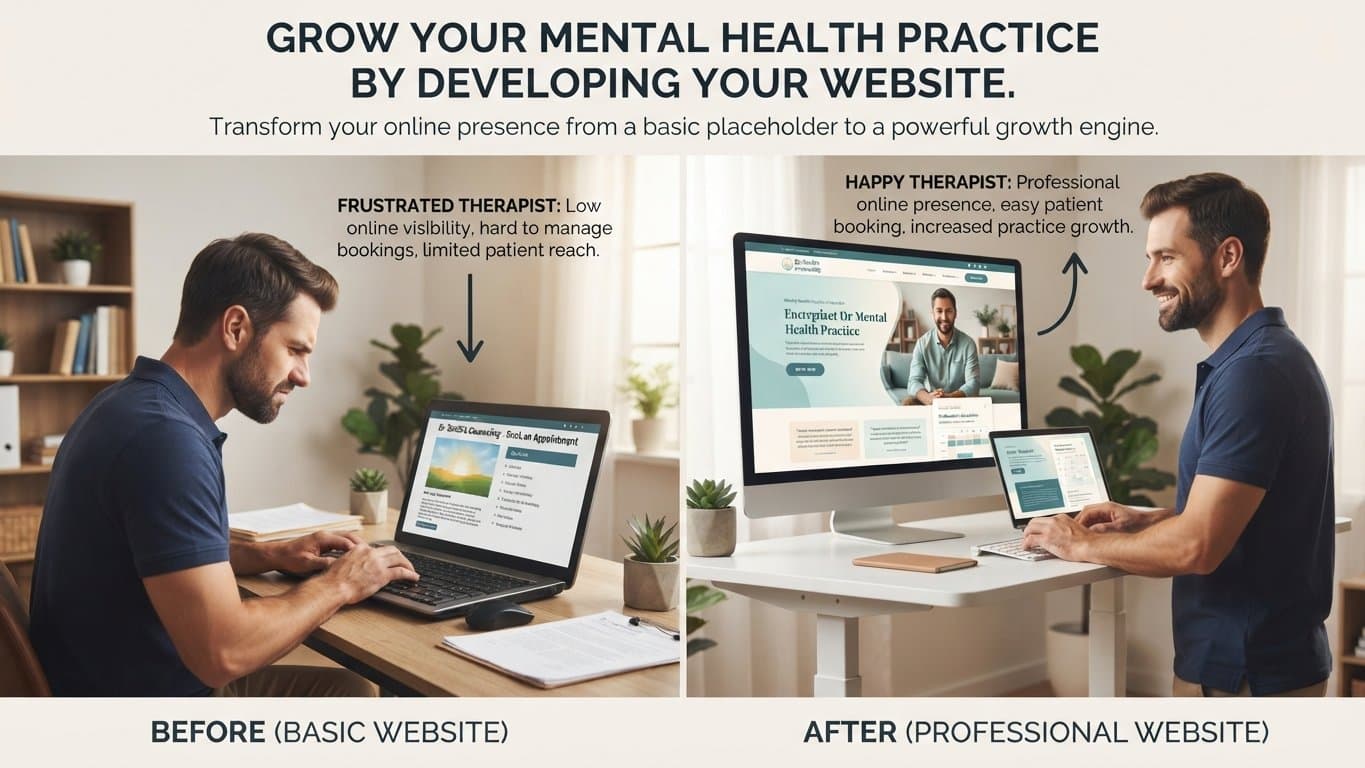


Digital mediums are now evolving as a new communication tool in mental health services to connect with patients, provide information about the services, and establish mental health professionals' profile. Many people who are considering a behavioral health treatment provider consult with an Internet search engine in advance of contacting a therapist, psychologist, psychiatrist, or behavioral health provider to find out how to treat a behavioral health disorder, what the provider has to offer, where they are located, and when they are available. This means that having a professional website is a crucial component to today's practice growth.
A site is more than simply an online business card. If perfectly planned and developed, it can help in the visibility of a search engine, patient education, appointment requests, communication, and digital marketing.
A well structured site also conveys a positive impression the first time it is visited, and makes it easy for patients to locate essential information without having to search and sift through components of the site. In the world of healthcare, where digitization is becoming more and more prevalent, having a good website can prove beneficial for the mental health provider who is doing some level of competition.
How Mental Health Web Development Supports Practice Growth
Professional mental health web development is targeted towards developing websites that address the needs of behavioral health providers and their patients. A mental health website is not just about presenting the information on the page, it's about communicating it in a sensitive way, and ensuring it is presented in a professional, trustworthy and patient manner.
Developing practices can help practices:
Improve online visibility
Present services clearly
Build professional credibility
Generate patient inquiries
Provide a link to an online request for appointments.
Provide educational information
Improve mobile accessibility
Increase the efforts on digital marketing.
When they all combine, a website isn't just a means of providing contact details; it's an integral component of practice growth.
Creating a Strong First Impression
A mental health practice can make its initial impression on a user by the website. Visitors can easily check the site's look and feel, its content, how easy the site is to navigate and how professional and well organized the site is before deciding whether to contact the site's provider.
The homepage should clearly state that the practice serves, what they do and how to get started. Key information should be communicated in an easy-to-understand and structured manner.
Visitors can easily navigate through the practice without having to look through several pages if professional provider biographies, service descriptions, contact information and calls to action are provided. An up-to-date look can also convey a message of the importance of patient care.
Improving the Patient Experience
Patients may be on stress or may be uncertain to seek out mental health care. This can be made more difficult with a complicated website.
A website geared toward patients' needs should be user-friendly, have readable information and easy-to-follow instructions. Visitors have the ability to easily locate information on services, providers, location, insurance and appointments.
Retail store features that are important to users:
Simple navigation
Clear page layouts
Easy-to-read content
Mobile-responsive design
Fast-loading pages
Visible contact information
Convenient appointment options
Users are more likely to stay on your website and move to the next step if it is easy to use.If your site is easy to use, it's likely that users will stay and take the next step, which may be visiting your practice.
Increasing Search Engine Visibility
There is also a base level of website development that also is essential to search engine optimization. Mental health services should be "visible" when people are looking for mental health services within their communities.
Optimized URLs, internal links, relevant keywords, service pages and well-organized headings and page titles are a few of the things that can make a website SEO friendly. Web pages can also target patients looking for services for specific areas through location-specific pages.
For instance, a therapist specializing in anxiety treatment can set up a specific page that details the anxiety treatment service, treatment strategy, as well as patient experience. This provides the search engines with the more relevant information, and visitors with understanding of what the practice provides.
Providing Valuable Educational Content
Mental health website may be a valuable educational tool. Patients are frequently asked about some of the symptoms they may experience, what treatments are available, the processes of therapy and what exactly to expect in their initial consultation.
Including any of the following is helpful in website content:
Mental health guides
Treatment explanations
Frequently asked questions
Therapy preparation information
Provider articles
Patient education resources
Useful content can showcase a provider's knowledge and provide information to customers before they call a provider. Educational resources can also play a role in SEO by enabling practices to respond to pertinent inquiries people are searching online.
Simplifying Appointment Scheduling
If people are interested in the practice they should be able to easily contact the practice through the website. When scheduling is difficult and they leave the site without making an inquiry, prospective patients are likely to blame the healthcare company for not keeping them informed.When patients can't find the scheduling info they are looking for, they might leave a site without inquiring about the scheduling.
A prominent call to action, like “Schedule an Appointment,” “Contact Our Practice” or “Request a Consultation” can help visitors take the next step.
Making the process even easier can be done through online scheduling. Patients can make appointments at their own pace and administrative do not need to deal with a lot of repetitive telephone appointments.
Therefore, a straightforward traveling schedule can enhance the comfort for patients as well as practice efficiency.
Building Trust and Professional Credibility
Trust is especially crucial in mental health treatment as patients might be giving their private information to the healthcare provider. Professionalism is a trait that a website must possess; but don't make promises that aren't possible to keep.
Detailed provider profiles can offer the clinician information about the provider and what they are about, their qualifications, experience, specialties and treatment approach. Having well-written descriptions of the services offered can also inform visitors whether the practice is right for them.
Other things that can be included to gain creditability are:
Professional provider profiles
Accurate practice information
Clear service descriptions
Educational resources
Privacy information
Consistent branding
Easy-to-find contact details
The clear, informative website can help alleviate any uncertainty and can motivate prospective patients to call.
Mobile-Friendly and Accessible Design
Numerous people look for health care providers via their smart phones. A website which can perform well only on a desktop computer can cause barriers to mobile users.
Responsive Design is a design approach that makes webpage pages flexible to change size and still function and be readable on different screen sizes. The functionality of buttons, menus, forms and text should be easy to use on smaller devices.
Accessibility is also an issue. Logical headings, simple fonts, descriptive links, easy to navigate through by keyboard, accessible multimedia and others can help make websites more accessible to people with varying needs.
Supporting Digital Marketing Strategies
A website serves as a hub for a lot of digital marketing. The practice website can be promoted to visitors through search engine optimization, social media, online directories, email campaigns, and more.
The site should then lead the visitors to the relevant services and actions. An effective journey can be as follows:
Search result → Service page → Provider information → Contact page → Appointment request
This helps to ensure that marketing traffic can direct easily towards a patient query.
Measuring Website Performance
Practices should also be able to assess their performance online through the website development. Analytics can give data on user behaviour and aid providers in discovering regions that need improvement.
Practices can monitor:
Popular service pages
Traffic sources
Visitor engagement
Appointment requests
Conversion rates
Pages with a high bounce rate.
This data can be used to identify pages that require optimization of messages and navigation, as well as content that is effective in gaining visitor interest.
Supporting Long-Term Practice Growth
Future expansion should be considered when developing a mental health website. Eventually there may be more providers, treatment services, locations, learning resources, or online scheduling options available for use in practices.
These changes can be more readily accomplished with a scalable website structure. Regular updates can also ensure that service information is accurate and website functions smoothly and reliably.
That's why, professional website development is a long-term investment that can keep a practice growing with the changing requirements.
FAQs
What are the reasons behind developing a website for mental health practices?
Website development can help practices be more visible online, communicate services, increase credibility, offer patient education and create patient inquiries about appointments.
What is important on a mental health practice website?
The service pages, provider profiles, contact details, appointment availability, educational materials, intuitive navigation, and mobile-friendly layout are essential features of a professional website.
Is web development a key to gaining new patients?
Yes. Having a user friendly, search optimized website can enhance the visibility of the practice and help potential patients understand the services offered and contact the practice.
Why Mobile Optimisation matters?
A lot of people rely on their smartphones for exploring health care options. Responsive design makes it possible to see website content on a variety of devices and to use it.
What is the benefit of SEO for the mental health industry?
By improving your website's visibility in search results, SEO can ensure that practices connect with individuals who are actively seeking mental health information and services.
Conclusion
In today's world, web development is a factor in the development of mental health practices. A professional website will increase visibility, enhance credibility, make scheduling more convenient, offer a convenient education and improve visibility.
Healthcare providers can build a mental health-focused online presence with a strategy for mental health web design, meeting the needs of their patients and the goals of their business. But paired with an eye-catching design, responsive website, accessibility, user-friendly content, analytical features and effective calls to action, a fully-functioning website can become a useful long-term tool for drawing in patients and fostering ongoing growth of your practice.