
Spotfund logo
Spotfund logo
Start Fundraising
PricingHelp & SupportStart Fundraising

Fundraise for

  • Medical Fundraising
  • Emergency Fundraising
  • Memorial Fundraising
  • Education Fundraising
  • Nonprofit Fundraising
  • Animal Fundraising
  • Community Fundraising

Featured topics

  • Fundraising for Youth Sports and School AthleticsNEW
  • Easy Fundraising Ideas for Individuals
  • *spotfund for NIL Collective Fundraising
  • Raising Money for Medical Expenses
  • Giving Tuesday Fundraising 2026HOT

Trending in

  • Medical
  • Memorial
  • Emergency
  • Nonprofit
  • Family
  • Sports
  • Business

Featured topics

  • *spotfund as a Recurring Donation Solution
  • Matching Gift CampaignsPOPULAR
  • Why Recurring Donations Are Important for Nonprofits
  • Donating to Youth Sports and School Athletics TeamsNEW
  • How it works
  • Common questions
  • Success stories
  • For brands and nonprofits
  • How do I withdraw money?
  • *spotfund blog
  • Reviews from people like you
  • Compare *spotfund to others

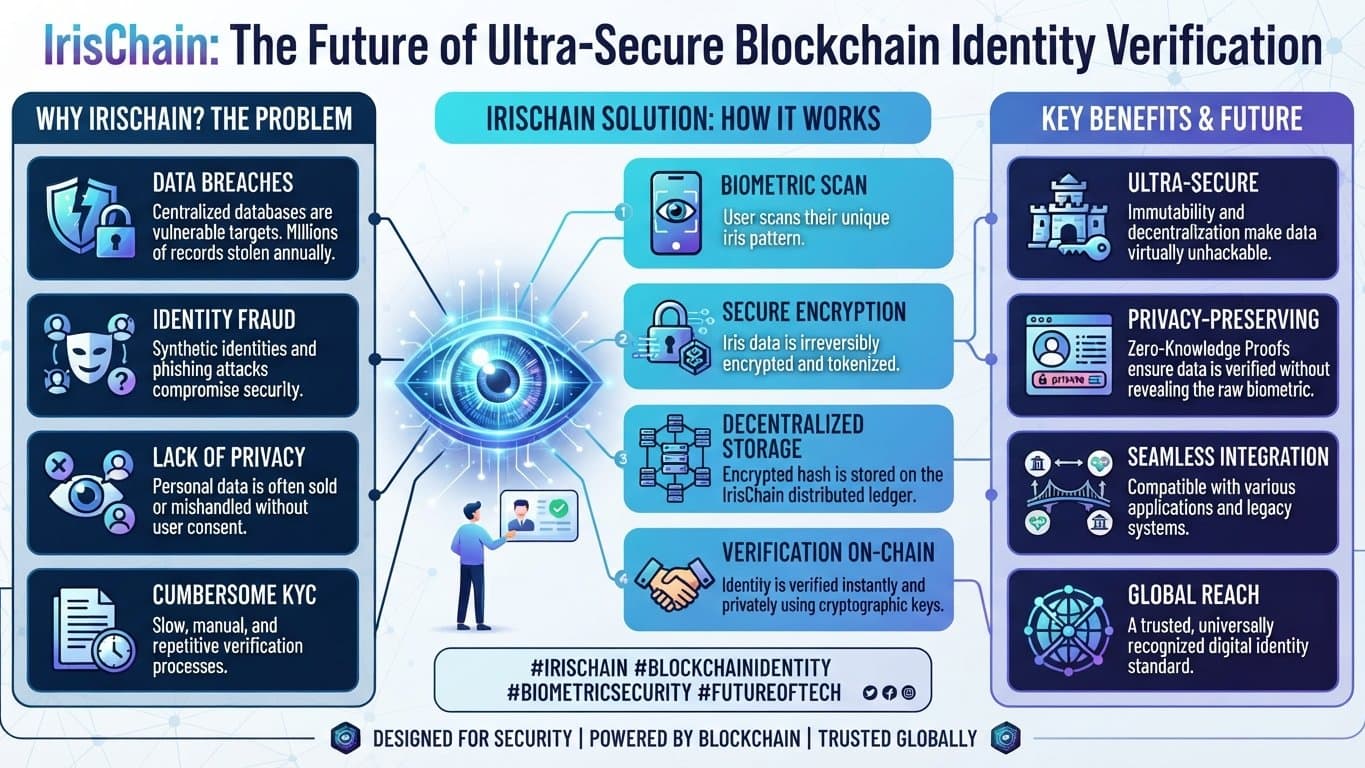
IrisChain: The Future Of Ultra-Secure Blockchain Identity

IrisChain: The Future Of Ultra-Secure Blockchain Identity

Fundraising for

Lina Lilli

Fundraising forLina Lilli
Lina Lilli

Lina Lilli

New York, New York

$0of $100 goal
0
Donors
0
Comments
0Share Arrow
Shares
Donation protected
👍 0% fee

In an increasingly digitized world, online security and personal identity protection have become central challenges. Traditional methods of authentication—such as passwords, multi-factor tokens, and basic security questions—are falling short against sophisticated cyber threats, synthetic identity theft, and automated breach tools. Security paradigms are shifting toward immutable, decentralized solutions.

At the intersection of cutting-edge biometrics and cryptographic ledgers lies IrisChain, a framework combining iris recognition technology with a decentralized blockchain system. This integration sets a new benchmark for ultra-secure identity verification.

Understanding Iris Recognition Biometrics

What Is Iris Recognition?

To evaluate the strengths of IrisChain, it is essential to ask: what is iris recognition?

Iris recognition technology is a biometric identification technique that captures and analyzes the complex, unique patterns present within the ring-shaped region surrounding the pupil. The iris features dynamic geometric patterns, including furrows, crypts, rings, arching ligaments, and tiny spots.

Unlike fingerprints—which can degrade through physical work—or facial geometry, which alters with age and expressions, the structural details of the human iris remain stable throughout an individual's life. Even identical twins possess entirely distinct iris structures.

+-----------------------------------------------------------------------+

|                       Iris Biometric Pipeline                         |

|                                                                       |

|  [Near-IR Capture] --> [Iris Localization] --> [Feature Extraction]   |

|                                                         |             |

|                                                         v             |

|  [Blockchain Verification] <-- [Zero-Knowledge Proof / IrisCode]      |

+-----------------------------------------------------------------------+

The Technical Mechanics of Iris Recognition Biometrics

The process of capturing and processing iris recognition biometrics follows a precise sequence:

  1. Illumination and Capture: Scanners use subtle, near-infrared (NIR) light to illuminate the eye. This lighting illuminates dark eyes and renders intricate structural patterns visible without causing visual discomfort or physical contact.

  2. Localization and Isolation: Computer vision algorithms isolate the iris by mapping its inner boundary (pupil) and outer boundary (sclera) while filtering out eyelids, eyelashes, and lens reflections.

  3. Normalization and Feature Extraction: The isolated annular image is mapped into a fixed mathematical polar coordinate space. Specialized mathematical wavelets analyze the spatial patterns to create a compact digital representation known as an IrisCode.

  4. Cryptographic Template Conversion: Instead of storing raw image files, the system transforms the IrisCode into a cryptographic hash or zero-knowledge proof (ZKP) construct.

When evaluated alongside other modalities, iris biometrics demonstrate distinct structural advantages:

Feature / Modality

Fingerprint Recognition

Facial Recognition

Iris Recognition Biometrics

Long-Term Stability

Moderate (subject to wear/injury)

Variable (ages, altered by expression)

Extremely High (unaltered over time)

False Acceptance Rate (FAR)

~1 in 100,000

~1 in 100,000 to 1,000,000

~1 in 1,000,000,000+

Spoof Vulnerability

Moderate (silicone molds/latents)

Higher (2D prints, 3D masks, deepfakes)

Extremely Low (requires liveness detection)

Hygiene / Contact

Touch-based

Contactless

Contactless (distance scanning)

The Flaw of Centralized Biometric Databases

While iris identification offers biometric precision, centralizing this data creates significant risk. Conventional identity networks store user credentials, biometric templates, and personal identifiers within centralized cloud servers or relational databases.

Centralized databases present distinct vulnerabilities:

  • Single Points of Failure: Central databases are prime targets for malicious actors. A single perimeter breach can expose millions of sensitive biometric records.

  • Irrevocability of Biometrics: Unlike compromised passwords, biological traits cannot be reset or reissued once stolen.

  • Unauthorized Tracking: Central operators can potentially track users across platforms without explicit user consent.

Solving these vulnerabilities requires shifting architecture from centralized servers to a decentralized ledger system.

Enter IrisChain: Fusing Biometrics with Blockchain

IrisChain addresses database vulnerabilities by coupling iris biometrics with blockchain technology. Rather than storing sensitive biological data in a central repository, IrisChain distributes authentication nodes across a decentralized framework.

                    +---------------------------+

                     |    User Iris Scanning     |

                     +-------------+-------------+

                                   |

                                   v

                     +---------------------------+

                     | Zero-Knowledge Proof (ZKP)|

                     +-------------+-------------+

                                   |

                                   v

    +------------------------------+------------------------------+

    |                              |                              |

    v                              v                              v

+-------+                      +-------+                      +-------+

| Node  | <--- Distributed --->| Node  | <--- Consensus --->  | Node  |

|   A   |       Validation     |   B   |       Ledger         |   C   |

+-------+                      +-------+                      +-------+

Key Structural Pillars of IrisChain

1. Immutable Infrastructure & Blockchain Development

Through specialized blockchain development, IrisChain builds customized consensus mechanisms designed for real-time authentication operations. By committing biometric hashes to a blockchain network, the platform ensures records remain immutable—tamper-resistant, verifiable, and protected against unauthorized alterations.

2. Decentralized Systems Architecture

Operating within decentralized systems, IrisChain removes reliance on central trust administrators. Identity verification occurs through cryptographic proofs distributed across node networks. If an individual node goes offline or experiences a breach, the broader system retains integrity and continues operating normally.

3. Distributed Ledger Technology (DLT)

Using distributed ledger technology (DLT), every identity validation leaves a verifiable, timestamped trace without leaking identity payload data. Instead of holding raw biometric images, the ledger maintains cryptographic references. Verification checks query the decentralized ledger to confirm authenticity without transmitting underlying personal data across public routes.

4. Cryptographic Proofs & Crypto Ledger Integration

IrisChain integrates zero-knowledge proofs (ZKPs) alongside a secure crypto ledger. Zero-knowledge cryptography lets users prove ownership of a matching iris pattern without revealing the underlying IrisCode or identity metadata to the verifying party.

The verification workflow operates as follows:

[User Device] ------------ Generates ZKP Proof ------------> [Verifier]

      |                                                          |

  Runs Scan                                              Queries Ledger

      |                                                          |

      v                                                          v

[Iris Code] -- (Hashing/Encryption) -- [On-Chain Commitment] <-- [Crypto Ledger]

How IrisChain Works Step-by-Step

Understanding IrisChain's identity cycle requires examining its core operational flow:

Step 1: Onboarding and Template Generation

  1. A user scans their iris using an NIR-capable capture device.

  2. The hardware extracts biometric features to form a local IrisCode.

  3. The device processes this data locally through a non-reversible cryptographic hashing function, generating a unique biometric identity commitment.

Step 2: On-Chain Registration

  1. The client device communicates with an IrisChain smart contract to register the cryptographic commitment on the blockchain system.

  2. The raw scan and original IrisCode are purged from local RAM, ensuring no biological images leave the local device.

  3. The commitment is written directly into the public or permissioned blockchain network.

Step 3: Decentralized Identity Authentication

  1. When authenticating for a service (such as Web3 dApps, banking portals, or physical access), the user performs a live scan.

  2. The client system generates a zero-knowledge proof showing that the live scan matches the registered cryptographic commitment.

  3. The verifier checks this ZKP against the crypto ledger.

  4. Upon cryptographic validation, access is granted instantly without exposing identity parameters or centralizing authentication credentials.

Primary Real-World Applications

IrisChain's architectural model supports diverse deployment scenarios:

Financial Services and Banking (DeFi & TradFi)

Identity theft and account takeover attacks account for significant financial losses annually. By linking financial access to IrisChain authentication, financial institutions and decentralized finance (DeFi) applications can enforce strict Anti-Money Laundering (AML) and Know Your Customer (KYC) compliance without holding central vaults of private customer data.

Border Control and Government Identity Programs

National identity infrastructure demands both operational speed and high accuracy. Incorporating IrisChain within border security environments accelerates passenger processing while mitigating the risk of credential forgery. Citizens maintain ownership of their biometric identifiers using decentralized sovereign identity models.

Healthcare Record Security

Protected Health Information (PHI) requires strict access management. IrisChain allows medical personnel and patients to access electronic health records securely. Medical histories remain anchored to verified patient identities on a private DLT network, preventing record misattribution and unauthorized access.

Enterprise Physical Access Control

High-security physical facilities—including data centers, research labs, and defense sites—can replace traditional keycards and basic biometrics with IrisChain hardware nodes. Access privileges tied to smart contracts allow automated clearance tracking and immutable audit trails.

Navigating Challenges and Technical Considerations

Deploying an enterprise-grade identity framework requires addressing specific operational challenges:

  1. Hardware Accessibility: Iris scanning requires specialized near-infrared sensors. As mobile manufacturers increasingly adopt NIR front-facing sensors, consumer access will broaden.

  2. Blockchain Scalability: High transaction throughput is vital for global identity networks. IrisChain uses Layer-2 scaling solutions and high-throughput consensus protocols to maintain fast verification speeds.

  3. Liveness Detection & Anti-Spoofing: Modern IrisChain edge scanners employ dynamic pupil dilation tests and multi-spectral lighting to counter high-resolution printed photos, 3D contact lenses, or synthetic deepfake attacks.

Conclusion

The convergence of biometrics and cryptography marks a fundamental paradigm shift in digital access control. Traditional authentication models that rely on static passwords or centralized databases are no longer viable in an era dominated by advanced cyber threats and identity forgery. Centralized biometric repositories remain vulnerable targets, where a single breach can compromise immutable human traits permanently.

IrisChain solves this dilemma by bridging iris recognition technology with the decentralized power of blockchain technology. By storing zero-knowledge cryptographic commitments on a distributed ledger technology (DLT) framework rather than raw biometric files, IrisChain creates a tamper-proof system where individuals retain complete sovereignty over their data. From financial transactions and government services to healthcare and enterprise security, IrisChain establishes an ultra-secure, privacy-preserving infrastructure for the future of digital identity verification.


Smiley Face

Be the first to donate and pin
your name here   📌

Organizer

Lina Lilli

Lina Lilli is the organizer of this fundraiser

IrisChain: The Future Of Ultra-Secure Blockchain Identity
Lina Lilli

Lina Lilli

New York, New York

Fundraising for

Lina Lilli

Fundraising forLina Lilli
Donation protected
👍 0% fee

In an increasingly digitized world, online security and personal identity protection have become central challenges. Traditional methods of authentication—such as passwords, multi-factor tokens, and basic security questions—are falling short against sophisticated cyber threats, synthetic identity theft, and automated breach tools. Security paradigms are shifting toward immutable, decentralized solutions.

At the intersection of cutting-edge biometrics and cryptographic ledgers lies IrisChain, a framework combining iris recognition technology with a decentralized blockchain system. This integration sets a new benchmark for ultra-secure identity verification.

Understanding Iris Recognition Biometrics

What Is Iris Recognition?

To evaluate the strengths of IrisChain, it is essential to ask: what is iris recognition?

Iris recognition technology is a biometric identification technique that captures and analyzes the complex, unique patterns present within the ring-shaped region surrounding the pupil. The iris features dynamic geometric patterns, including furrows, crypts, rings, arching ligaments, and tiny spots.

Unlike fingerprints—which can degrade through physical work—or facial geometry, which alters with age and expressions, the structural details of the human iris remain stable throughout an individual's life. Even identical twins possess entirely distinct iris structures.

+-----------------------------------------------------------------------+

|                       Iris Biometric Pipeline                         |

|                                                                       |

|  [Near-IR Capture] --> [Iris Localization] --> [Feature Extraction]   |

|                                                         |             |

|                                                         v             |

|  [Blockchain Verification] <-- [Zero-Knowledge Proof / IrisCode]      |

+-----------------------------------------------------------------------+

The Technical Mechanics of Iris Recognition Biometrics

The process of capturing and processing iris recognition biometrics follows a precise sequence:

  1. Illumination and Capture: Scanners use subtle, near-infrared (NIR) light to illuminate the eye. This lighting illuminates dark eyes and renders intricate structural patterns visible without causing visual discomfort or physical contact.

  2. Localization and Isolation: Computer vision algorithms isolate the iris by mapping its inner boundary (pupil) and outer boundary (sclera) while filtering out eyelids, eyelashes, and lens reflections.

  3. Normalization and Feature Extraction: The isolated annular image is mapped into a fixed mathematical polar coordinate space. Specialized mathematical wavelets analyze the spatial patterns to create a compact digital representation known as an IrisCode.

  4. Cryptographic Template Conversion: Instead of storing raw image files, the system transforms the IrisCode into a cryptographic hash or zero-knowledge proof (ZKP) construct.

When evaluated alongside other modalities, iris biometrics demonstrate distinct structural advantages:

Feature / Modality

Fingerprint Recognition

Facial Recognition

Iris Recognition Biometrics

Long-Term Stability

Moderate (subject to wear/injury)

Variable (ages, altered by expression)

Extremely High (unaltered over time)

False Acceptance Rate (FAR)

~1 in 100,000

~1 in 100,000 to 1,000,000

~1 in 1,000,000,000+

Spoof Vulnerability

Moderate (silicone molds/latents)

Higher (2D prints, 3D masks, deepfakes)

Extremely Low (requires liveness detection)

Hygiene / Contact

Touch-based

Contactless

Contactless (distance scanning)

The Flaw of Centralized Biometric Databases

While iris identification offers biometric precision, centralizing this data creates significant risk. Conventional identity networks store user credentials, biometric templates, and personal identifiers within centralized cloud servers or relational databases.

Centralized databases present distinct vulnerabilities:

  • Single Points of Failure: Central databases are prime targets for malicious actors. A single perimeter breach can expose millions of sensitive biometric records.

  • Irrevocability of Biometrics: Unlike compromised passwords, biological traits cannot be reset or reissued once stolen.

  • Unauthorized Tracking: Central operators can potentially track users across platforms without explicit user consent.

Solving these vulnerabilities requires shifting architecture from centralized servers to a decentralized ledger system.

Enter IrisChain: Fusing Biometrics with Blockchain

IrisChain addresses database vulnerabilities by coupling iris biometrics with blockchain technology. Rather than storing sensitive biological data in a central repository, IrisChain distributes authentication nodes across a decentralized framework.

                    +---------------------------+

                     |    User Iris Scanning     |

                     +-------------+-------------+

                                   |

                                   v

                     +---------------------------+

                     | Zero-Knowledge Proof (ZKP)|

                     +-------------+-------------+

                                   |

                                   v

    +------------------------------+------------------------------+

    |                              |                              |

    v                              v                              v

+-------+                      +-------+                      +-------+

| Node  | <--- Distributed --->| Node  | <--- Consensus --->  | Node  |

|   A   |       Validation     |   B   |       Ledger         |   C   |

+-------+                      +-------+                      +-------+

Key Structural Pillars of IrisChain

1. Immutable Infrastructure & Blockchain Development

Through specialized blockchain development, IrisChain builds customized consensus mechanisms designed for real-time authentication operations. By committing biometric hashes to a blockchain network, the platform ensures records remain immutable—tamper-resistant, verifiable, and protected against unauthorized alterations.

2. Decentralized Systems Architecture

Operating within decentralized systems, IrisChain removes reliance on central trust administrators. Identity verification occurs through cryptographic proofs distributed across node networks. If an individual node goes offline or experiences a breach, the broader system retains integrity and continues operating normally.

3. Distributed Ledger Technology (DLT)

Using distributed ledger technology (DLT), every identity validation leaves a verifiable, timestamped trace without leaking identity payload data. Instead of holding raw biometric images, the ledger maintains cryptographic references. Verification checks query the decentralized ledger to confirm authenticity without transmitting underlying personal data across public routes.

4. Cryptographic Proofs & Crypto Ledger Integration

IrisChain integrates zero-knowledge proofs (ZKPs) alongside a secure crypto ledger. Zero-knowledge cryptography lets users prove ownership of a matching iris pattern without revealing the underlying IrisCode or identity metadata to the verifying party.

The verification workflow operates as follows:

[User Device] ------------ Generates ZKP Proof ------------> [Verifier]

      |                                                          |

  Runs Scan                                              Queries Ledger

      |                                                          |

      v                                                          v

[Iris Code] -- (Hashing/Encryption) -- [On-Chain Commitment] <-- [Crypto Ledger]

How IrisChain Works Step-by-Step

Understanding IrisChain's identity cycle requires examining its core operational flow:

Step 1: Onboarding and Template Generation

  1. A user scans their iris using an NIR-capable capture device.

  2. The hardware extracts biometric features to form a local IrisCode.

  3. The device processes this data locally through a non-reversible cryptographic hashing function, generating a unique biometric identity commitment.

Step 2: On-Chain Registration

  1. The client device communicates with an IrisChain smart contract to register the cryptographic commitment on the blockchain system.

  2. The raw scan and original IrisCode are purged from local RAM, ensuring no biological images leave the local device.

  3. The commitment is written directly into the public or permissioned blockchain network.

Step 3: Decentralized Identity Authentication

  1. When authenticating for a service (such as Web3 dApps, banking portals, or physical access), the user performs a live scan.

  2. The client system generates a zero-knowledge proof showing that the live scan matches the registered cryptographic commitment.

  3. The verifier checks this ZKP against the crypto ledger.

  4. Upon cryptographic validation, access is granted instantly without exposing identity parameters or centralizing authentication credentials.

Primary Real-World Applications

IrisChain's architectural model supports diverse deployment scenarios:

Financial Services and Banking (DeFi & TradFi)

Identity theft and account takeover attacks account for significant financial losses annually. By linking financial access to IrisChain authentication, financial institutions and decentralized finance (DeFi) applications can enforce strict Anti-Money Laundering (AML) and Know Your Customer (KYC) compliance without holding central vaults of private customer data.

Border Control and Government Identity Programs

National identity infrastructure demands both operational speed and high accuracy. Incorporating IrisChain within border security environments accelerates passenger processing while mitigating the risk of credential forgery. Citizens maintain ownership of their biometric identifiers using decentralized sovereign identity models.

Healthcare Record Security

Protected Health Information (PHI) requires strict access management. IrisChain allows medical personnel and patients to access electronic health records securely. Medical histories remain anchored to verified patient identities on a private DLT network, preventing record misattribution and unauthorized access.

Enterprise Physical Access Control

High-security physical facilities—including data centers, research labs, and defense sites—can replace traditional keycards and basic biometrics with IrisChain hardware nodes. Access privileges tied to smart contracts allow automated clearance tracking and immutable audit trails.

Navigating Challenges and Technical Considerations

Deploying an enterprise-grade identity framework requires addressing specific operational challenges:

  1. Hardware Accessibility: Iris scanning requires specialized near-infrared sensors. As mobile manufacturers increasingly adopt NIR front-facing sensors, consumer access will broaden.

  2. Blockchain Scalability: High transaction throughput is vital for global identity networks. IrisChain uses Layer-2 scaling solutions and high-throughput consensus protocols to maintain fast verification speeds.

  3. Liveness Detection & Anti-Spoofing: Modern IrisChain edge scanners employ dynamic pupil dilation tests and multi-spectral lighting to counter high-resolution printed photos, 3D contact lenses, or synthetic deepfake attacks.

Conclusion

The convergence of biometrics and cryptography marks a fundamental paradigm shift in digital access control. Traditional authentication models that rely on static passwords or centralized databases are no longer viable in an era dominated by advanced cyber threats and identity forgery. Centralized biometric repositories remain vulnerable targets, where a single breach can compromise immutable human traits permanently.

IrisChain solves this dilemma by bridging iris recognition technology with the decentralized power of blockchain technology. By storing zero-knowledge cryptographic commitments on a distributed ledger technology (DLT) framework rather than raw biometric files, IrisChain creates a tamper-proof system where individuals retain complete sovereignty over their data. From financial transactions and government services to healthcare and enterprise security, IrisChain establishes an ultra-secure, privacy-preserving infrastructure for the future of digital identity verification.

Organizer

Lina Lilli

Lina Lilli is the organizer of this fundraiser

$0of $100 goal
0Donors
0Comments
0Share ArrowShares
Smiley Face

Be the first to donate and pin
your name here   📌

★★★★★ Trustpilot Reviews

Ready to start?

Join the thousands like you finding help on *spotfund.

Start FundraisingHow it works
Spotfund Balloons