



The problem
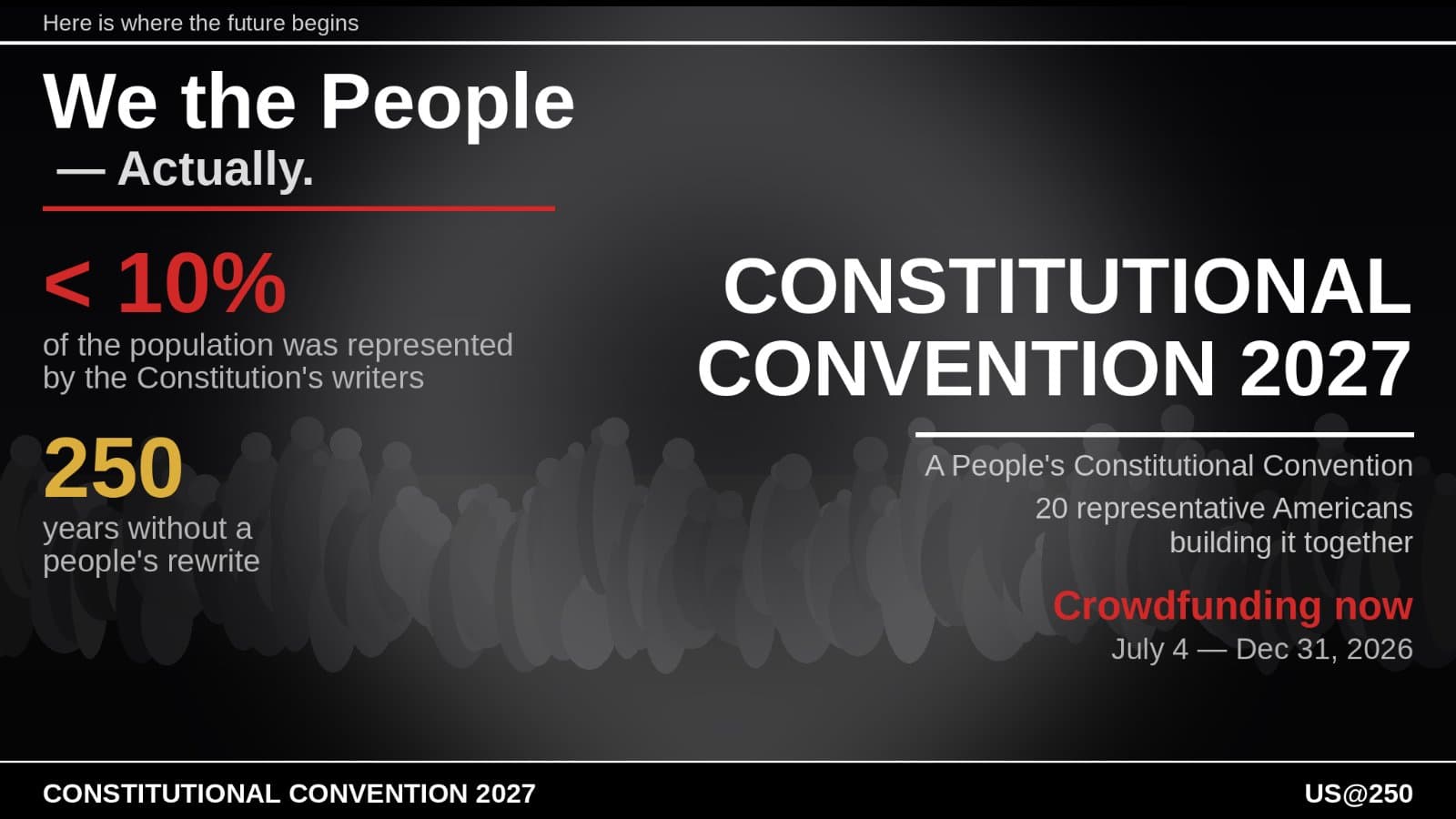
The U.S. Constitution was written in 1787 by fewer than 60 men---elite, white, male property owners who represented less than 10% of the people living in America at the time. Women, enslaved people, Indigenous nations, the poor---none were in the room.
Nearly 250 years later, it has never been rewritten through a genuinely participatory process. We treat the Constitution as sacred text rather than as what it actually is: a design document. And like any design, it reflects the values, blind spots, and interests of whoever made it.
Countries around the world have recognized this problem in themselves. South Africa wrote a new constitution at the end of apartheid, receiving 1.7 million public submissions. Iceland crowdsourced a draft after economic collapse. Tunisia, Nepal, Kenya, and Germany have all rewritten their foundational documents when the old ones no longer reflected who they were.
The United States has never done this. Not once in 250 years.
What we're doing
Constitutional Convention 2027 is assembling 20 qualitatively representative U.S. residents across race, class, gender, indigeneity, ability, age, geography, socioeconomic background and more, to do something that has never been done in America: collaboratively write a People's Constitution.
This is not a think tank project. There are no politicians, no lawyers running the show, no institutions with an agenda. This is a community-led process where community members outnumber and outrank professionals, own all decisions, and lead every step.
The process has two phases:
Phase 1 — Relationship building (4 months): Before anyone writes a word of constitutional text, the group spends four months building authentic, vulnerable, healthy relationships across difference using relational methods like Sustained Dialogue. Constitutional design without real relationships will fail. This phase is the foundation.
Phase 2 — Constitutional design (6 months): The group meets weekly to collaboratively draft a new Constitution. They will also decide, together, what role technology plays in their process — including whether and how to use AI tools. That community decision, made by historically-excluded people with genuine power over their own tools, is part of what makes this project unprecedented.
What you'll get
By November 2027, after the 251st anniversary of the United States, we will publish the People's Constitution online, displayed side by side with the current 1787 document, clause by clause, open for public annotation and response.
This is not a petition. It is not a protest. It is a design---a concrete, detailed, readable document showing what American democracy could look like if the people actually wrote it.
Why now
We are living through a period of deep polarization, institutional mistrust, and questions about whether American democracy can still work. Other countries have responded to moments like this by returning to the first principles and rewriting the rules together. We believe Americans are ready to do the same.
The United States turns 250 in 2026. We want to mark that anniversary not with nostalgia, but with imagination.
How the money is used
Every dollar goes directly to compensating participants for their time because real participation requires real compensation, especially for people facing economic precarity.
$25 pays for a person to participate for 15 minutes.
$50 pays for a person to participate for 30 minutes.
$100 pays for a person to participate for an hour.
$200 pays for two people to co-work for an hour.
$500 pays for a subcommittee of 5 people to work on a proposal for an hour.
$1,000 pays for a committee of 10 to work on a proposal for an hour.
$2,000 pays for a full group meeting of 20 participants for an hour.
$4,000 pays for a full group deliberation for 2 hours.
$8,000 pays for the group to meet for 2 weeks.
$16,000 pays for the group to meet for a month.
The budget is built on a simple principle: $100/hour × 2 hours/week × 44 weeks × 20 people = $176,000 total. We are raising $176,000 as the first phase of funding to launch the project and sustain the first six months of relationship-building sessions.
No participant should have to choose between joining this process and paying their bills. Your contribution makes it possible for the full range of Americans to be in the room, not just those who can afford to volunteer.
Timeline
This fundraising campaign will run from July 4, 2026 - December 31, 2026. The project kicks off in January 2027.
About the project lead
Victor Udoewa is a designer, researcher, and systems practitioner with experience working at the national government level across all 50 states. He conducts co-design and has spent his career building processes where communities lead instead of professionals.
Frequently asked questions
Is this legal?
Yes. Private citizens have the right to draft and publish proposed constitutional text. This document will not automatically replace the current Constitution: it is a design proposal and a public contribution to the national conversation about what American democracy should be.
Who are the 20 people?
Participants are recruited through established national networks and community-based organizations, screened to ensure qualitative representation across age, education, income, race, gender, indigeneity, ability, geography, and more. Replacements are recruited in advance so the project can continue if someone needs to step down.
What if you don't raise the full amount?
If funded partially through other means, we will adjust the timeline or number of sessions rather than reduce participant compensation.
What if you raise more than is needed?
If we raise more than the goal or if we receive other funding from philanthropy, this will allow us to increase the number of participants so that we can have one from every state, territory, protectorate, or extra-state district of the country.
Will anyone actually listen to this?
Maybe not immediately. But the document matters regardless. It tells a different story about what America could be. It gives nonprofits, Congressional staff, and advocacy organizations a concrete reference point for their work. It demonstrates that ordinary U.S. Americans are capable of designing the rules they want to live by. Ultimately, it shows a group of 20 residents doing what Congress has been unable to do---come together across differences and productively build something together. The process is the demonstration and outcome.
Further Questions and Contact
If you have further questions or want to get in contact, email me at
info@justicebydesignpbc.com or victor@justicebydesignpbc.com
You can also check out slides about the project:
- Constitutional Convention 2027 presentation
- Constitutional Convention 2027 theory presentation (if you want more academic theory)