

Deepfake Detection for Digital Identity: Tackling Synthetic Personas With AI and Liveness Detection
Digital identity verification is becoming more important as businesses move onboarding, authentication, financial services, and customer interactions online. At the same time, advances in artificial intelligence are making identity fraud more sophisticated.
Fraudsters can now create realistic synthetic faces, manipulate videos, generate voices, and combine genuine personal information with fabricated details. These techniques can be used to build synthetic personas that appear legitimate during online verification.
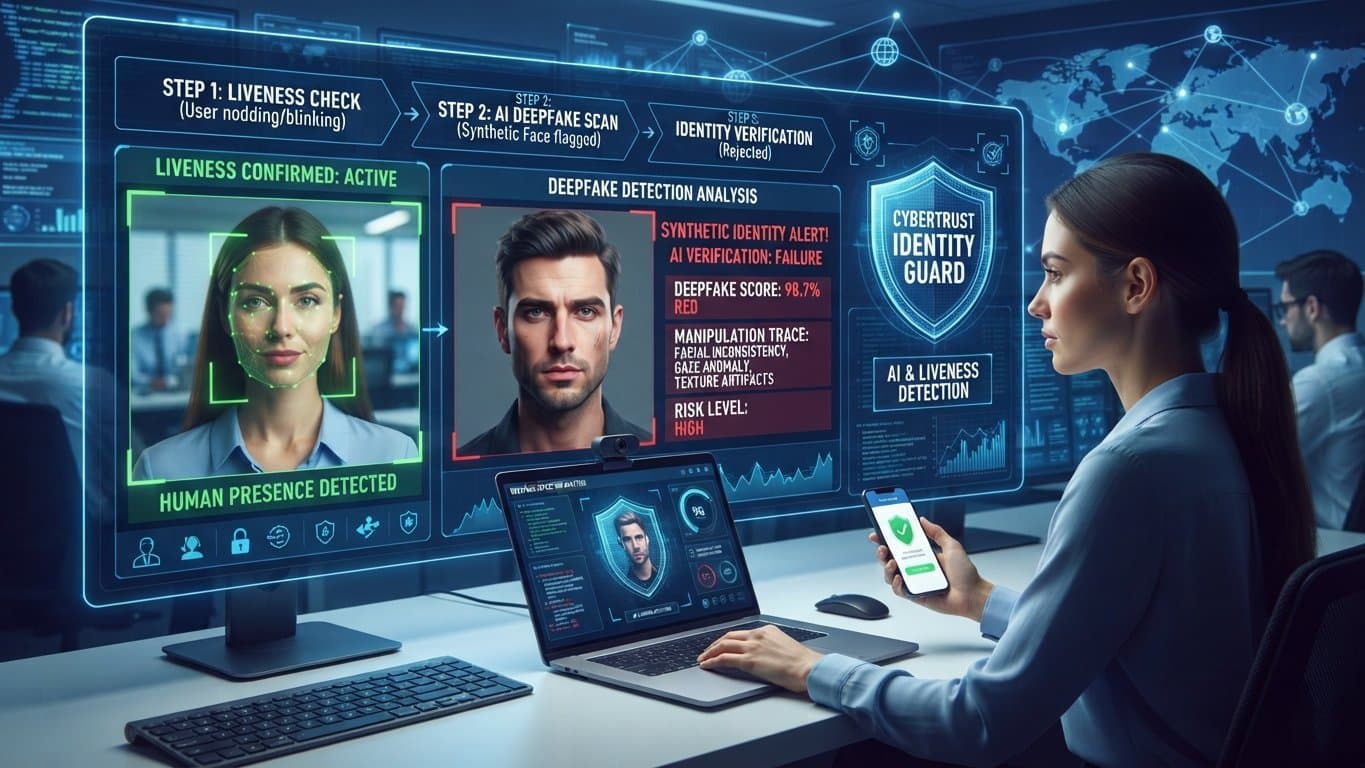
To address these threats, organizations are increasingly using multiple security technologies rather than depending on a single identity check. Deepfake detection and liveness detection can play complementary roles in this approach. Deepfake detection focuses on identifying manipulated or AI-generated media, while liveness detection helps determine whether a real person is physically present during the verification process.
What Are Synthetic Personas?
Synthetic personas are identities created using a mixture of real and fabricated information. An attacker may use legitimate personal details alongside artificial photographs, generated biometric information, or manipulated media.
Unlike traditional identity theft, synthetic identity fraud does not always involve impersonating one specific person. Instead, the fraudster can construct an identity that appears authentic when examined through individual verification checks.
AI has made this process more sophisticated. Generative tools can produce realistic facial images and videos that may be difficult to identify through basic visual inspection.
This creates a significant challenge for businesses that rely on remote identity verification.
Why AI Creates New Identity Security Challenges
Traditional identity verification methods were designed around information such as names, passwords, documents, and photographs. Many of these elements can be copied, stolen, or manipulated.
AI-generated content introduces another problem: digital evidence itself can be fabricated.
For example, a fraudulent applicant could potentially use a synthetic facial image during an online application. A manipulated video could also be used to create the appearance of a genuine person completing a verification process.
As synthetic media becomes more realistic, businesses need verification systems that can evaluate more than surface-level appearance.
How Deepfake Detection Supports Digital Identity
Deepfake detection uses AI and machine learning to analyze digital media for signs of manipulation or synthetic generation.
Depending on the technology, a detection system may examine facial characteristics, image texture, lighting, movement, frame consistency, and other technical signals.
In video-based verification, the system can analyze changes between frames to identify inconsistencies that may indicate artificial manipulation.
The goal is to provide an additional signal about whether the submitted media can be trusted.
Beyond Simple Face Swaps
Deepfakes are not limited to replacing one person's face with another. AI can modify individual facial characteristics, expressions, skin texture, voices, and other elements without creating an obvious face swap.
This means modern detection systems need to look for subtle inconsistencies.
A video may appear realistic when viewed normally but contain unusual patterns when analyzed frame by frame. Similarly, synthetic audio may sound natural while displaying technical characteristics associated with generated speech.
Deepfake detection can help analyze these hidden signals.
What Is Liveness Detection?
Liveness detection is another important component of biometric security.
Its primary purpose is to assess whether a real person is physically present during a verification interaction. Depending on the implementation, it may analyze facial movement, texture, depth, lighting, or other characteristics captured during the session.
This helps protect against certain presentation attacks where someone attempts to use a photograph, prerecorded video, or another artificial representation instead of completing the verification themselves.
Deepfake Detection and Liveness Detection Work Differently
Although these technologies are often discussed together, they address different security questions.
Deepfake detection asks:
Is the submitted image or video potentially manipulated or generated by AI?
Liveness detection asks:
Does the biometric interaction appear to come from a real, physically present person?
Using both technologies can provide broader coverage.
For example, facial recognition can assess whether the user's face matches a trusted identity reference. Liveness detection can assess physical presence, while deepfake detection can analyze the media for potential synthetic manipulation.
Creating a Layered Identity Verification Process
A strong digital identity system can combine multiple technologies in a single workflow.
A verification process may begin with identity document validation. The system can then capture the user's facial image or video and compare it with the photograph on the document.
After that, liveness detection can assess whether the user appears to be physically present. Deepfake detection can provide additional analysis of the captured media.
Other risk signals can then contribute to the final decision.
This layered approach makes it more difficult for attackers to exploit weaknesses in one individual component.
Supporting Digital Onboarding
Remote onboarding is one of the most important applications for these technologies.
Customers can complete identity verification through a smartphone or computer without visiting a physical location. However, businesses must still establish reasonable confidence that the person applying is genuine.
A workflow combining document checks, facial recognition, liveness detection, and deepfake analysis can provide several independent signals.
Routine applications can potentially be processed automatically, while suspicious cases can be escalated for additional verification or manual review.
Protecting Against AI-Powered Impersonation
AI-powered impersonation can involve more than synthetic faces. Attackers may combine manipulated images, generated voices, stolen documents, and other information.
A layered identity security system can examine different aspects of the interaction instead of relying entirely on one biometric match.
For example, if facial characteristics match a reference image but other signals indicate potential manipulation, the organization can request additional verification.
This risk-based approach can help prevent a single convincing piece of synthetic media from determining the entire identity decision.
The Importance of Facial Recognition
Facial recognition can remain an important part of this process because it helps establish whether a user's facial characteristics correspond with a trusted reference.
However, facial recognition should not be confused with liveness detection or deepfake detection.
Facial recognition focuses primarily on identity similarity. Liveness detection focuses on physical presence, while deepfake detection focuses on media authenticity.
These distinct functions can complement each other within a broader identity verification architecture.
Using Risk-Based Authentication
Not every verification attempt requires the same level of scrutiny.
A routine account registration may present a different level of risk from a high-value transaction, account recovery request, or unusual login.
Organizations can use risk-based authentication to determine when additional checks are necessary.
Signals from facial recognition, liveness detection, deepfake analysis, device information, and behavioral patterns can contribute to an overall risk assessment.
Higher-risk interactions can trigger stronger verification requirements without necessarily adding unnecessary friction to every user.
Challenges in Deepfake Detection
Deepfake detection is not a perfect solution. Generative AI continues to evolve, and new techniques can make synthetic media increasingly difficult to distinguish from authentic content.
Detection performance can also be affected by video compression, poor lighting, camera quality, background conditions, and other environmental factors.
False positives and false negatives are therefore important considerations.
Organizations should regularly test their detection systems and evaluate performance against current and emerging forms of synthetic media.
Challenges in Liveness Detection
Liveness detection also requires careful implementation.
A system must distinguish between legitimate users and presentation attacks while operating across different devices and environmental conditions.
Camera quality, lighting, network conditions, and user behavior can influence the verification experience.
Businesses should therefore evaluate both security performance and usability. A system that is highly restrictive may create unnecessary friction for legitimate customers, while a system that is too permissive may provide insufficient protection.
Protecting Biometric Information
Deepfake detection and liveness detection can operate within workflows involving sensitive identity and biometric information.
Organizations should consider privacy throughout the entire verification lifecycle. This includes determining what information needs to be collected, how it is processed, where it is stored, who can access it, and when it should be deleted.
Strong security controls and data minimization can help reduce unnecessary exposure.
Privacy should be treated as part of the identity security strategy rather than as an afterthought.
Continuous Monitoring and Model Improvement
AI-powered identity threats are constantly changing. A detection model that performs well against one type of manipulation may require additional testing when new generation techniques appear.
Organizations should monitor system performance and regularly evaluate detection capabilities.
Testing can include different types of synthetic media, presentation attacks, devices, lighting conditions, and real-world verification scenarios.
Continuous improvement helps organizations keep their identity systems better prepared for changing threats.
The Future of Synthetic Identity Protection
The future of digital identity security is likely to involve increasingly integrated technologies.
Deepfake detection, liveness detection, facial recognition, document analysis, behavioral intelligence, and device signals can work together to create a more comprehensive assessment.
AI systems may increasingly analyze these signals in real time and determine whether additional verification is necessary.
The focus is shifting from simply asking whether an identity document is valid or whether a face matches a photograph. Organizations increasingly need to establish whether the identity, biometric information, user, and digital interaction are all consistent with a legitimate person.
Conclusion
Synthetic personas represent a growing challenge for digital identity verification because AI can make fabricated identities and manipulated media appear increasingly realistic.
Deepfake detection helps identify potential AI-generated or manipulated media, while liveness detection helps determine whether a genuine person is physically present during the verification process. Facial recognition can add another layer by comparing the user's facial characteristics with a trusted identity reference.
When these technologies are combined with document verification, device intelligence, behavioral analysis, and risk-based authentication, organizations can build a stronger and more flexible identity security framework.
As generative AI continues to evolve, businesses will need identity verification systems that do more than recognize faces. They will need layered technologies capable of assessing the authenticity of digital media, the presence of the user, and the consistency of the overall identity interaction.