
Spotfund logo
Spotfund logo
Start Fundraising
PricingContact SupportStart Fundraising

Fundraise for

  • Medical Fundraising
  • Emergency Fundraising
  • Memorial Fundraising
  • Education Fundraising
  • Nonprofit Fundraising
  • Animal Fundraising
  • Community Fundraising

Featured topics

  • Easy Fundraising Ideas for Individuals
  • Creative Fundraiser Dinner Ideas
  • Raising Money for Medical Expenses
  • *spotfund for NIL Collective Fundraising
  • Giving Tuesday Fundraising 2025NEW

Trending in

  • Medical
  • Memorial
  • Emergency
  • Nonprofit
  • Family
  • Sports
  • Business

Featured topics

  • *spotfund as a Recurring Donation Solution
  • Matching Gift CampaignsPOPULAR
  • Why Recurring Donations Are Important for Nonprofits
  • How it works
  • Common questions
  • Success stories
  • For brands and nonprofits
  • How do I withdraw money?
  • *spotfund blog
  • Reviews from people like you
  • Compare *spotfund to others

Fund The Future Of Ergonomic Desks

Fund The Future Of Ergonomic Desks

Fundraising for

Emille Cop

Fundraising forEmille Cop
Emille Cop

Emille Cop

Livermore, California

$0of $100 goal
0
Donors
0
Comments
0Share Arrow
Shares
Donation protected
👍 0% fee

The Complete Guide to Riser Desks in 2026

If you've spent the last few years sitting through eight-hour workdays, you've probably heard someone mention a "riser desk." Maybe a coworker propped their laptop up on one, or you saw an ad promising better posture and less back pain. But what actually is a riser desk, and is it worth adding to your setup?

This guide breaks down everything you need to know — what riser desks are, how they compare to full standing desks, what the research says about their benefits, and how to choose the right one for your space and budget.

What Is a Riser Desk?

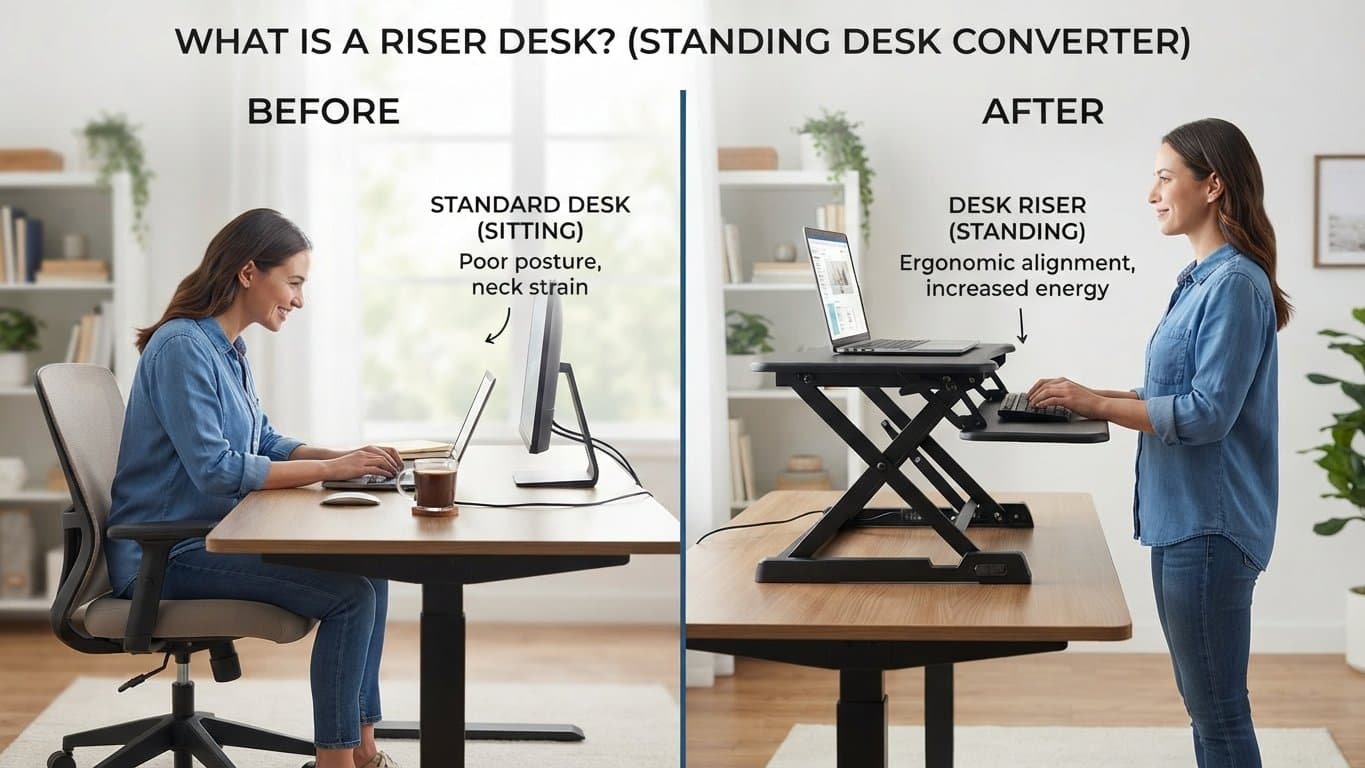
A riser desk — sometimes called a desk converter — is a platform that sits on top of your existing desk and lifts your keyboard, mouse, and monitor to standing height. Instead of replacing your whole desk, you simply place the riser on top, adjust it upward when you want to stand, and lower it back down when you want to sit.

For a full breakdown of how they work and what to look for, the site's core guide, What Is a Riser Desk?, covers the mechanics and design variations in detail.

Riser Desk vs. Standing Desk: What's the Difference?

This is one of the most common questions people have before buying. In short:

  • A riser desk sits on top of your current desk and only raises your work surface — it's cheaper, more portable, and doesn't require replacing furniture.

  • A standing desk replaces the entire desk with a height-adjustable surface — offering more stability and a larger work area, at a higher price point.

If you're weighing the two, the dedicated Riser Desk vs. Standing Desk comparison walks through cost, stability, and ergonomics side by side. For an even deeper dive into full standing desks, the What Is a Standing Desk? guide is a good next stop.

Why People Are Switching to Riser Desks

The appeal of a riser desk comes down to a few practical advantages:

  • Lower cost. You get many of the ergonomic benefits of a standing desk without replacing your entire workstation.

  • No installation hassle. Most riser desks require no tools and can be set up in minutes.

  • Portability. Many models can be moved between rooms or even taken to the office.

  • Health benefits. Alternating between sitting and standing throughout the day has been linked to reduced back pain and improved energy levels.

For the full breakdown of the research behind these claims, the Health Benefits guide covers what's been studied and what it means in practice. And if you're still deciding whether the investment makes sense for you, Are Riser Desks Worth It? tackles that question directly.

How Much Do Riser Desks Cost?

Prices vary widely depending on size, build quality, and features:

  • Budget models ($50–$150): Basic single-tier platforms, usually manual lift.

  • Mid-range models ($150–$300): Tiered designs with separate keyboard and monitor levels, better stability, and higher weight capacity.

  • Premium models ($300–$500+): Electric lift mechanisms, dual-monitor support, and reinforced frames.

For most users, the $150–$300 range hits the sweet spot between stability and value.

Choosing the Right Riser Desk for Your Setup

Not every riser desk fits every workspace. A few things worth thinking through:

For Gaming

If you're setting up a battle station rather than a work desk, stability and desk space for peripherals matter more than portability. The Best Standing Desk for Gaming guide covers picks suited to that use case.

For Programmers

Long coding sessions call for solid dual-monitor support and a setup that won't wobble during heavy typing. See Best Desk for Programmers for recommendations built around that workflow.

For Students

Budget and desk footprint tend to matter most for dorm rooms and shared spaces. The Best Desk for Students guide focuses on compact, affordable options.

On a Budget

If you're trying to stay under a firm price ceiling, Best Standing Desk Under $200 rounds up the strongest options that won't break the bank.

Portable Needs

If you split time between a home office and a workplace desk, the Best Portable Riser Desk guide highlights lightweight, easy-to-move models.

For the current top overall picks across price points, Best Riser Desks 2026 rounds up tested and reviewed options.

Setting Up Your Riser Desk Correctly

Buying the right desk is only half the equation — proper setup matters just as much for comfort and injury prevention:

  • Elbow angle: Your elbows should sit at roughly 90 degrees when typing.

  • Monitor height: The top of your screen should sit at or just below eye level.

  • Standing intervals: Most guidance suggests standing for 2–4 hours across an 8-hour workday, broken into shorter intervals rather than one long stretch.

  • Anti-fatigue mat: Standing on a hard floor for extended periods increases fatigue — a good mat makes a noticeable difference.

The Monitor Height Guide and Chair Height Guide both go deeper into dialing in these details for your specific setup, and if back discomfort is what brought you here in the first place, Back Pain & Standing Desks is worth reading directly.

Riser Desk, Electric vs. Manual, and Other Comparisons

Beyond the riser-vs-standing question, a few other comparisons come up often when people are deciding what to buy:

  • Electric vs. Manual — whether a motorized lift is worth the extra cost.

  • Converter vs. Adjustable Desk — budget constraints versus a dedicated height-adjustable workstation.

  • Standing vs. Treadmill Desk — for anyone considering adding movement, not just standing, to their workday.

Building a Full Ergonomic Workspace

A riser desk is often just the first piece of a healthier setup. Once your desk height is sorted, it's worth looking at the rest of your workstation — chair height, monitor positioning, and general layout all affect how sustainable a standing routine actually is. The What Is an Ergonomic Desk? and Ergonomic Desks guides are good starting points, and the broader Workstation Guides and Home Office Setup sections cover the rest of the room around your desk.

Final Thoughts

A riser desk is one of the lowest-effort, lowest-cost ways to introduce more movement into a desk-bound workday. It won't replace the stability of a full standing desk, but for most people, it's a practical middle ground — especially if you're not ready to commit to replacing your entire workstation.

If you're still narrowing down your options, start with What Is a Riser Desk? for the fundamentals, then move on to Best Riser Desks 2026 once you're ready to compare specific models.


Smiley Face

Be the first to donate and pin
your name here   📌

Organizer

Emille Cop

Emille Cop is the organizer of this fundraiser

Fund The Future Of Ergonomic Desks
Emille Cop

Emille Cop

Livermore, California

Fundraising for

Emille Cop

Fundraising forEmille Cop
Donation protected
👍 0% fee

The Complete Guide to Riser Desks in 2026

If you've spent the last few years sitting through eight-hour workdays, you've probably heard someone mention a "riser desk." Maybe a coworker propped their laptop up on one, or you saw an ad promising better posture and less back pain. But what actually is a riser desk, and is it worth adding to your setup?

This guide breaks down everything you need to know — what riser desks are, how they compare to full standing desks, what the research says about their benefits, and how to choose the right one for your space and budget.

What Is a Riser Desk?

A riser desk — sometimes called a desk converter — is a platform that sits on top of your existing desk and lifts your keyboard, mouse, and monitor to standing height. Instead of replacing your whole desk, you simply place the riser on top, adjust it upward when you want to stand, and lower it back down when you want to sit.

For a full breakdown of how they work and what to look for, the site's core guide, What Is a Riser Desk?, covers the mechanics and design variations in detail.

Riser Desk vs. Standing Desk: What's the Difference?

This is one of the most common questions people have before buying. In short:

  • A riser desk sits on top of your current desk and only raises your work surface — it's cheaper, more portable, and doesn't require replacing furniture.

  • A standing desk replaces the entire desk with a height-adjustable surface — offering more stability and a larger work area, at a higher price point.

If you're weighing the two, the dedicated Riser Desk vs. Standing Desk comparison walks through cost, stability, and ergonomics side by side. For an even deeper dive into full standing desks, the What Is a Standing Desk? guide is a good next stop.

Why People Are Switching to Riser Desks

The appeal of a riser desk comes down to a few practical advantages:

  • Lower cost. You get many of the ergonomic benefits of a standing desk without replacing your entire workstation.

  • No installation hassle. Most riser desks require no tools and can be set up in minutes.

  • Portability. Many models can be moved between rooms or even taken to the office.

  • Health benefits. Alternating between sitting and standing throughout the day has been linked to reduced back pain and improved energy levels.

For the full breakdown of the research behind these claims, the Health Benefits guide covers what's been studied and what it means in practice. And if you're still deciding whether the investment makes sense for you, Are Riser Desks Worth It? tackles that question directly.

How Much Do Riser Desks Cost?

Prices vary widely depending on size, build quality, and features:

  • Budget models ($50–$150): Basic single-tier platforms, usually manual lift.

  • Mid-range models ($150–$300): Tiered designs with separate keyboard and monitor levels, better stability, and higher weight capacity.

  • Premium models ($300–$500+): Electric lift mechanisms, dual-monitor support, and reinforced frames.

For most users, the $150–$300 range hits the sweet spot between stability and value.

Choosing the Right Riser Desk for Your Setup

Not every riser desk fits every workspace. A few things worth thinking through:

For Gaming

If you're setting up a battle station rather than a work desk, stability and desk space for peripherals matter more than portability. The Best Standing Desk for Gaming guide covers picks suited to that use case.

For Programmers

Long coding sessions call for solid dual-monitor support and a setup that won't wobble during heavy typing. See Best Desk for Programmers for recommendations built around that workflow.

For Students

Budget and desk footprint tend to matter most for dorm rooms and shared spaces. The Best Desk for Students guide focuses on compact, affordable options.

On a Budget

If you're trying to stay under a firm price ceiling, Best Standing Desk Under $200 rounds up the strongest options that won't break the bank.

Portable Needs

If you split time between a home office and a workplace desk, the Best Portable Riser Desk guide highlights lightweight, easy-to-move models.

For the current top overall picks across price points, Best Riser Desks 2026 rounds up tested and reviewed options.

Setting Up Your Riser Desk Correctly

Buying the right desk is only half the equation — proper setup matters just as much for comfort and injury prevention:

  • Elbow angle: Your elbows should sit at roughly 90 degrees when typing.

  • Monitor height: The top of your screen should sit at or just below eye level.

  • Standing intervals: Most guidance suggests standing for 2–4 hours across an 8-hour workday, broken into shorter intervals rather than one long stretch.

  • Anti-fatigue mat: Standing on a hard floor for extended periods increases fatigue — a good mat makes a noticeable difference.

The Monitor Height Guide and Chair Height Guide both go deeper into dialing in these details for your specific setup, and if back discomfort is what brought you here in the first place, Back Pain & Standing Desks is worth reading directly.

Riser Desk, Electric vs. Manual, and Other Comparisons

Beyond the riser-vs-standing question, a few other comparisons come up often when people are deciding what to buy:

  • Electric vs. Manual — whether a motorized lift is worth the extra cost.

  • Converter vs. Adjustable Desk — budget constraints versus a dedicated height-adjustable workstation.

  • Standing vs. Treadmill Desk — for anyone considering adding movement, not just standing, to their workday.

Building a Full Ergonomic Workspace

A riser desk is often just the first piece of a healthier setup. Once your desk height is sorted, it's worth looking at the rest of your workstation — chair height, monitor positioning, and general layout all affect how sustainable a standing routine actually is. The What Is an Ergonomic Desk? and Ergonomic Desks guides are good starting points, and the broader Workstation Guides and Home Office Setup sections cover the rest of the room around your desk.

Final Thoughts

A riser desk is one of the lowest-effort, lowest-cost ways to introduce more movement into a desk-bound workday. It won't replace the stability of a full standing desk, but for most people, it's a practical middle ground — especially if you're not ready to commit to replacing your entire workstation.

If you're still narrowing down your options, start with What Is a Riser Desk? for the fundamentals, then move on to Best Riser Desks 2026 once you're ready to compare specific models.

Organizer

Emille Cop

Emille Cop is the organizer of this fundraiser

$0of $100 goal
0Donors
0Comments
0Share ArrowShares
Smiley Face

Be the first to donate and pin
your name here   📌

★★★★★ Trustpilot Reviews

Ready to start?

Join the thousands like you finding help on *spotfund.

Start FundraisingHow it works
Spotfund Balloons