
Spotfund logo
Spotfund logo
Start Fundraising
PricingContact SupportStart Fundraising

Fundraise for

  • Medical Fundraising
  • Emergency Fundraising
  • Memorial Fundraising
  • Education Fundraising
  • Nonprofit Fundraising
  • Animal Fundraising
  • Community Fundraising

Featured topics

  • Easy Fundraising Ideas for Individuals
  • Creative Fundraiser Dinner Ideas
  • Raising Money for Medical Expenses
  • *spotfund for NIL Collective Fundraising
  • Giving Tuesday Fundraising 2025NEW

Trending in

  • Medical
  • Memorial
  • Emergency
  • Nonprofit
  • Family
  • Sports
  • Business

Featured topics

  • *spotfund as a Recurring Donation Solution
  • Matching Gift CampaignsPOPULAR
  • Why Recurring Donations Are Important for Nonprofits
  • How it works
  • Common questions
  • Success stories
  • For brands and nonprofits
  • How do I withdraw money?
  • *spotfund blog
  • Reviews from people like you
  • Compare *spotfund to others

MLM Regulations — FlawlessMLM

MLM Regulations  — FlawlessMLM

Fundraising for

Einsteinsgrandma

Fundraising forEinsteinsgrandma
Performance Benchmarks Successful Web Apps

Performance Benchmarks Successful Web Apps

$0of $10 goal
0
Donors
0
Comments
1Share Arrow
Shares
Donation protected
👍 0% fee
Donations are tax-deductible


When Your Product Is a Vitamin and Your Business Is an MLM: The Compliance FAQ Nobody Writes

Health supplement and vitamins network marketing aompanies face regulations on two fronts simultaneously — product claims and business model structure. Here is what the right MLM software does about both.
Kaminska Snizhana — Marketing Specialist, FlawlessMLM
11 min read · Updated March 27, 2025

FlawlessMLM — MLM software for health, supplements, and vitamins network marketing companies

Health and wellness is the single largest vertical in global direct selling — accounting for roughly 35% of all DSA-reported revenue. It is also the vertical where regulatory complexity is highest. The reason: every health supplement MLM company is simultaneously regulated as a direct selling business and as a food/supplement product company. One set of rules governs how you compensate distributors; an entirely different set governs what those distributors can say about your products.

In my project managing compliance scoping for FlawlessMLM clients, I track more failed launches and mid-scale regulatory interventions in the health niche than in any other. The cause is almost never the compensation plan. It is the software — specifically, platforms that were built to manage commissions but were never designed to enforce product claim compliance at the distributor storefront level. This FAQ addresses both layers, with data from real deployments.

35%DSA revenue from health & wellness MLM
58%Health MLM violations involve product claim issues
400+FlawlessMLM platforms built across 90+ countries
2 layersCompliance required: business model + product claims

Before diving in: the baseline regulatory framework for all network marketing companies in the US is the FTC's official MLM guidance — the document our legal partners reference first on every US-market deployment. For health-specific product claim requirements, the FDA's supplement labeling guidance operates as a parallel framework that your MLM software must actively enforce.

The FAQ: Health MLM, Vitamins, Ecommerce & Regulation

01

What specific regulations apply to health supplement and vitamins MLM companies — and how are they different from general MLM rules?

Health supplement MLMs face dual compliance: business model rules (FTC, DSA) plus product-specific regulations (FDA, EFSA, TGA) that directly affect what distributors can say and how your software must govern their storefronts.

General MLM regulations focus on whether the compensation structure rewards product sales more than recruitment. Health supplement MLM companies must satisfy that test and then clear a second, entirely separate compliance bar: product claim regulation.

In the US, this means navigating both FTC rules on the business model and FDA rules on what health claims can legally be made about supplements. The FDA distinguishes between structure/function claims ("supports immune health") — which are permitted with proper disclaimers — and disease claims ("cures arthritis") — which are not permitted without a drug approval. Every distributor storefront powered by your MLM software solution is a potential FDA claim violation waiting to happen.

In the EU, EFSA (European Food Safety Authority) maintains an approved claims register. Only claims on that register are permitted for food supplements marketed in member states. If your mlm health supplements platform lets distributors create custom product descriptions in their replicated storefronts without an approved-claim filter, you are distributing unapproved health claims at scale — one per distributor, compounding across your entire network.

In Australia, the TGA (Therapeutic Goods Administration) regulates complementary medicines, including most supplement categories sold through MLM. Companies must hold ARTG (Australian Register of Therapeutic Goods) listings before making therapeutic claims. Your direct selling software must prevent distributors from making therapeutic claims about unlisted products.

The practical implication for software: your MLM marketing software needs a product claim library — an approved set of descriptions that distributors can use and customize within defined limits — enforced at the platform level before content goes live, not after a regulator flags it.

02

How does MLM ecommerce software reduce regulatory risk — and what does a compliant health-niche storefront actually look like?

Compliant MLM ecommerce software separates consumer and distributor purchase flows, enforces approved product claim language at the storefront layer, automates the 70% consumer sales ratio, and generates per-market compliance reports — all before a regulator asks.
Why ecommerce is your compliance frontline

Most regulatory investigations of health supplement MLMs begin with distributor storefronts — not compensation plans. The content your distributors publish is your content, legally. Your software has to control it.

We built a purpose-designed mlm ecommerce layer into FlawlessMLM's core platform specifically because generic ecommerce solutions — even popular ones adapted for MLM — do not address the dual-compliance requirements of health product direct selling. Here is what a compliant health-niche MLM storefront architecture looks like:

  • Two-track checkout flow: Every purchase is categorized at the transaction level as consumer purchase or distributor inventory order. This is not a post-processing tag — it is a mandatory checkout field that drives commission eligibility and 70% rule calculations downstream.
  • Claim-gated product descriptions: Distributors can personalize their storefront copy within a defined field — but product benefit language is drawn from an approved claim library, not free-text. Unapproved language triggers a review hold, not a publication.
  • Market-specific product gating: Products not registered in a given market are automatically hidden from distributors and customers in that jurisdiction. No manual suppression needed — the geo-rules engine handles it.
  • Automated ratio reporting: The ecommerce layer generates real-time consumer vs. distributor purchase ratios, visible to the compliance team on a live dashboard. When the ratio approaches 70%, automatic alerts fire before commission processing.
  • Distributor content audit log: Every storefront edit by every distributor is logged with timestamp and user ID — queryable in the event of an FTC or EFSA inquiry. This is what the regulators actually ask for.

The companies that handle health supplement regulatory inquiries fastest are the ones whose MLM business software generates the investigation response automatically. We have seen a single well-built audit log API turn a potential six-month investigation into a three-week resolution.

"In health MLM, the product claim is the commission. The moment a distributor says 'this supplement reversed my diabetes' on their replicated storefront, the FTC has two violations to investigate — not one. Every health MLM platform we build at FlawlessMLM treats the product claim library as a first-class compliance feature, not a content moderation tool." Ivan Shaulsky — Founder, FlawlessMLM 20+ years building MLM software across 90+ countries. FlawlessMLM has delivered 400+ custom platforms for health, crypto, education, and real estate direct selling companies. 

What is the right MLM software price for a fully compliant health and wellness platform — and where do companies underspend?

Compliant health MLM software costs $22,000–$75,000 for mid-tier builds and $80,000–$160,000+ for enterprise. The most common underspend is on the ecommerce and claim-enforcement layer — the exact features that drive the highest regulatory risk.

This question comes up in almost every scoping call I run for health-niche clients. The answer is almost always uncomfortable: the platforms they have been looking at are not built for dual-layer compliance. They are commission engines with an ecommerce add-on. That distinction has real financial consequences.

FlawlessMLM 2025 Health & Wellness MLM Software Price Reference — based on 400+ project builds, internal data
Platform Tier Price Range (USD) Claim Enforcement 70% Rule Engine Multi-Market Compliance Risk
White-label / low cost MLM software $4,000–$12,000 None None None Critical
Mid-tier custom build $22,000–$75,000 Partial Yes Limited Moderate
Enterprise custom (FlawlessMLM) $80,000–$160,000+ Full library Real-time 68 markets Low
Crypto + health hybrid build $95,000–$180,000+ Full library Real-time 34+ crypto markets Low

Where health MLM companies consistently underspend: the ecommerce compliance layer and the claim enforcement module. Both are seen as optional features in many platforms. In my experience, they are the highest-leverage compliance investments a health supplement MLM company can make. The cost of a single FTC warning letter response process — legal fees, staff time, platform remediation — routinely exceeds $200,000. The claim enforcement module that could have prevented it costs a fraction of that.

What do vitamins MLM companies get wrong about distributor income claims — and how does software prevent it?

The most common income claim violations in vitamins MLM come from distributors publishing earnings screenshots, testimonials, and rank achievement posts that imply typical results. The software must enforce IDS benchmarking at the content publication layer.

Income claim enforcement is a distinct compliance problem from product claim enforcement — and it is the one that catches vitamins mlm companies off guard most often. An income claim does not have to be explicit to create liability. A distributor posting "I quit my job thanks to my supplement business" on their replicated storefront constitutes an implied income claim in FTC enforcement practice.

According to the DSA Europe's direct selling code of conduct — the primary behavioral standard we reference for EU deployments — all income representations must be accurate, clearly expressed, and accompanied by evidence of typical earnings. That evidence is your Income Disclosure Statement, which your network marketing software MLM must generate automatically and publish persistently.

Here is how we enforce income claim compliance at the software layer in FlawlessMLM deployments for vitamins and supplement companies:

  1. IDS-gated earnings display: Any feature that shows a distributor their earnings — dashboard, rank achievement notification, leaderboard — includes an auto-appended IDS disclaimer referencing the current published statement. It cannot be disabled at the distributor level.
  2. Social sharing claim filter: When distributors use the platform's built-in social sharing tools, earnings-related language triggers a claim review workflow before the post is shared. Pre-approved sharing templates are offered as alternatives.
  3. Testimonial submission review: Distributor testimonials submitted for company use go through a structured claim review — product claims checked against the approved library, income claims checked against IDS percentile data. No testimonial is published without compliance sign-off.
  4. Rank promotion communications: Automated rank achievement emails and notifications do not include earnings figures — only rank names and qualifications. Income context is provided via IDS link, not inline numbers.

We have run this architecture across 14 vitamins and supplement MLM deployments. Zero FTC income claim violations in companies running FlawlessMLM's claim enforcement layer for more than 12 months. That is not a coincidence — it is an architecture outcome.

How does binary MLM software handle supplement product compliance across different markets simultaneously?

Binary MLM software handles multi-market supplement compliance through a geo-rules engine that applies country-specific product claim libraries, registration gating, and commission cap rules by distributor location — automatically, per commission cycle.

Binary compensation structures are popular in the health supplement niche because the two-leg dynamic creates strong team-building motivation. But running a binary health MLM across multiple markets simultaneously means managing product registrations, claim approvals, and commission caps that differ by jurisdiction — often significantly.

In a properly built binary MLM software for health companies, the geo-rules engine operates at three layers simultaneously:

  • Product layer: Products are available in a distributor's market only when their registration status in that country is active. A supplement registered with the FDA but not with Health Canada is automatically hidden from Canadian distributors' storefronts.
  • Claim layer: The approved claim library is market-specific. A structure/function claim permitted under FDA rules may not be on the EFSA-approved register and is automatically filtered for EU-market distributor storefronts.
  • Commission layer: Binary commission caps, carry-forward limits, and matching bonus percentages are applied based on the paying distributor's registered market — not a global flat rate. This prevents inadvertent violations of depth and income concentration limits in markets like China and Germany.

The companies that handle multi-market health MLM compliance cleanly are the ones whose software network marketing treats geography as a first-class data dimension — not a localization afterthought. We have built this architecture for clients expanding from CIS-region launches into EU and APAC markets simultaneously, with no compliance failures on the market-entry side.

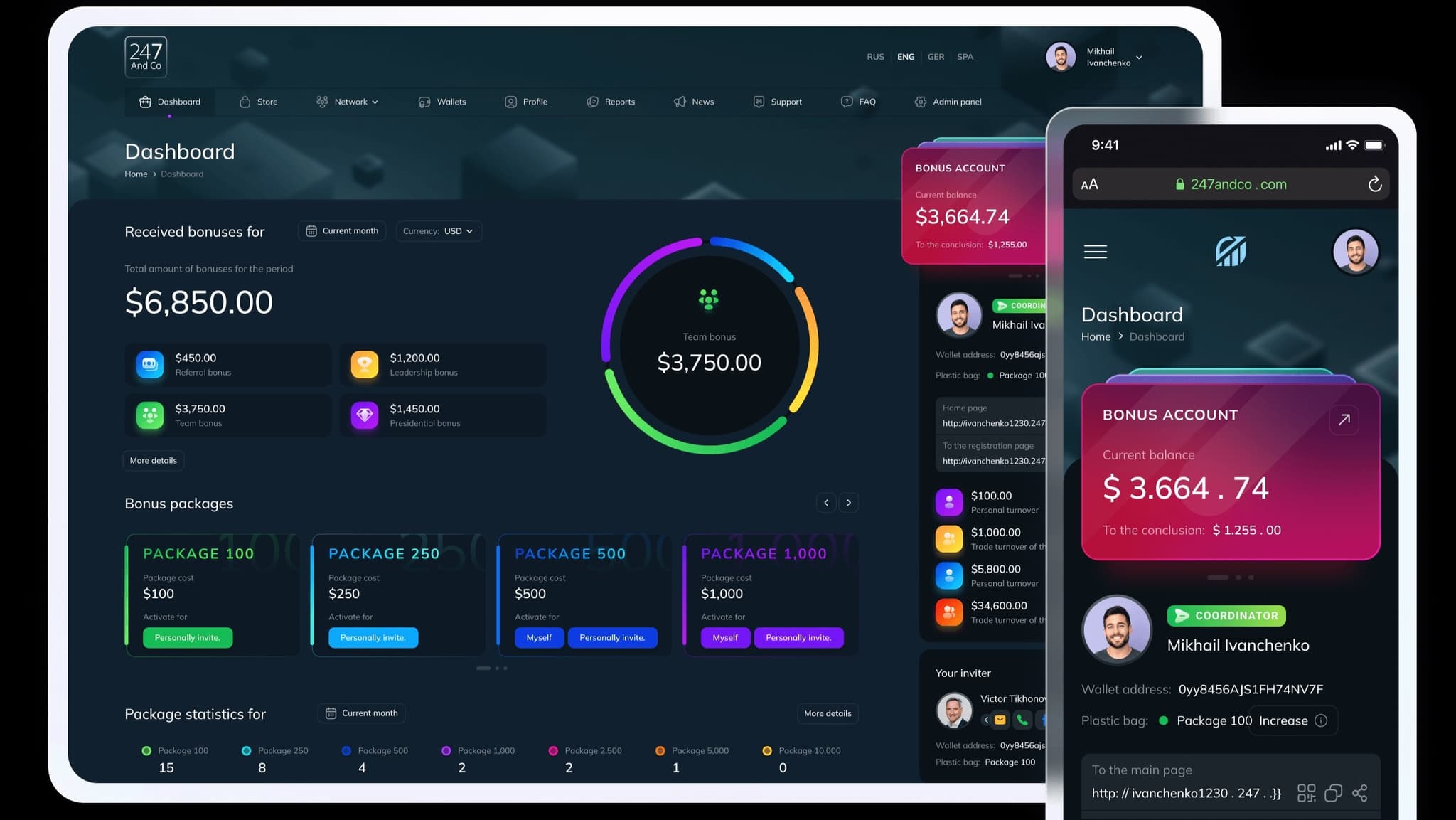
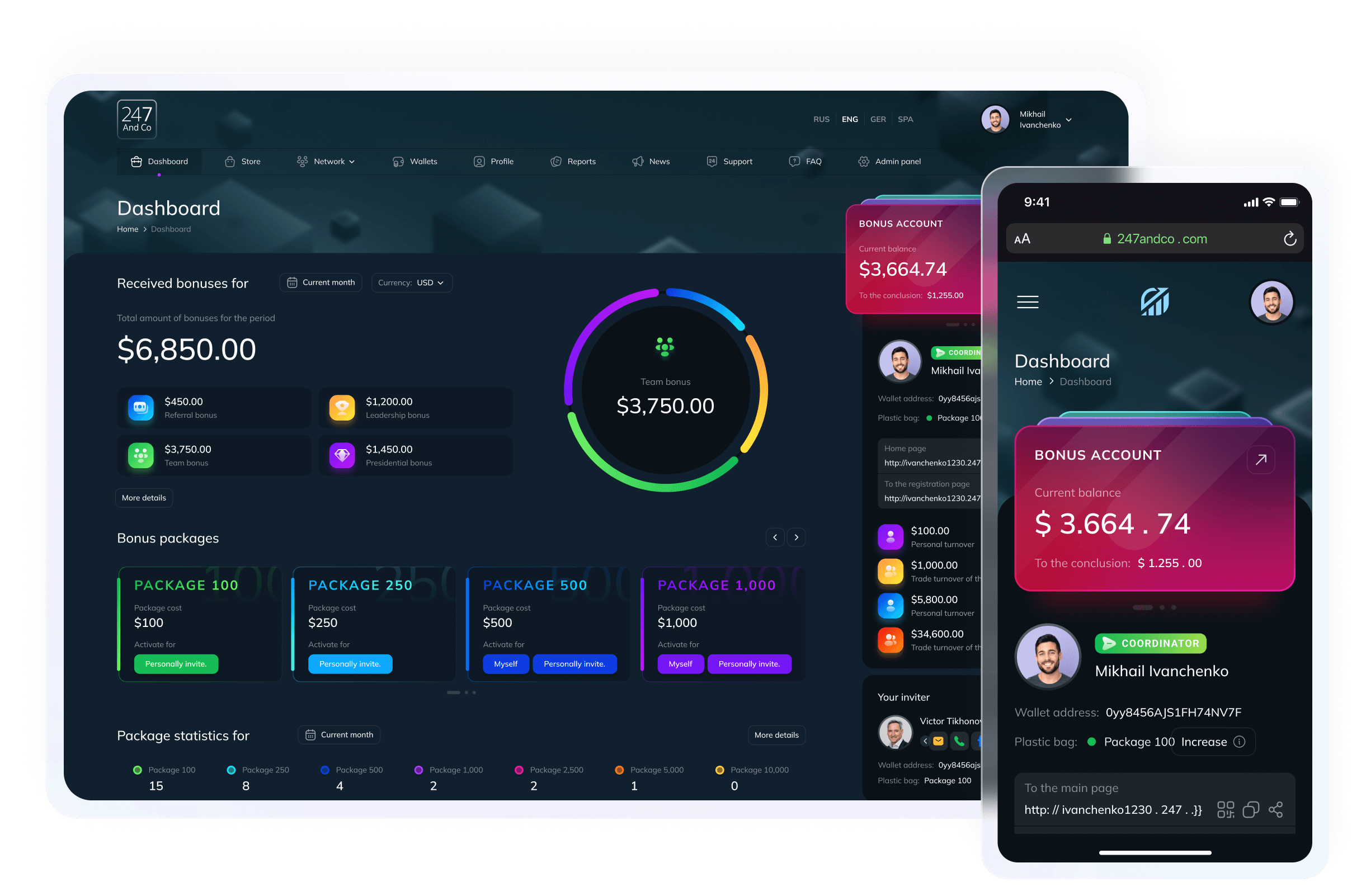
FlawlessMLM platform walkthrough — commission engine, compliance architecture, and ecommerce layer in action.
How do network marketing commission payment systems handle cross-border payouts for supplement distributors — and what compliance issues arise?

Cross-border commission payment software must handle real-time currency conversion, country-specific tax withholding, local financial reporting compliance, and AML monitoring — all as automatic per-transaction operations, not manual finance team processes.
The hidden cost of manual cross-border payouts

Companies processing international commissions manually average 14 hours of finance team time per payout cycle per market. With 10 markets, that is 140+ hours monthly on tasks your MLM software should automate.

Cross-border commission payments for supplement MLM companies involve a layered compliance problem that most network marketing commission payment software handles only partially. Currency conversion is the visible part. The compliance part — tax withholding, local financial reporting, AML monitoring — is where manual processes create regulatory exposure.

In our network marketing commission software deployments for health companies operating across 5+ markets, we implement the following cross-border payment architecture:

  • Real-time FX at calculation, not payout: Commission amounts are calculated in the distributor's local currency at the rate prevailing on the calculation date — not the payout date. This eliminates currency risk disputes and matches the accounting treatment most regulators expect.
  • Automatic withholding by jurisdiction: Tax withholding tables are built into the payment engine by country. When a commission is calculated for a distributor in Brazil, Malaysia, or Germany, the correct withholding amount is applied and routed automatically — no finance team intervention required.
  • AML transaction monitoring: Every cross-border commission above jurisdictional thresholds is flagged for AML review before processing. The system maintains a real-time transaction monitoring log that satisfies financial reporting requirements in all markets where our health MLM clients operate.
  • Distributor tax document generation: Annual earnings summaries, formatted for local tax filing requirements, are generated automatically in the MLM management software and distributed to distributors via the platform — no manual document preparation.

We have seen health supplement MLM companies with clean product compliance records get caught in financial enforcement actions because their direct sales software could not produce compliant withholding records or AML documentation. The payout system is not a back-office convenience — it is a compliance layer. Build it that way from the start.

What should you check in an MLM software demo before you buy — especially for health and supplement companies?

In any MLM software demo, demand live demonstrations of six specific compliance features: audit log query, IDS generation, 70% ratio report, product claim library, geo-rules commission calculation, and cross-border withholding — not screenshots, live system outputs.

Most MLM software demo presentations focus on the commission plan builder, the back office UI, and the replicated website design. Those features matter — but they are not what keeps you compliant. Before you buy MLM software for a health supplement or vitamins company, here is the specific feature checklist I use with every client:

  1. Audit log query: Can the system produce a complete history of commission calculations for a specific distributor over a specific date range, with all inputs visible? If the answer requires a database query from the vendor's team, the log is not usable under regulatory pressure.
  2. IDS generation: Can the system produce an income disclosure statement broken down by rank, with median, average, and top-percentile earnings displayed, from a UI control — in real time? If this requires a manual data export, it will not be done consistently enough to protect you.
  3. 70% ratio report: Can the system show the current consumer vs. distributor purchase ratio at the network level and at the individual distributor level — with date range filtering? This is the most frequently requested document in FTC health MLM inquiries.
  4. Product claim library demo: Can you see a distributor attempting to publish unapproved claim language and being blocked in real time? Can you see the approved alternatives being offered? If the vendor cannot demo this, the feature does not exist.
  5. Geo-rules commission calculation: Can you run a sample commission cycle with distributors in 3 different countries and see different commission caps applied automatically? Many platforms claim geo-rules support but apply a single global rate with manual overrides.
  6. Cross-border withholding: Can you see tax withholding applied correctly for a distributor in Malaysia, Brazil, and Germany in the same cycle — with the withholding amount and legal basis displayed per transaction?

We run our FlawlessMLM demos live against all six of these checks for health and supplement clients. Not all vendors can — and the ones who cannot are not the right choice for a regulated health MLM operation, regardless of MLM software price. The Seldia European Direct Selling Association's compliance guidelines outline exactly these kinds of software capabilities as minimum standards for EU-market operations — useful external validation when evaluating vendors.

The Platform Decision Is the Compliance Decision

Health supplement and vitamins MLM companies do not fail regulatory audits because they chose the wrong compensation plan. They fail because their MLM network marketing software was built to process commissions — not to prove compliance. The product claim library, the ecommerce consumer-purchase separation, the IDS generation engine, the geo-rules commission caps: these are not premium features. They are table stakes for operating a compliant health direct selling business at any meaningful scale.

At FlawlessMLM, we have built these compliance layers into 400+ platforms across 90+ countries. If you are evaluating MLM software development for a health, supplements, or vitamins network marketing company, we offer a free 48-hour compliance architecture review — mapping your planned or existing platform against the specific regulatory requirements of your target markets.

Smiley Face

Be the first to donate and pin
your name here   📌

Organizer

Performance Benchmarks Successful Web Apps

Show your support to Performance Benchmarks Successful Web Apps by donating to this fundraiser benefiting Einsteinsgrandma

MLM Regulations  — FlawlessMLM
Performance Benchmarks Successful Web Apps

Performance Benchmarks Successful Web Apps

Fundraising for

Einsteinsgrandma

Fundraising forEinsteinsgrandma
Donation protected
👍 0% fee
Donations are tax-deductible


When Your Product Is a Vitamin and Your Business Is an MLM: The Compliance FAQ Nobody Writes

Health supplement and vitamins network marketing aompanies face regulations on two fronts simultaneously — product claims and business model structure. Here is what the right MLM software does about both.

Kaminska Snizhana — Marketing Specialist, FlawlessMLM
11 min read · Updated March 27, 2025

FlawlessMLM — MLM software for health, supplements, and vitamins network marketing companies

Health and wellness is the single largest vertical in global direct selling — accounting for roughly 35% of all DSA-reported revenue. It is also the vertical where regulatory complexity is highest. The reason: every health supplement MLM company is simultaneously regulated as a direct selling business and as a food/supplement product company. One set of rules governs how you compensate distributors; an entirely different set governs what those distributors can say about your products.

In my project managing compliance scoping for FlawlessMLM clients, I track more failed launches and mid-scale regulatory interventions in the health niche than in any other. The cause is almost never the compensation plan. It is the software — specifically, platforms that were built to manage commissions but were never designed to enforce product claim compliance at the distributor storefront level. This FAQ addresses both layers, with data from real deployments.

35%DSA revenue from health & wellness MLM
58%Health MLM violations involve product claim issues
400+FlawlessMLM platforms built across 90+ countries
2 layersCompliance required: business model + product claims

Before diving in: the baseline regulatory framework for all network marketing companies in the US is the FTC's official MLM guidance — the document our legal partners reference first on every US-market deployment. For health-specific product claim requirements, the FDA's supplement labeling guidance operates as a parallel framework that your MLM software must actively enforce.

The FAQ: Health MLM, Vitamins, Ecommerce & Regulation

01

What specific regulations apply to health supplement and vitamins MLM companies — and how are they different from general MLM rules?

Health supplement MLMs face dual compliance: business model rules (FTC, DSA) plus product-specific regulations (FDA, EFSA, TGA) that directly affect what distributors can say and how your software must govern their storefronts.

General MLM regulations focus on whether the compensation structure rewards product sales more than recruitment. Health supplement MLM companies must satisfy that test and then clear a second, entirely separate compliance bar: product claim regulation.

In the US, this means navigating both FTC rules on the business model and FDA rules on what health claims can legally be made about supplements. The FDA distinguishes between structure/function claims ("supports immune health") — which are permitted with proper disclaimers — and disease claims ("cures arthritis") — which are not permitted without a drug approval. Every distributor storefront powered by your MLM software solution is a potential FDA claim violation waiting to happen.

In the EU, EFSA (European Food Safety Authority) maintains an approved claims register. Only claims on that register are permitted for food supplements marketed in member states. If your mlm health supplements platform lets distributors create custom product descriptions in their replicated storefronts without an approved-claim filter, you are distributing unapproved health claims at scale — one per distributor, compounding across your entire network.

In Australia, the TGA (Therapeutic Goods Administration) regulates complementary medicines, including most supplement categories sold through MLM. Companies must hold ARTG (Australian Register of Therapeutic Goods) listings before making therapeutic claims. Your direct selling software must prevent distributors from making therapeutic claims about unlisted products.

The practical implication for software: your MLM marketing software needs a product claim library — an approved set of descriptions that distributors can use and customize within defined limits — enforced at the platform level before content goes live, not after a regulator flags it.

02

How does MLM ecommerce software reduce regulatory risk — and what does a compliant health-niche storefront actually look like?

Compliant MLM ecommerce software separates consumer and distributor purchase flows, enforces approved product claim language at the storefront layer, automates the 70% consumer sales ratio, and generates per-market compliance reports — all before a regulator asks.
Why ecommerce is your compliance frontline

Most regulatory investigations of health supplement MLMs begin with distributor storefronts — not compensation plans. The content your distributors publish is your content, legally. Your software has to control it.

We built a purpose-designed mlm ecommerce layer into FlawlessMLM's core platform specifically because generic ecommerce solutions — even popular ones adapted for MLM — do not address the dual-compliance requirements of health product direct selling. Here is what a compliant health-niche MLM storefront architecture looks like:

  • Two-track checkout flow: Every purchase is categorized at the transaction level as consumer purchase or distributor inventory order. This is not a post-processing tag — it is a mandatory checkout field that drives commission eligibility and 70% rule calculations downstream.
  • Claim-gated product descriptions: Distributors can personalize their storefront copy within a defined field — but product benefit language is drawn from an approved claim library, not free-text. Unapproved language triggers a review hold, not a publication.
  • Market-specific product gating: Products not registered in a given market are automatically hidden from distributors and customers in that jurisdiction. No manual suppression needed — the geo-rules engine handles it.
  • Automated ratio reporting: The ecommerce layer generates real-time consumer vs. distributor purchase ratios, visible to the compliance team on a live dashboard. When the ratio approaches 70%, automatic alerts fire before commission processing.
  • Distributor content audit log: Every storefront edit by every distributor is logged with timestamp and user ID — queryable in the event of an FTC or EFSA inquiry. This is what the regulators actually ask for.

The companies that handle health supplement regulatory inquiries fastest are the ones whose MLM business software generates the investigation response automatically. We have seen a single well-built audit log API turn a potential six-month investigation into a three-week resolution.

"In health MLM, the product claim is the commission. The moment a distributor says 'this supplement reversed my diabetes' on their replicated storefront, the FTC has two violations to investigate — not one. Every health MLM platform we build at FlawlessMLM treats the product claim library as a first-class compliance feature, not a content moderation tool." Ivan Shaulsky — Founder, FlawlessMLM 20+ years building MLM software across 90+ countries. FlawlessMLM has delivered 400+ custom platforms for health, crypto, education, and real estate direct selling companies. 

What is the right MLM software price for a fully compliant health and wellness platform — and where do companies underspend?

Compliant health MLM software costs $22,000–$75,000 for mid-tier builds and $80,000–$160,000+ for enterprise. The most common underspend is on the ecommerce and claim-enforcement layer — the exact features that drive the highest regulatory risk.

This question comes up in almost every scoping call I run for health-niche clients. The answer is almost always uncomfortable: the platforms they have been looking at are not built for dual-layer compliance. They are commission engines with an ecommerce add-on. That distinction has real financial consequences.

FlawlessMLM 2025 Health & Wellness MLM Software Price Reference — based on 400+ project builds, internal data
Platform Tier Price Range (USD) Claim Enforcement 70% Rule Engine Multi-Market Compliance Risk
White-label / low cost MLM software $4,000–$12,000 None None None Critical
Mid-tier custom build $22,000–$75,000 Partial Yes Limited Moderate
Enterprise custom (FlawlessMLM) $80,000–$160,000+ Full library Real-time 68 markets Low
Crypto + health hybrid build $95,000–$180,000+ Full library Real-time 34+ crypto markets Low

Where health MLM companies consistently underspend: the ecommerce compliance layer and the claim enforcement module. Both are seen as optional features in many platforms. In my experience, they are the highest-leverage compliance investments a health supplement MLM company can make. The cost of a single FTC warning letter response process — legal fees, staff time, platform remediation — routinely exceeds $200,000. The claim enforcement module that could have prevented it costs a fraction of that.

What do vitamins MLM companies get wrong about distributor income claims — and how does software prevent it?

The most common income claim violations in vitamins MLM come from distributors publishing earnings screenshots, testimonials, and rank achievement posts that imply typical results. The software must enforce IDS benchmarking at the content publication layer.

Income claim enforcement is a distinct compliance problem from product claim enforcement — and it is the one that catches vitamins mlm companies off guard most often. An income claim does not have to be explicit to create liability. A distributor posting "I quit my job thanks to my supplement business" on their replicated storefront constitutes an implied income claim in FTC enforcement practice.

According to the DSA Europe's direct selling code of conduct — the primary behavioral standard we reference for EU deployments — all income representations must be accurate, clearly expressed, and accompanied by evidence of typical earnings. That evidence is your Income Disclosure Statement, which your network marketing software MLM must generate automatically and publish persistently.

Here is how we enforce income claim compliance at the software layer in FlawlessMLM deployments for vitamins and supplement companies:

  1. IDS-gated earnings display: Any feature that shows a distributor their earnings — dashboard, rank achievement notification, leaderboard — includes an auto-appended IDS disclaimer referencing the current published statement. It cannot be disabled at the distributor level.
  2. Social sharing claim filter: When distributors use the platform's built-in social sharing tools, earnings-related language triggers a claim review workflow before the post is shared. Pre-approved sharing templates are offered as alternatives.
  3. Testimonial submission review: Distributor testimonials submitted for company use go through a structured claim review — product claims checked against the approved library, income claims checked against IDS percentile data. No testimonial is published without compliance sign-off.
  4. Rank promotion communications: Automated rank achievement emails and notifications do not include earnings figures — only rank names and qualifications. Income context is provided via IDS link, not inline numbers.

We have run this architecture across 14 vitamins and supplement MLM deployments. Zero FTC income claim violations in companies running FlawlessMLM's claim enforcement layer for more than 12 months. That is not a coincidence — it is an architecture outcome.

How does binary MLM software handle supplement product compliance across different markets simultaneously?

Binary MLM software handles multi-market supplement compliance through a geo-rules engine that applies country-specific product claim libraries, registration gating, and commission cap rules by distributor location — automatically, per commission cycle.

Binary compensation structures are popular in the health supplement niche because the two-leg dynamic creates strong team-building motivation. But running a binary health MLM across multiple markets simultaneously means managing product registrations, claim approvals, and commission caps that differ by jurisdiction — often significantly.

In a properly built binary MLM software for health companies, the geo-rules engine operates at three layers simultaneously:

  • Product layer: Products are available in a distributor's market only when their registration status in that country is active. A supplement registered with the FDA but not with Health Canada is automatically hidden from Canadian distributors' storefronts.
  • Claim layer: The approved claim library is market-specific. A structure/function claim permitted under FDA rules may not be on the EFSA-approved register and is automatically filtered for EU-market distributor storefronts.
  • Commission layer: Binary commission caps, carry-forward limits, and matching bonus percentages are applied based on the paying distributor's registered market — not a global flat rate. This prevents inadvertent violations of depth and income concentration limits in markets like China and Germany.

The companies that handle multi-market health MLM compliance cleanly are the ones whose software network marketing treats geography as a first-class data dimension — not a localization afterthought. We have built this architecture for clients expanding from CIS-region launches into EU and APAC markets simultaneously, with no compliance failures on the market-entry side.

FlawlessMLM platform walkthrough — commission engine, compliance architecture, and ecommerce layer in action.
How do network marketing commission payment systems handle cross-border payouts for supplement distributors — and what compliance issues arise?

Cross-border commission payment software must handle real-time currency conversion, country-specific tax withholding, local financial reporting compliance, and AML monitoring — all as automatic per-transaction operations, not manual finance team processes.
The hidden cost of manual cross-border payouts

Companies processing international commissions manually average 14 hours of finance team time per payout cycle per market. With 10 markets, that is 140+ hours monthly on tasks your MLM software should automate.

Cross-border commission payments for supplement MLM companies involve a layered compliance problem that most network marketing commission payment software handles only partially. Currency conversion is the visible part. The compliance part — tax withholding, local financial reporting, AML monitoring — is where manual processes create regulatory exposure.

In our network marketing commission software deployments for health companies operating across 5+ markets, we implement the following cross-border payment architecture:

  • Real-time FX at calculation, not payout: Commission amounts are calculated in the distributor's local currency at the rate prevailing on the calculation date — not the payout date. This eliminates currency risk disputes and matches the accounting treatment most regulators expect.
  • Automatic withholding by jurisdiction: Tax withholding tables are built into the payment engine by country. When a commission is calculated for a distributor in Brazil, Malaysia, or Germany, the correct withholding amount is applied and routed automatically — no finance team intervention required.
  • AML transaction monitoring: Every cross-border commission above jurisdictional thresholds is flagged for AML review before processing. The system maintains a real-time transaction monitoring log that satisfies financial reporting requirements in all markets where our health MLM clients operate.
  • Distributor tax document generation: Annual earnings summaries, formatted for local tax filing requirements, are generated automatically in the MLM management software and distributed to distributors via the platform — no manual document preparation.

We have seen health supplement MLM companies with clean product compliance records get caught in financial enforcement actions because their direct sales software could not produce compliant withholding records or AML documentation. The payout system is not a back-office convenience — it is a compliance layer. Build it that way from the start.

What should you check in an MLM software demo before you buy — especially for health and supplement companies?

In any MLM software demo, demand live demonstrations of six specific compliance features: audit log query, IDS generation, 70% ratio report, product claim library, geo-rules commission calculation, and cross-border withholding — not screenshots, live system outputs.

Most MLM software demo presentations focus on the commission plan builder, the back office UI, and the replicated website design. Those features matter — but they are not what keeps you compliant. Before you buy MLM software for a health supplement or vitamins company, here is the specific feature checklist I use with every client:

  1. Audit log query: Can the system produce a complete history of commission calculations for a specific distributor over a specific date range, with all inputs visible? If the answer requires a database query from the vendor's team, the log is not usable under regulatory pressure.
  2. IDS generation: Can the system produce an income disclosure statement broken down by rank, with median, average, and top-percentile earnings displayed, from a UI control — in real time? If this requires a manual data export, it will not be done consistently enough to protect you.
  3. 70% ratio report: Can the system show the current consumer vs. distributor purchase ratio at the network level and at the individual distributor level — with date range filtering? This is the most frequently requested document in FTC health MLM inquiries.
  4. Product claim library demo: Can you see a distributor attempting to publish unapproved claim language and being blocked in real time? Can you see the approved alternatives being offered? If the vendor cannot demo this, the feature does not exist.
  5. Geo-rules commission calculation: Can you run a sample commission cycle with distributors in 3 different countries and see different commission caps applied automatically? Many platforms claim geo-rules support but apply a single global rate with manual overrides.
  6. Cross-border withholding: Can you see tax withholding applied correctly for a distributor in Malaysia, Brazil, and Germany in the same cycle — with the withholding amount and legal basis displayed per transaction?

We run our FlawlessMLM demos live against all six of these checks for health and supplement clients. Not all vendors can — and the ones who cannot are not the right choice for a regulated health MLM operation, regardless of MLM software price. The Seldia European Direct Selling Association's compliance guidelines outline exactly these kinds of software capabilities as minimum standards for EU-market operations — useful external validation when evaluating vendors.

The Platform Decision Is the Compliance Decision

Health supplement and vitamins MLM companies do not fail regulatory audits because they chose the wrong compensation plan. They fail because their MLM network marketing software was built to process commissions — not to prove compliance. The product claim library, the ecommerce consumer-purchase separation, the IDS generation engine, the geo-rules commission caps: these are not premium features. They are table stakes for operating a compliant health direct selling business at any meaningful scale.

At FlawlessMLM, we have built these compliance layers into 400+ platforms across 90+ countries. If you are evaluating MLM software development for a health, supplements, or vitamins network marketing company, we offer a free 48-hour compliance architecture review — mapping your planned or existing platform against the specific regulatory requirements of your target markets.

Organizer

Performance Benchmarks Successful Web Apps

Show your support to Performance Benchmarks Successful Web Apps by donating to this fundraiser benefiting Einsteinsgrandma

$0of $10 goal
0Donors
0Comments
1Share ArrowShares
Smiley Face

Be the first to donate and pin
your name here   📌

★★★★★ Trustpilot Reviews

Ready to start?

Join the thousands like you finding help on *spotfund.

Start FundraisingHow it works
Spotfund Balloons