

How Technology Is Transforming Healthcare Billing Processes
Explore the role technology plays in changing the landscape of healthcare billing by automating it, leveraging AI, sending electronic claims, enabling analytics, payment systems, and boosting revenue cycle efficiency.
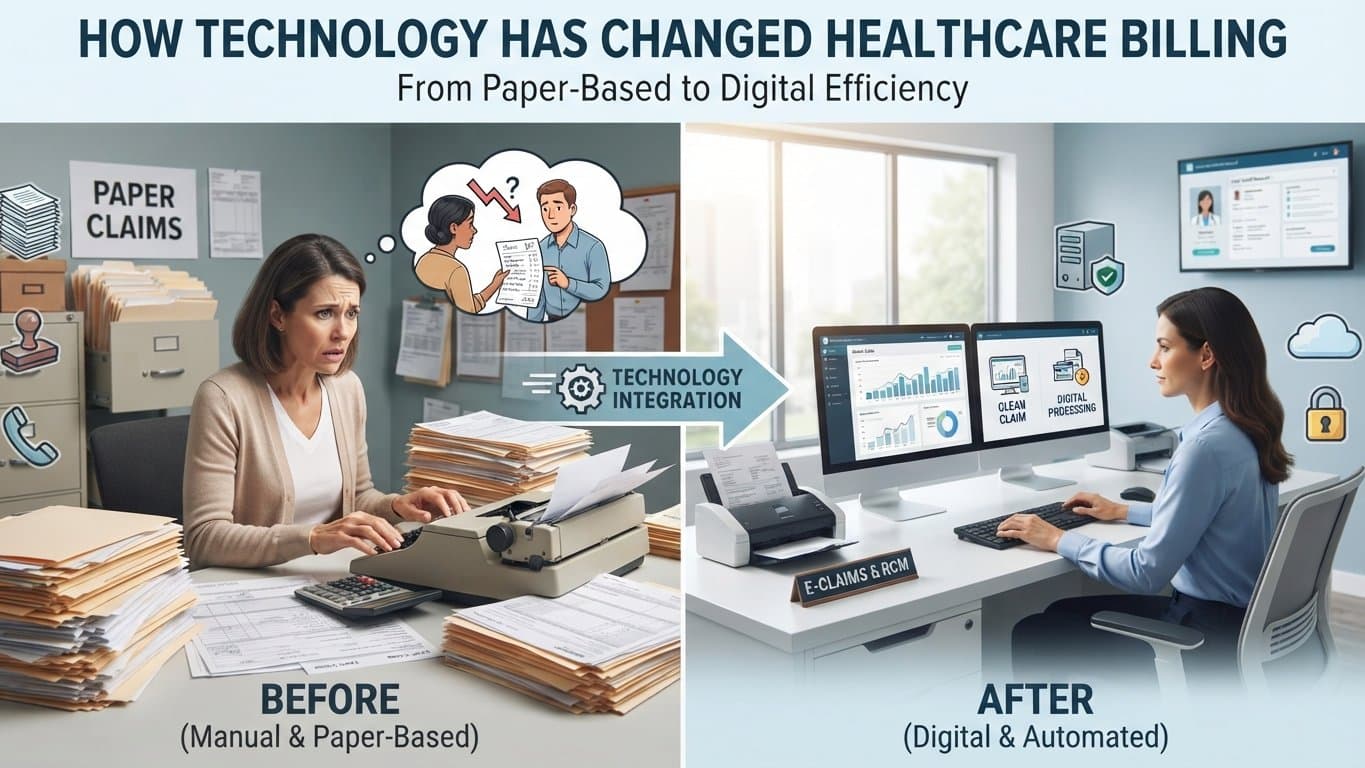
The healthcare billing process has long been a paper-driven, time-consuming, manual data entry, telephone and claim chasing, and repetitive administrative nightmare. These traditional methods can lead to delays, inaccuracies, and extra expenses in healthcare management as organizations contend with increasing workloads and more intricate insurance needs.In the context of healthcare, where organizations handle more patients and complex insurance demands, these traditional approaches can cause delays, inaccuracies, and additional expenses.
Technology is transforming this environment by helping to speed up, connect and simplify the billing process. Digital solutions are supporting the healthcare industry to achieve greater accuracy and less administrative burden, from electronic claims to automated insurance verification, AI to real-time analytics.
Technologies aren't just quickening the billing process. It also introduces financial issues at an earlier stage, enhances communication, boosts compliance and offers a more stable patient financial journey for practices.
How Medical Billing Services Benefit From Technology
Today's medical billing services are more technologically advanced and find it easier to handle the entire revenue cycle in an efficient manner. Digital systems can integrate patient registration, insurance verification, coding, claim submission, claim payment and denial management all in one seamless process.
Technology can support:
Electronic patient registration
Automated eligibility verification
Medical coding workflows
Claim scrubbing
Electronic claim submission
Electronic payment posting
Denial tracking
Accounts receivable monitoring
Revenue cycle analytics
Technology minimises manual tasks, enabling billing professionals to spend more time on more complex claims and financial matters where a human touch is needed.
Digital Patient Registration Improves Data Accuracy
Patient register is the basic of the billing process. Claim rejections and delayed reimbursement can result from incorrect demographic and/or insurance information.
Digital registration platforms enable patients to input data digitally prior to, during or after appointments. This information can then be seamlessly integrated into the practice's EMR or Practice Management System.
This reduces:
Duplicate data entry
Handwriting errors
Missing information
Incorrect demographic details
Data-entry delays
Having accurate information at the start of the revenue cycle can help to make the process smoother.
Automated Insurance Eligibility Verification
Another tech improvement space that's significantly progressing is insurance verification.
Automated systems have the capability to verify eligibility and benefits electronically, which will limit the amount of manual calls that need to be placed by staff to every patient's payers.
This will vary depending on the system, but may include:
Active coverage
Deductibles
Copayments
Coinsurance
Coverage limitations
Referral requirements
Prior authorization requirements
Having this information early on is one way to help healthcare organizations avoid claims problems when delivering services.
Electronic Claims Speed Up Reimbursement
Claims that are paper based need to be processed and handled longer. Claims can be transmitted from the healthcare provider to the claims payer much more efficiently with electronic claims.
By helping billing teams, electronic submission:
Submit claims quickly
Receive electronic acknowledgments
Track claim status
Identify rejected claims
Correct errors faster
Hastiness in claim movement may decrease the time in between delivery of healthcare services and reimbursement.
Claim Scrubbing Reduces Preventable Errors
Before claims are submitted, technology can help to enhance claim accuracy.
Automated claim-scrubbing systems review claims for issues that can arise, such as:
Invalid codes
Missing information
Incorrect modifiers
Demographic inconsistencies
Payer-specific requirements
Duplicate submissions
Any claims that are flagged by the system will be available for review and correction prior to being sent to the payer.
This proactive approach can enhance the first pass acceptance of claims, and minimize claim denial management effort.
Artificial Intelligence Is Changing Billing Workflows
AI is playing an ever more prominent role in healthcare billing. AI-powered tools are capable of sifting through vast amounts of billing information and detecting trends that might not be apparent when looking at it manually.
AI can be used to help with capacities include:
Denial prediction
Coding assistance
Documentation analysis
Claim review
Payment pattern analysis
Revenue forecasting
Workflow prioritization
One such use case is when predictive analytics can be used to detect claims with a greater risk of being denied, so that a billing team can review them prior to submission.
The goal of using AI is to assist rather than replace skilled billers in their work. Human interpretation of information is still needed when assessing complex clinical, coding and payers information.
Automated Payment Posting Improves Efficiency
When staff manually enter data from paper explanations of benefits or electronic remittance data, payment posting can be very time consuming.
Electronic remittance information can be stored in automated payment posting systems which can be used to match payments to specific claims.
They can be used to help identify:
Insurance payments
Adjustments
Patient balances
Contractual differences
Outstanding amounts
Automation frees up employees to address discrepancies and unclosed accounts, as well as repetitive data entry.
Technology Strengthens Denial Management
Claim denials have the potential to have a dramatic impact on health care revenue. Today's billing platform offers resources to monitor and analyze denial activity.
Using technology can classify denials into:
Payer
Provider
Procedure
Diagnosis
Location
Denial reason
This information can assist companies determine recurring issues. When a practice finds it has a recurring problem with specific payers due to authorization problems, a better authorization process can be implemented rather than constantly correction errors.
Revenue Cycle Analytics Improve Financial Visibility
The primary benefit of the latest billing technology is that it supplies real-time or near real-time monetary details.
Dashboards can track:
Claim acceptance rates
Denial rates
Delays in payment of the account.
Collection rates
Payment turnaround
Outstanding balances
Revenue trends
These insights can help managers pinpoint bottlenecks and make data-driven personnel, work process, and budget changes.
Cloud-Based Systems Improve Accessibility
Authorized users can retrieve billing data from various places with cloud-based billing platforms.
This can be useful to organisations that have:
Multiple offices
Remote billing teams
Distributed administrative staff
Growing provider networks
Cloud technology can also make software maintenance easier and lighter on local hardware, but with a bit of due diligence, they can assess security and vendor control.
Better Technology Can Improve Patient Communication
Patient experience is impacted by healthcare billing technology, as well.
Modern systems can deliver to the patient:
Online statements
Electronic payment options
Payment reminders
Cost estimates
Insurance information
Digital communication
This makes it easier for patients to understand and manage their financial obligations, and provides them with convenient payment options.
More effective billing communication can also help to eliminate confusion and enhance patient satisfaction.
Security and Compliance Remain Essential
While technology will add efficiency, healthcare organizations need to maintain patient privacy.
Billing platforms need to have suitable security features, including:
Access controls
Encryption
Authentication
Audit logs
Secure data transmission
Regular security monitoring
Additionally, organizations must make sure that their technology and processes are also compliant with relevant privacy and healthcare regulations.
Integrating Billing With EHR Systems
When the EHR system is integrated with billing systems, there's no need to move information between the two.
Effective communication within systems allows information to flow more easily through clinical documentation to billing workflow.
Integration may reduce:
Duplicate data entry
Missing information
Communication gaps
Manual errors
Processing delays
A connected technology environment can help to ease the transition between patient care and reimbursements.
Challenges of Technology Adoption
There are problems with technology that cannot be solved by all billing issues. When implementing a healthcare ERP system, there are potential issues that must be addressed in relation to:
Implementation costs
Staff training requirements
Software integration issues
Security concerns
Vendor dependence
The implementation needs to be well planned, employees need to be adequately trained and good performance monitoring is essential to ensure it is successful.
The Importance of Human Expertise
In an era of fast technological advancement, there are still some skilled billing professionals needed.
Humans are required in situations where technology cannot process information and learn patterns:
Complex denial appeals
Unusual payer requirements
Coding judgment
Patient financial communication
Compliance decisions
Workflow improvements
The best way to do this is to use automation and have a professional who can oversee it.
Conclusion
Technology is reshaping healthcare billing, automating many manual processes to speed up workflows, connect various departments, and rely on data. Healthcare organizations are benefiting from automated insurance verification, electronic claims, claims scrubbing, AI for analysis, electronic payment posting, and denial management tools to boost accuracy and financial efficiency.
But the success of the technology won't just happen by chance when you buy new software. Integration of systems is essential, security of sensitive data is a must, training employees, and human oversight all apply to the organizations.
As technology and professional expertise come together, healthcare providers can design a more streamlined revenue cycle, minimize avoidable billing issues, increase cash-flow and create a better financial customer experience. With the digital healthcare revolution in progress, technology will be a significant player in healthcare billing in the future.
FAQs
What are the ways technology is enhancing healthcare billing?
Technology enhances billing, from automating the insurance verification process to the submission and posting of payments; tracking insurance denials, reporting and more.
Is there a way for technology to help decrease medical billing errors?
Yes. Automated validation/claim scrubbing processes can detect missing or inconsistent information prior to claim submission.
In what ways can AI assist with Medical Billing?
Billing information can be processed to detect denial patterns, assist with coding procedures, prioritize claims, and offer predictive insights, all of which can be supported by AI.
Is medical billing a thing of the past due to technology?
No, technology replaces repetitive work, and the wisdom of the professionals is still necessary for complex claims, appeals, compliance and decision making.
What are the advantages of the billing technology to the patients?
With a digital billing system, you get better bills, online payment options, financial information and quicker answers to your financial queries.