

Quinn: The Little Boy Who Needs Blood to Grow Up
There are things parents are supposed to worry about.
Did my child eat enough?
Did he get enough sleep?
Did he brush his teeth?
What will he be when he grows up?
Will he play baseball?
Will he go to college?
Will he fall in love?
Will he have children of his own?
Those are the normal questions.
The questions every parent gets to ask.
But our family has another question that never goes away.
Will Quinn's body be able to keep going?
Our son Quinn was born with Beta Thalassemia Major, also called transfusion dependent beta thalassemia or Cooley's Anemia.
It is a genetic blood disorder that prevents his body from making enough healthy hemoglobin.
Hemoglobin is what carries oxygen throughout the body.
Without enough of it, the body cannot function the way it should.
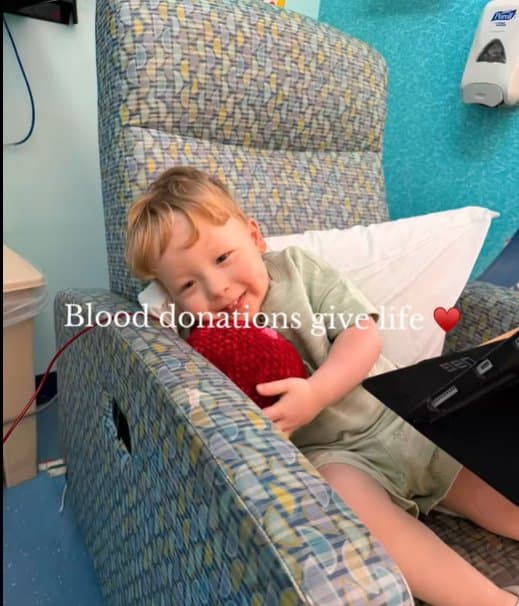
For Quinn, donated blood isn't simply a medical treatment.
It is what keeps him alive.
Right now, Quinn receives a blood transfusion every 21 days.
Three weeks.
Then we do it again.
And again.
And again.
For most people, three weeks is just a stretch of time on the calendar.
For us, it is part of the rhythm of keeping our son alive.
The CDC notes that people with beta thalassemia major commonly require transfusions about every three weeks to maintain adequate hemoglobin levels and prevent the complications of severe anemia.
And there is something strange about watching your child receive blood.
The first time you really understand what is happening, it changes the way you look at the world.
Because somewhere, another person made a decision to donate blood.
A stranger.
Someone who may never know Quinn exists.
Someone who may never know that their blood became part of his story.
Someone who may never know that their donation helped a little boy wake up with enough oxygen carrying red blood cells to run, laugh, play and be a kid.
That is the beautiful side of transfusions.
But there is another side.
Every transfusion brings iron with it.
And the human body has no natural way to simply get rid of all that excess iron.
So the same blood that keeps Quinn alive also creates another threat.
Iron overload.
The iron can accumulate in organs including the liver, heart and other tissues. Over time, iron overload can cause serious organ damage, including liver disease, heart problems and endocrine complications.
That is why Quinn receives iron chelation treatment every night.
Every.
Single.
Night.
The chelation treatment is there to grab onto excess iron and help his body remove it before that iron can cause irreversible damage.
So Quinn's life is a balance.
Blood to keep him alive.
Chelation to protect him from the consequences of needing that blood.
And we repeat that cycle over and over.
There is no weekend off.
There is no vacation from it.
There is no "maybe we can skip tonight."
His treatment schedule doesn't care if it is Christmas.
It doesn't care if we are exhausted.
It doesn't care if Quinn wants to play.
It doesn't care if Mom and Dad have had a terrible day.
The treatment still has to happen.
Because Quinn still has to wake up tomorrow.
And then there is the part people don't see.
Beta thalassemia isn't just about transfusions.
Without adequate treatment, chronic anemia can affect growth, bones, energy, cognition, the liver and spleen, and normal development.
Iron overload adds another layer of risk.
The liver can become overloaded with iron.
The heart can accumulate iron.
The endocrine system can be affected.
Growth and puberty can be affected.
Bone health can be affected.
The body is essentially being asked to survive a disease that doesn't allow it to make enough of something as fundamental as healthy blood.
And the treatment that saves the child creates its own lifelong burden.
That is the cruel part of this disease.
The medicine keeps him alive, but the medicine doesn't make him normal.
It keeps the clock running.
It buys time.
It gives Quinn the opportunity to grow up.
But without something more, he remains dependent on it.
There are things Quinn may never get to take for granted.
He may never know what it feels like to simply wake up and not think about his blood counts.
He may never know what it is like to go years without a transfusion.
He may never be able to simply decide he doesn't feel like going to the hospital.
He may never understand why his parents have to plan life around medical appointments.
He may never get the luxury of forgetting about his disease.
And there are things we don't know yet.
We don't know exactly what his future will look like.
We don't know what complications he may or may not experience.
We don't know what his body will face as he grows.
But we do know what his life looks like today.
Every 21 days, blood.
Every night, chelation.
Constant monitoring.
Constant vigilance.
And parents who would give absolutely anything to change it.
Then something happened.
We got word that Quinn may have an opportunity that could change the trajectory of his entire life.
Gene therapy.
Not another medication to manage the disease.
Not another temporary fix.
A potential treatment designed to address the genetic problem responsible for his transfusion dependence.
That is a completely different conversation.
The FDA has approved gene therapies for transfusion dependent beta thalassemia, including CASGEVY and ZYNTEGLO. CASGEVY uses a patient's own blood stem cells, modifies them outside the body and returns them after conditioning treatment.
In clinical data reviewed by the FDA, 91.4% of the evaluated CASGEVY patients with transfusion dependent beta thalassemia achieved transfusion independence for at least 12 consecutive months while maintaining the specified hemoglobin level.
That does not mean Quinn is guaranteed to be cured.
It does not mean the treatment is easy.
It does not mean there are no risks.
And it does not mean Quinn has already been accepted for treatment.
That is exactly why we have a consultation.
On Monday, August 24, we have an opportunity to take Quinn to Atlanta for a consultation at the Bone Marrow Transplant Center.
This is where we find out whether this possibility can become a reality for our son.
And there is something incredibly difficult about writing the next sentence.
We can't afford to go.
Not because we don't want to.
Not because we aren't willing to fight.
Not because we don't believe Quinn is worth fighting for.
We simply need help getting there.
And our family has been hit from another direction too.
On June 8, I underwent cervical fusion surgery involving C4 through C7.
I have been on short term disability since the middle of May.
I have only recently been able to return to the office, and even that is limited to office work as I continue recovering.
So while Quinn continues his battle with a disease that never takes a day off, our family has also been trying to keep everything together while I recover.
Medical bills.
Travel.
Daily life.
Lost income.
Quinn's treatment.
And now, potentially, the most important medical opportunity we have ever been given.
It is a lot.
More than we can handle alone.
And honestly, I don't want to pretend otherwise.
We need help.
But here's what I don't want you to see when you look at Quinn.
I don't want you to see a sick kid.
I want you to see Quinn.
A little boy in footie pajamas.
A little boy who can put his face in a clear box and pretend he's underwater.
A little boy with a deep voice that makes us laugh.
A little boy who sings.
A little boy who wants to play.
A little boy who has no idea how many people are fighting for him.
He is not his diagnosis.
He is not his transfusion schedule.
He is not his iron levels.
He is not the machines, needles, appointments or procedures.
He's Quinn.
And he deserves the chance to grow up.
He deserves to find out what he wants to be.
He deserves scraped knees.
He deserves school pictures.
He deserves birthday parties.
He deserves to complain about homework.
He deserves to learn how to drive.
He deserves to fall in love.
He deserves to become a father if that is what he wants someday.
He deserves all the ordinary things that families like ours sometimes forget are extraordinary.
Right now, we don't know what gene therapy will mean for Quinn.
That's what August 24 is about.
Finding out.
Getting answers.
Understanding the risks.
Understanding the process.
Finding out if this is something that could give Quinn a different future.
But we have to get him there first.
So I'm asking for help.
If you can donate, please donate to Quinn's fundraiser.
If you can't donate, please share this story.
If you can do both, we will never be able to adequately thank you.
Your donation isn't just helping us pay for a trip to Atlanta.
It is helping us pursue an opportunity for our son.
An opportunity that could potentially change how he lives for the rest of his life.
We have spent years learning how to survive one transfusion at a time.
Now we have been given a chance to ask a much bigger question:
What if Quinn didn't have to spend his whole life dependent on transfusions?
We don't know the answer yet.
But we're going to Atlanta to find out.
And we need our people behind us.
We need family.
We need friends.
We need strangers.
We need anyone who sees a little boy and believes he deserves a chance.
If you can help us get Quinn to Atlanta on August 24, you are not just helping a family with expenses.
You're helping a little boy chase a future he hasn't even had the chance to imagine yet.
Please help us get Quinn to Atlanta.
Donate if you can.
Share if you can't.
Pray for him.
Talk about him.
Say his name.
Because sometimes a miracle doesn't arrive as one giant moment.
Sometimes it looks like thousands of ordinary people deciding that one little boy matters.
Quinn matters.
And we're going to keep fighting for him
_______________________________________________________________________
Working towards a better quality of Life:
Most parents spend their child's first years planning birthday parties, family vacations, and dreams for the future.
We've spent much of Quinn's first three years in hospitals, infusion centers, doctor's offices, and on the road seeking the specialized care he needs to survive.
Quinn was born with Beta Thalassemia Major, a rare genetic blood disorder that prevents his body from producing enough healthy hemoglobin. Because of this, he depends on regular blood transfusions and ongoing medical treatment to stay healthy and continue growing.
At just three years old, Quinn has already endured countless needle sticks, blood draws, transfusions, tests, and medical appointments. Yet through it all, he remains a bright, loving, and courageous little boy whose smile can light up an entire room.
Everything we do revolves around giving him the best life possible.
And we would do it all again without hesitation.
But the reality is that the financial impact of caring for a child with complex medical needs has been enormous.
Over the past three years, our savings have slowly disappeared. Every emergency fund, every home improvement fund, every dollar we managed to put aside has gone toward Quinn's care, travel expenses, medical costs, lost work time, and the countless unexpected expenses that come with raising a medically complex child.
We don't regret a single dollar.
Our son is worth every sacrifice.
Today, however, our family faces a challenge we can no longer overcome on our own.
The home where Quinn lives, plays, and grows is in serious need of repair.
Our septic system has failed and must be replaced. Parts of our property are beginning to sink toward the nearby channel, creating concerns about the long-term stability of our home. The house itself is aging and extremely energy inefficient, causing utility bills to climb higher every year while necessary repairs continue to be delayed.
For years, we've chosen Quinn over everything else.
We chose hospital trips instead of home projects.
Medical bills instead of renovations.
Treatment plans instead of savings plans.
And while we would never change those decisions, the result is that our home now needs critical repairs that are beyond our ability to fund.
We're asking for help not because we want more than others have, but because we want to provide our son with something every child deserves: a safe, stable place to call home.
The funds raised through this campaign will be used to:
• Replace the failed septic system
• Address structural and erosion issues threatening the property
• Improve the home's energy efficiency and reduce ongoing expenses
• Complete critical repairs necessary to keep our home safe and livable
• Create a more stable environment for Quinn's future
If you've ever watched a child face challenges they didn't choose, then you understand why we fight so hard for Quinn every day.
If you've ever sacrificed for someone you love, then you understand the choices we've made.
And if you're able to help, whether through a donation, a share, or simply keeping our family in your thoughts and prayers, we would be forever grateful.
As Quinn approaches his third birthday, our greatest wish isn't a party or presents.
It's the ability to give him a safe home where he can continue to grow, thrive, and enjoy the childhood he deserves.
Thank you for believing in Quinn.
Thank you for standing with our family.
And thank you for helping us write the next chapter of his story.
With gratitude,
Greg, Hannah, Family, and Team Quinn