Spotfund logo
Spotfund logo
Start Fundraising
PricingContact SupportStart Fundraising

Fundraise for

  • Medical Fundraising
  • Emergency Fundraising
  • Memorial Fundraising
  • Education Fundraising
  • Nonprofit Fundraising
  • Animal Fundraising
  • Community Fundraising

Featured topics

  • Easy Fundraising Ideas for Individuals
  • Creative Fundraiser Dinner Ideas
  • Raising Money for Medical Expenses
  • *spotfund for NIL Collective Fundraising
  • Giving Tuesday Fundraising 2025NEW

Trending in

  • Medical
  • Memorial
  • Emergency
  • Nonprofit
  • Family
  • Sports
  • Business

Featured topics

  • *spotfund as a Recurring Donation Solution
  • Matching Gift CampaignsPOPULAR
  • Why Recurring Donations Are Important for Nonprofits
  • How it works
  • Common questions
  • Success stories
  • For brands and nonprofits
  • How do I withdraw money?
  • *spotfund blog
  • Reviews from people like you
  • Compare *spotfund to others

How To Boost The First-Time Success Rate Of Precision Parts

How To Boost The First-Time Success Rate Of Precision Parts

Fundraising for

Nonju The Non Judgemental Church Of Christ

Fundraising forNonju The Non Judgemental Church Of Christ
Sajid Sipra

Sajid Sipra

Many, Louisiana

$0of $100 goal
0
Donors
0
Comments
1Share Arrow
Shares
Donation protected
👍 0% fee
Donations are tax-deductible

Introduction

Hardware entrepreneurs and R&D teams consistently face a critical bottleneck: translating complex designs into high-precision machined parts. The journey is often marred by high first-article failure costs, blown budgets, delayed timelines, and parts that fail to meet performance specs. Frequently, the root cause lies not in the design itself, but in selecting a mismatched manufacturing process or vendor—prioritizing low quoted price over a supplier’s genuine engineering competency and quality systems in Precision 5-Axis CNC Services. This article provides a systematic framework to help innovators efficiently evaluate a 5-Axis CNC Service Provider in 2026. It moves beyond simple price comparison, focusing on technical capability, quality assurance, and collaborative synergy to ensure project success from the very first attempt. The following five key questions reveal the core dimensions for selecting a superior precision manufacturing partner.

Why is First-Time Success Rate the Gold Standard for Measuring a 5-Axis CNC Supplier?

For hardware projects operating on tight R&D budgets and aggressive timelines, the first-time success rate of a 5-Axis CNC Service Provider is the ultimate metric.

The High Cost of First-Article Failure

A failed first article triggers a costly cascade: expenses for remachining, scrap material, and engineering reruns. Most critically, project delays can derail funding or market windows. Common failures stem from programming errors, improper workpiece fixturing, and uncorrected thermal deformation during the machining of complex parts.

The Proactive Path to Predictable Success

Leading providers of Precision 5-Axis CNC Services mitigate these risks through a front-loaded, preventative methodology, transforming the first article into a predictable milestone.

l Prevention Through Digital Validation

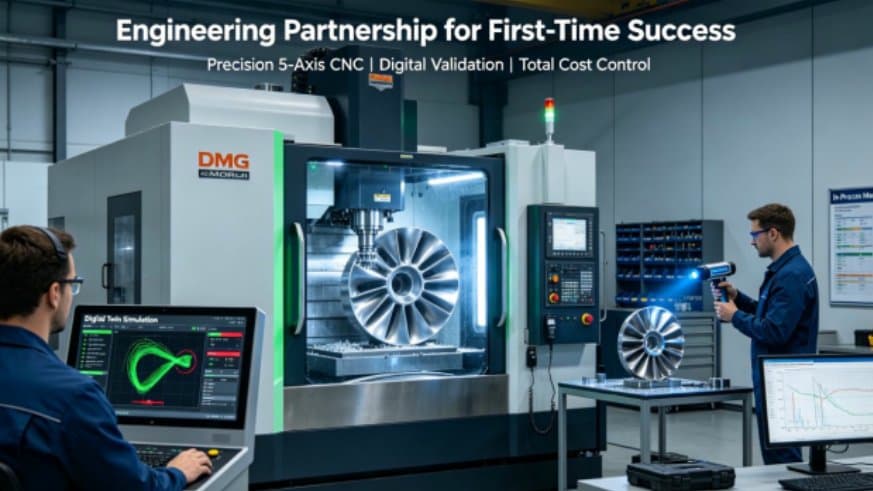
They employ digital twin simulations to visualize and validate the entire process in a virtual environment, identifying collisions and toolpath issues before any metal is cut. Advanced, governed process planning ensures optimal strategies.

l Control Through Process Integration

Integration of on-machine probing and in-process measurement enables real-time compensation. This ensures the part remains within tolerance throughout the machining cycle, shifting focus from post-production inspection to in-process assurance.

Beyond Price, What Three Hidden Costs Should You Scrutinize When Selecting Top 5-Axis CNC Manufacturers in China?

While the unit price on a quote is visible, the total cost of engagement with a machining vendor includes significant hidden variables. When evaluating Top 5-Axis CNC Manufacturers China, three hidden costs demand attention: communication and revision costs, quality failure costs, and time delay costs. Communication costs escalate with unclear instructions, slow response times, and the need for multiple clarification loops, consuming valuable engineering hours. Quality failure costs, as mentioned, are compounded by rework, scrap, and potential liability. Time delay costs, often the most severe, can stall product launches and impact revenue.


Choosing a representative of Best 5-Axis CNC Machining China minimizes these hidden expenses, optimizing the Total Cost of Ownership (TCO). A proficient partner provides expert Design for Manufacturability (DFM) feedback early, preventing costly design flaws. Their robust quality management system, often certified to international standards, reduces the statistical probability of defects. Furthermore, reliable project management ensures on-time delivery, protecting the project's critical path. A holistic evaluation, therefore, must weigh engineering support and process reliability as heavily as the unit price. According to the 2026 5-Axis CNC Guide, thoroughly assessing a supplier's engineering support capability is crucial for long-term value. A deeper dive into this topic is available in this resource on5 axis CNC machining services.

What is the Core Difference Between Custom 5-Axis CNC Machining and Standard Service?

The distinction between standard and custom 5-axis work defines the required competency of the 5-Axis Machining Supplier.

The Defining Difference: Partnership vs. Transaction

The core distinction lies in the relationship's nature. Standard service is a transactional execution of known designs. True Custom 5-Axis CNC Machining is a collaborative, technical partnership aimed at manufacturing complex, one-off, or highly specialized components that push the boundaries of both material and geometry.

The Demands of a Custom Partnership

This advanced customization imposes significantly higher demands on a 5-Axis Machining Supplier, transforming their role.

l Technical and Material Expertise

It requires in-depth material science knowledge to handle exotic alloys or composites. Expertise in machining difficult materials is essential to maintain tool life and achieve required surface integrity and tolerances.

l Collaborative Process and Engineering

Most critically, it demands sophisticated fixturing design for unstable geometries. The process is inherently iterative, involving close collaboration between the client’s and supplier’s engineers for DFM, strategy selection, and even co-developing tooling, making the supplier an active engineering extension.

How Can You Verify if a 5-Axis CNC Factory's Accuracy Claims Are Reliable?

Verbal promises of micron-level tolerance are commonplace. Verifying them requires a due diligence checklist focused on data and systems, not just machine brand names. When assessing a provider of Precision 5-Axis CNC Services, ask for specific Process Capability Index (Cpk/Ppk) data for critical tolerances, which statistically proves consistent performance. Inquire about the thermal compensation systems on their CNC equipment, as heat is a primary source of dimensional drift during long operations.


Any qualified 5-Axis CNC Machining Services partner should be willing and able to provide comprehensive First Article Inspection (FAI) reports or full-dimensional layout reports for similar past projects, validated by high-grade metrology equipment like CMMs. Crucially, verify the calibration and grade of their measurement equipment itself. A factory's commitment to transparency with this data is a strong indicator of its actual capabilities. For instance, a manufacturer with extensive experience in aerospace and medical fields, such as LS Manufacturing, typically equips its 5 axis CNC machining factory with advanced on-machine probing and laser tool setters to ensure real-time accuracy control and data-driven validation.

According to 2026 Trends, Where Will the Future Value of 5-Axis CNC Machining Services Be Concentrated?

Looking ahead, the value proposition of 5-Axis CNC Machining Services is shifting from discrete part fabrication to integrated manufacturing intelligence. The 2026 5-Axis CNC Guide points to a future where value is concentrated in digital-physical convergence. Artificial Intelligence and machine learning algorithms are beginning to optimize toolpaths in real-time for maximum efficiency and minimal wear, while also predicting maintenance needs to prevent unscheduled downtime.


Furthermore, seamless integration with robotics and automated pallet systems is creating "lights-out" manufacturing cells, ensuring consistent quality and 24/7 productivity for volume production. Finally, full supply chain digitalization and traceability—from material lot to final part—is becoming a non-negotiable requirement in regulated industries. Therefore, selecting a future-proof supplier means evaluating their roadmap in these areas: their adoption of AI-driven process optimization, readiness for automation integration, and implementation of digital thread platforms that provide complete transparency and data lineage for every component produced.

Conclusion

Selecting a 5-axis CNC service provider is a strategic decision that impacts the fundamental viability of a hardware product. It requires a holistic evaluation of engineering depth, quality system rigor, and project management discipline. By focusing on the pillars of first-time success rate, total cost of ownership, depth of customization support, and verifiable precision claims, innovators can identify a partner that does more than cut metal—they de-risk the entire path from prototype to production. Your design deserves to be realized with precision.


Ready to ensure your complex design is manufactured right the first time? Download our comprehensive Precision Part Design Checklist, or upload your 3D drawings today to receive a detailed manufacturability analysis and process recommendation report from a qualified engineering team.

Author Bio

The author is a hardware product development consultant with over 15 years of experience, specializing in the fields of precision manufacturing and supply chain optimization.

FAQs

Q1: Is 5-axis CNC machining too expensive for low-volume prototype work?

A1: Not necessarily. The ability of 5-axis machining to complete complex features in a single setup often saves the cost and time associated with multiple setups on several 3-axis machines. For geometrically complex prototypes, it can be more cost-effective and faster in total project terms, while also avoiding the cumulative errors of multiple fixturings.

Q2: How can I determine if my part requires 5-axis CNC machining instead of 3-axis?

A2: A simple rule of thumb: if the part has deep cavities requiring multi-angle access, complex contoured surfaces, inclined holes, or continuous organic (free-form) surfaces, 5-axis machining is typically more efficient and accurate. 3-axis machining remains suitable primarily for prismatic parts where all features are accessible from the top-down (Z-axis) approach.

Q3: Is quality and delivery reliable when sourcing precision 5-axis CNC parts from China?

A3: It is entirely supplier-dependent. Top-tier Chinese manufacturers operate world-class equipment and adhere to stringent, internationally recognized quality management systems. The key is to validate capability through technical dialogue, audit quality documentation (e.g., Cpk reports, ISO certificates), order first-article samples, and establish clear contractual agreements that include inspection reports and delivery protocols.

Q4: What information should I provide with my STEP file when requesting a quote to get the most accurate response?

A4: Beyond the 3D model, always specify: material grade and specification, all surface finish requirements, identified critical dimensions and their tolerances, target budget quantities (prototype, pilot, production), and required delivery date. Clear, complete information allows the supplier to provide an optimized and accurate manufacturing solution.

Q5: What role do digital twins or virtual machining play in 5-axis CNC?

A5: Digital twin simulation creates a virtual model of the entire machining process—machine, tool, fixture, and workpiece—before physical cutting begins. It is critical for proactively detecting and avoiding tool collisions, gouges, excessive vibration, and other errors. This technology optimizes toolpaths for efficiency and safety, dramatically increasing first-article success rates. It is a hallmark of advanced Precision 5-Axis CNC Services.



Smiley Face

Be the first to donate and pin
your name here   📌

Organizer

Sajid Sipra

Show your support to Sajid Sipra by donating to this fundraiser benefiting Nonju The Non Judgemental Church Of Christ

How To Boost The First-Time Success Rate Of Precision Parts
Sajid Sipra

Sajid Sipra

Many, Louisiana

Fundraising for

Nonju The Non Judgemental Church Of Christ

Fundraising forNonju The Non Judgemental Church Of Christ
Donation protected
👍 0% fee
Donations are tax-deductible

Introduction

Hardware entrepreneurs and R&D teams consistently face a critical bottleneck: translating complex designs into high-precision machined parts. The journey is often marred by high first-article failure costs, blown budgets, delayed timelines, and parts that fail to meet performance specs. Frequently, the root cause lies not in the design itself, but in selecting a mismatched manufacturing process or vendor—prioritizing low quoted price over a supplier’s genuine engineering competency and quality systems in Precision 5-Axis CNC Services. This article provides a systematic framework to help innovators efficiently evaluate a 5-Axis CNC Service Provider in 2026. It moves beyond simple price comparison, focusing on technical capability, quality assurance, and collaborative synergy to ensure project success from the very first attempt. The following five key questions reveal the core dimensions for selecting a superior precision manufacturing partner.

Why is First-Time Success Rate the Gold Standard for Measuring a 5-Axis CNC Supplier?

For hardware projects operating on tight R&D budgets and aggressive timelines, the first-time success rate of a 5-Axis CNC Service Provider is the ultimate metric.

The High Cost of First-Article Failure

A failed first article triggers a costly cascade: expenses for remachining, scrap material, and engineering reruns. Most critically, project delays can derail funding or market windows. Common failures stem from programming errors, improper workpiece fixturing, and uncorrected thermal deformation during the machining of complex parts.

The Proactive Path to Predictable Success

Leading providers of Precision 5-Axis CNC Services mitigate these risks through a front-loaded, preventative methodology, transforming the first article into a predictable milestone.

l Prevention Through Digital Validation

They employ digital twin simulations to visualize and validate the entire process in a virtual environment, identifying collisions and toolpath issues before any metal is cut. Advanced, governed process planning ensures optimal strategies.

l Control Through Process Integration

Integration of on-machine probing and in-process measurement enables real-time compensation. This ensures the part remains within tolerance throughout the machining cycle, shifting focus from post-production inspection to in-process assurance.

Beyond Price, What Three Hidden Costs Should You Scrutinize When Selecting Top 5-Axis CNC Manufacturers in China?

While the unit price on a quote is visible, the total cost of engagement with a machining vendor includes significant hidden variables. When evaluating Top 5-Axis CNC Manufacturers China, three hidden costs demand attention: communication and revision costs, quality failure costs, and time delay costs. Communication costs escalate with unclear instructions, slow response times, and the need for multiple clarification loops, consuming valuable engineering hours. Quality failure costs, as mentioned, are compounded by rework, scrap, and potential liability. Time delay costs, often the most severe, can stall product launches and impact revenue.


Choosing a representative of Best 5-Axis CNC Machining China minimizes these hidden expenses, optimizing the Total Cost of Ownership (TCO). A proficient partner provides expert Design for Manufacturability (DFM) feedback early, preventing costly design flaws. Their robust quality management system, often certified to international standards, reduces the statistical probability of defects. Furthermore, reliable project management ensures on-time delivery, protecting the project's critical path. A holistic evaluation, therefore, must weigh engineering support and process reliability as heavily as the unit price. According to the 2026 5-Axis CNC Guide, thoroughly assessing a supplier's engineering support capability is crucial for long-term value. A deeper dive into this topic is available in this resource on5 axis CNC machining services.

What is the Core Difference Between Custom 5-Axis CNC Machining and Standard Service?

The distinction between standard and custom 5-axis work defines the required competency of the 5-Axis Machining Supplier.

The Defining Difference: Partnership vs. Transaction

The core distinction lies in the relationship's nature. Standard service is a transactional execution of known designs. True Custom 5-Axis CNC Machining is a collaborative, technical partnership aimed at manufacturing complex, one-off, or highly specialized components that push the boundaries of both material and geometry.

The Demands of a Custom Partnership

This advanced customization imposes significantly higher demands on a 5-Axis Machining Supplier, transforming their role.

l Technical and Material Expertise

It requires in-depth material science knowledge to handle exotic alloys or composites. Expertise in machining difficult materials is essential to maintain tool life and achieve required surface integrity and tolerances.

l Collaborative Process and Engineering

Most critically, it demands sophisticated fixturing design for unstable geometries. The process is inherently iterative, involving close collaboration between the client’s and supplier’s engineers for DFM, strategy selection, and even co-developing tooling, making the supplier an active engineering extension.

How Can You Verify if a 5-Axis CNC Factory's Accuracy Claims Are Reliable?

Verbal promises of micron-level tolerance are commonplace. Verifying them requires a due diligence checklist focused on data and systems, not just machine brand names. When assessing a provider of Precision 5-Axis CNC Services, ask for specific Process Capability Index (Cpk/Ppk) data for critical tolerances, which statistically proves consistent performance. Inquire about the thermal compensation systems on their CNC equipment, as heat is a primary source of dimensional drift during long operations.


Any qualified 5-Axis CNC Machining Services partner should be willing and able to provide comprehensive First Article Inspection (FAI) reports or full-dimensional layout reports for similar past projects, validated by high-grade metrology equipment like CMMs. Crucially, verify the calibration and grade of their measurement equipment itself. A factory's commitment to transparency with this data is a strong indicator of its actual capabilities. For instance, a manufacturer with extensive experience in aerospace and medical fields, such as LS Manufacturing, typically equips its 5 axis CNC machining factory with advanced on-machine probing and laser tool setters to ensure real-time accuracy control and data-driven validation.

According to 2026 Trends, Where Will the Future Value of 5-Axis CNC Machining Services Be Concentrated?

Looking ahead, the value proposition of 5-Axis CNC Machining Services is shifting from discrete part fabrication to integrated manufacturing intelligence. The 2026 5-Axis CNC Guide points to a future where value is concentrated in digital-physical convergence. Artificial Intelligence and machine learning algorithms are beginning to optimize toolpaths in real-time for maximum efficiency and minimal wear, while also predicting maintenance needs to prevent unscheduled downtime.


Furthermore, seamless integration with robotics and automated pallet systems is creating "lights-out" manufacturing cells, ensuring consistent quality and 24/7 productivity for volume production. Finally, full supply chain digitalization and traceability—from material lot to final part—is becoming a non-negotiable requirement in regulated industries. Therefore, selecting a future-proof supplier means evaluating their roadmap in these areas: their adoption of AI-driven process optimization, readiness for automation integration, and implementation of digital thread platforms that provide complete transparency and data lineage for every component produced.

Conclusion

Selecting a 5-axis CNC service provider is a strategic decision that impacts the fundamental viability of a hardware product. It requires a holistic evaluation of engineering depth, quality system rigor, and project management discipline. By focusing on the pillars of first-time success rate, total cost of ownership, depth of customization support, and verifiable precision claims, innovators can identify a partner that does more than cut metal—they de-risk the entire path from prototype to production. Your design deserves to be realized with precision.


Ready to ensure your complex design is manufactured right the first time? Download our comprehensive Precision Part Design Checklist, or upload your 3D drawings today to receive a detailed manufacturability analysis and process recommendation report from a qualified engineering team.

Author Bio

The author is a hardware product development consultant with over 15 years of experience, specializing in the fields of precision manufacturing and supply chain optimization.

FAQs

Q1: Is 5-axis CNC machining too expensive for low-volume prototype work?

A1: Not necessarily. The ability of 5-axis machining to complete complex features in a single setup often saves the cost and time associated with multiple setups on several 3-axis machines. For geometrically complex prototypes, it can be more cost-effective and faster in total project terms, while also avoiding the cumulative errors of multiple fixturings.

Q2: How can I determine if my part requires 5-axis CNC machining instead of 3-axis?

A2: A simple rule of thumb: if the part has deep cavities requiring multi-angle access, complex contoured surfaces, inclined holes, or continuous organic (free-form) surfaces, 5-axis machining is typically more efficient and accurate. 3-axis machining remains suitable primarily for prismatic parts where all features are accessible from the top-down (Z-axis) approach.

Q3: Is quality and delivery reliable when sourcing precision 5-axis CNC parts from China?

A3: It is entirely supplier-dependent. Top-tier Chinese manufacturers operate world-class equipment and adhere to stringent, internationally recognized quality management systems. The key is to validate capability through technical dialogue, audit quality documentation (e.g., Cpk reports, ISO certificates), order first-article samples, and establish clear contractual agreements that include inspection reports and delivery protocols.

Q4: What information should I provide with my STEP file when requesting a quote to get the most accurate response?

A4: Beyond the 3D model, always specify: material grade and specification, all surface finish requirements, identified critical dimensions and their tolerances, target budget quantities (prototype, pilot, production), and required delivery date. Clear, complete information allows the supplier to provide an optimized and accurate manufacturing solution.

Q5: What role do digital twins or virtual machining play in 5-axis CNC?

A5: Digital twin simulation creates a virtual model of the entire machining process—machine, tool, fixture, and workpiece—before physical cutting begins. It is critical for proactively detecting and avoiding tool collisions, gouges, excessive vibration, and other errors. This technology optimizes toolpaths for efficiency and safety, dramatically increasing first-article success rates. It is a hallmark of advanced Precision 5-Axis CNC Services.


Organizer

Sajid Sipra

Show your support to Sajid Sipra by donating to this fundraiser benefiting Nonju The Non Judgemental Church Of Christ

$0of $100 goal
0Donors
0Comments
1Share ArrowShares
Smiley Face

Be the first to donate and pin
your name here   📌

★★★★★ Trustpilot Reviews

Ready to start?

Join the thousands like you finding help on *spotfund.

Start FundraisingHow it works
Spotfund Balloons