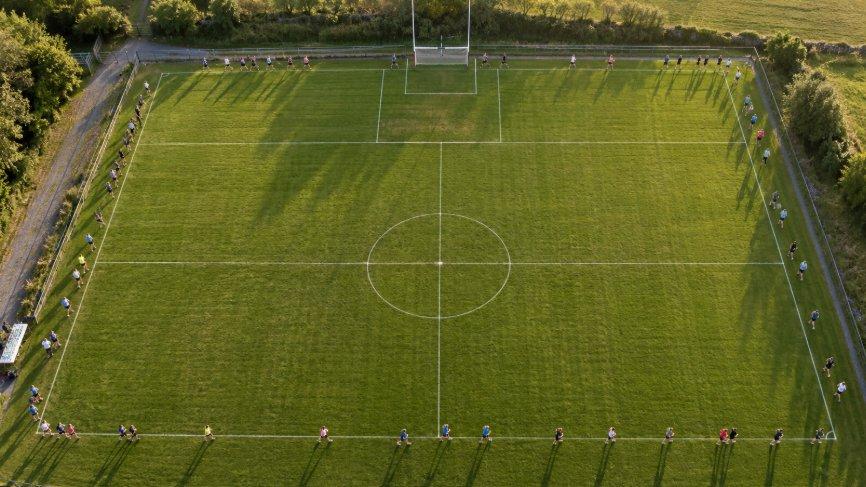

Most lists of fundraising ideas for sports teams could be written for any club in any sport: a car wash, a quiz night, a bake sale. They work, but they ignore the two things a Gaelic football club has that a bowling league does not. You play on a field bigger than a rugby or soccer pitch, and your game has scoring rules simple enough to explain to a stranger on the sideline.
The ideas below use both. They suit a new club in the US as well as an established one anywhere, and none of them needs a professional fundraiser.
Start with the bill
Most fundraising ideas for clubs skip the first step: pick the cost before you pick the event. "Help the club" is hard to give to. "Pay for a set of jerseys before the summer tournaments" is easy, because a donor can picture it and you can show them the result. USGAA's guide to starting a club lists the basics a new club needs: a bank account, playing and training equipment, a sponsor and jerseys. Any of those makes a better goal than a round number.
Then match the fundraiser to the size of the bill. A family day might cover footballs and cones. Jerseys usually call for a sponsor. Travel to a tournament is often a mix of both, plus an online page.
A sponsored 5k on your own pitch
A 5k fundraiser on public roads normally means permits, a route and marshals. If your club already trains on a full-size field, you have a measured course with no traffic. The only question is how many laps of the pitch make 5k, and the answer depends on the field, because a Gaelic football pitch can be anywhere from 130 to 145 meters long and 80 to 90 meters wide.
The guide's pitch page has already done that arithmetic for the common sizes: about 10.6 laps on a full-size 145 by 90 meter pitch, which measures 470 meters around the outside lines, and nearly 12 on the smallest full-size one. If yours is somewhere in between, add the length and width, double it, and divide 5,000 by the answer.
Treat it as a fun run, not a race. Knowing the lap count lets you offer two kinds of pledge. A flat pledge is simpler to collect. A pledge per lap gives younger players and walkers a reason to keep going, and it lets a donor set a ceiling they are comfortable with. Put one volunteer on lap counting for every few runners, because tallying laps from memory afterward invites arguments.
The distance helps with recruiting runners, too. Pparkrun organizes free, weekly, 5km timed runs around the world, so plenty of parents and neighbors already know roughly what 5k feels like. Invite them to run, not only to sponsor.
Jersey sponsorship a business can say yes to
Kit sponsorship, the Irish and British term for a business's name on the team jerseys, is a bigger ask than a pledge, so it goes better in writing. Say what the business gets: its name on the front of the shirts, a mention on the club's social accounts, maybe a banner at home games. Say how long the deal runs and how many players will wear the shirt. Then say what the money pays for, in one line.
Local businesses get a lot of requests. A one-page offer with a photo of the team in its current jerseys does more than a long email.
After the season, send the sponsor photos of the jerseys in action. That is where the renewal conversation starts.
Skills challenges built on the scoring rules
This is where Gaelic football beats most sports club fundraising ideas. Under the 2026 rules, a kick over the bar from on or outside the 40-meter arc scores two points, as long as no teammate touches the ball after the kick. The arc is measured from the middle of the goal line and painted on the grass, so everyone can see where the line is.
That gives you a ready-made challenge. One hypothetical format: supporters pay for five kicks from outside the arc, and sponsors pledge a set amount for every two-pointer the senior players land in ten attempts. For younger players or first-timers, move the kicks inside the arc, to the 20-meter line, where a score counts one point and the distance is far more forgiving.
Keep it short and visible. People stay for a challenge they can watch from the sideline.
Tournaments and family days
A small-sided tournament between your own teams, or with clubs nearby, brings entry fees, food sales and a crowd in one afternoon. Gaelic football is amateur and full teams are 15 a side, but a short game with fewer players fits a single field and a busy schedule.
Fold a family day into the same event. Bounce houses and face painting are standard, and they work. Less common is a "try the game" session where parents and neighbors handle the ball for the first time. For a club in the US, that is recruitment as much as fundraising, which few youth sports fundraising ideas manage.
Taking the campaign online
The best online fundraising ideas for sports teams are the ones above with a page attached. A crowdfunding page lets relatives abroad and former players back the 5k or the kicking challenge without being there. A few things make the page work:
A goal tied to the bill you chose, in one sentence.
Real photos of the team, used with each player's or parent's permission.
Updates during the campaign: the lap count, a video of a two-pointer, the new jerseys arriving.
A thank-you to every donor once the money is spent.
Share one link everywhere. Splitting donors across several pages makes each one look less supported than it is.
What donors want to see before they give
People give to clubs they trust, and trust comes from plain information. The National Council of Nonprofits puts it in four words in its guidance on ethical fundraising: "Transparency inspires confidence." The same guidance says donors expect their gifts to be acknowledged, and it treats honoring what a donor asked their money to be used for as both an ethical and a legal matter. If someone gives for jerseys, the money buys jerseys.
US clubs have one more question to answer honestly: is the gift tax-deductible? Only if the club is an organization eligible to receive them, usually a 501(c)(3). Before you print "tax-deductible" on anything, look the club up in the IRS Tax Exempt Organization Search, which shows whether an organization is eligible. Even then, the IRS says a donor who gets something back, such as a meal at the family day, can generally deduct only the amount above that item's fair market value. USGAA links guidelines for clubs that want to register as a 501(c)(3). Sort that out, ideally with a tax adviser, before a large campaign rather than after.
Two habits finish the job. Publish what was raised and what it bought, even as a single post. And never pay anyone, volunteer or professional, a percentage of what they bring in: the Council's guidance says paying a fundraiser that way is not appropriate.
One well-run event a season, a clear report afterward and a thank-you by name will do more for next year's appeal than three new ideas tried once.